Thursday, August 25, 2016

Face-to-Face, Person-to-Person

Radio and TV journalist Edward R. Murrow, was born Egbert Roscoe Murrow on April 25, 1908 in Greensboro, North Carolina; died of lung cancer, April 27, 1965 in Pawling, New York. 

Edward R. Murrow is recognized as the dean of 20th century broadcast journalism. Before Murrow, broadcast journalism was an unwanted stepbrother of the newspapers, and most radio reporters were writers by trade. Murrow’s high standards for reporting and superb narrative skills -- his aim being to report for the ears, not for the page -- raised the bar for all broadcast reporters who would follow him. 

A student orator at Washington State College who served as president of a national college students’ organization, Murrow backed into radio as an educational radio show producer. His duties took him to Europe in 1937, and with World War II brewing, Murrow found himself on the air feeding the hungry demand for news about Hitler as one of America’s first radio foreign correspondents. 

He first captivated American audiences, though, with his dramatic eyewitness reports from London during the Nazi blitzes of 1940. With bombs and air-raid sirens sounding in the background, Murrow would intone with his deep, rich voice, "THIS is London . . . it’s a bomber’s moon out tonight."  Very quickly his influence as a journalist began to eclipse that of the print correspondents, not only because he was beating their reports by several hours, but because millions of listeners soon began to empathize with this man whose voice was coming to them in their living rooms from the heart of the action. Later, Murrow provided commentary while flying in an Allied bombing run over Germany, and accompanied U.S. troops as they liberated the Buchenwald concentration camp. 

After the War, Murrow became CBS news director, and led CBS into the television age with his weekly news program See It Now (1951-58), covering such stories as the Korean War, human rights in South Africa and the polio vaccine. During these programs, Murrow exuded the same kind of cool, casual image that he had developed on radio, typically with a lit cigarette in hand and a cloud of smoke around him. After spending two episodes exposing the abusive red-baiting methods of Senator Joseph McCarthy with snippets from McCarthy’s own speeches, McCarthy demanded equal time and accused Murrow of spreading "propaganda for communist causes." As it turned out, Murrow gave McCarthy the chance to ruin himself; public opinion turned dramatically against McCarthy after his angry response, and within a year McCarthy had been censured by the Senate. 

In 1954, Murrow had also introduced a celebrity interview show, Person to Person (1954-59) which featured in-depth interviews of such people as Eleanor Roosevelt, Groucho Marx, Marilyn Monroe and Duke Ellington. Advertisers began to pull their support from See It Now in 1955 due to the controversial nature of Murrow’s reports, leading Murrow to launch an attack against the institution of television in a speech to TV and radio news directors.  Arguing that commercial interests were using the medium to "distract, delude, amuse and insulate" viewers. In 1958, CBS cancelled See It Now, but Murrow continued to do occasional news documentaries, such as his highly-acclaimed report on the conditions of migrant workers, "Harvest of Shame" (1960). 

In 1961, Murrow left CBS to accept an appointment by John Kennedy as head of the U.S. Information Agency, which had as its mission informing the world about American culture and democratic principles; he served there until 1964. George Clooney’s film about the Joe McCarthy feud, Good Night, and Good Luck (2005), named for Murrow’s sign-off slogan and starring David Strathairn as Murrow, is highly recommended.

"It has always seemed to me the real art in this business is not so much moving information or guidance or policy five or ten thousand miles. That is an electronic problem. The real art is to move it the last three feet in face-to-face conversation." -- Edward R. Murrow. 


Labels: , ,

Thursday, May 15, 2008

Oz


L. Frank Baum was born on this day in 1856 in Chittenango, New York.

A failed theater owner, dry goods seller and magazine editor, and a some-time breeder of fancy poultry, Frank Baum began writing books for children in 1899, publishing the modestly successful Father Goose. The following year he wrote the book which would make his name in pop culture, The Wonderful Wizard of Oz (1900), a fantasy tale with decidedly Nietzschean undertones about a Kansas girl and her adventures with a scarecrow, a tin woodsman and a lion in a magical other-world. Baum took the name for his other-world from the letters on the bottom drawer of his filing cabinet: "O-Z."

Wildly popular, the book was almost instantaneously turned into a musical, but the most familiar musical version, preserved in MGM’s classic film, The Wizard of Oz (1939; directed by Victor Fleming, with Judy Garland, Ray Bolger, Jack Haley and Bert Lahr), did not take shape until shortly before that movie was made, when Harold Arlen and E.Y. Harburg collaborated on such songs as "Somewhere Over the Rainbow" and "If I Were King of the Forest."

Following the book’s success, Baum wrote 13 more Oz books, none of which came close to matching the first in its irresistible, mythically pregnant plot or its lasting popularity. He unsuccessfully tried to promote his books with a traveling vaudeville slide show and toured in Europe for a time before filing bankruptcy in 1911 and settling in Hollywood on his wife's money in a home he called "Ozcot." He died there on May 6, 1919.

Labels: ,

Friday, July 20, 2007

The Death of Floyd Collins


"Young people, all take warning from Floyd Collin's fate,/ And get right with your maker before it is too late./ It may not be a Sand Cave in which we find our tomb,/ But on that day of judgment, we too must meet our doom." -- Vernon Dalhart, "The Death of Floyd Collins."

Floyd Collins, spelunker, was born on this day in 1887 in Flint Ridge, Kentucky.

The Collins family made their living farming in Kentucky, but a good living it was not, for the Southern sinkhole geology of the region was not ideal for agriculture. It was, however, ideal for underground caves with remarkable mineral formations, and many farming families supplemented their meager incomes by opening the caves to tourists.

Floyd Collins was particularly adept at finding and navigating underground caves, and discovered the Crystal Cave in 1917, opening it for tours shortly thereafter -- although because it was off the beaten path, it was not too lucrative. Collins continued exploring, caught up in the commercial "cave wars," hoping to find an underground connection between his own caves and the popular Mammoth Caves nearby.

While navigating through a new cave he had discovered, the Sand Cave, Floyd became trapped when a 27-pound stone pinned his leg against the cold wet cave wall 70 feet below the surface. A day later he was discovered by his brother Homer, who attempted to dig him out without success. As more help was required, crowds of onlookers and newspaper reporters began to form outside the cave, causing a traffic mess for 12 miles from the cave entrance. Soon, Collins’ rescue became front page news around the country, with diminutive Louisville Courier-Journal reporter Skeets Miller squeezing through the passageways to deliver Floyd food and keep his spirits up (Miller would ultimately win a Pulitzer Prize for his coverage of the story).

Rescue efforts went awry when the cave pathways began to collapse as miners attempted to dig a vertical shaft to reach Floyd. On the 18th day of digging, the rescuers finally got to Floyd, but he had died just 24 hours before they reached him, on February 17, 1925. The Collins family had a glass coffin encased around his body and placed it in Crystal Cave, where cavers paid their respects to Floyd for years afterward until his eventual burial in a nearby rural cemetery.

Campers at Mammoth Cave National Park occasionally report seeing the ghost of Floyd Collins there.


Labels: , ,

Friday, June 29, 2007

Captain Boyton and His Rubber Suit


Adventurer and amusement park owner Paul Boyton was born on this day in 1848 in either Dublin, Ireland or Pittsburgh, Pennsylvania.

Boyton gained world-wide renown for his ocean exploits performed while wearing a floating, air-tight rubber suit, designed with the help of C.S. Merriman. In 1874, notably, he jumped overboard into heavy seas from a transatlantic ship wearing the suit, a day's sail away from Ireland, and paddled himself -- feet first, kayak style -- back to Cork. His navigation of the Mississippi River in a similar fashion made headlines in the U.S.

As a paid mercenary, he swam in the service of the Peruvian government in 1885, attaching explosives to a Chilean man-of-war in the dead of night; the grateful Peruvians awarded him the rank of "Captain." Upon his return to the U.S., he helped to organize the United States Life-Saving Service, a precursor to the Coast Guard, and briefly served as captain of the Atlantic City ocean life-savers. In 1892, he published a popular memoir of his exploits in the water, The Story of Paul Boyton.

After his arrival in New York City in 1895, he bought 16 acres behind the Elephant Hotel in Coney Island, and opened Sea Lion Park, the first outdoor amusement park in the world. The park was best known for its Shoot-the-Chutes ride, in which flat-bottomed toboggan boats slid down a steep slide into a broad lagoon. Boyton also entertained guests with his 40 trained sea lions, a la Sea World, and with demonstrations of his famous rubber suit. The park enjoyed a modest success for a few years, overshadowed by George Tilyou's gigantic Steeplechase Park.

After a dismal rainy summer season left him financially hobbled in 1902, he sold the business and lived the rest of his years quietly (and mostly on dry land), and died April 19, 1924 in Brooklyn, New York.


Labels: , ,

Friday, June 22, 2007

What Santa Looks Like


Haddon Sundblom was born on this day in 1899 in Muskegon, Michigan.

Sundblom was a commercial illustrator for Chicago's Stevens-Gross Agency. He was best known for his 35 years of illustrations of Santa Claus for Coca-Cola ads (beginning in 1931) that fundamentally sealed the American pop culture image of jolly old St. Nick as a big plump man -- rather than as an elf as depicted by Robert Walter Weir (c. 1837), Thomas Nast (c. 1862) and others. Sundblom is also allegedly responsible for the creation of the Quaker Oats Quaker and Aunt Jemima.

Sundblom died on March 10, 1976 in Chicago, Illinois.


Labels:

Friday, May 25, 2007

It Was a Dark and Stormy Night ...


"He never wrote an invitation to dinner without an eye on posterity." -- Benjamin Disraeli.

Edward Bulwer-Lytton, a prolific novelist with a reputation for ornate wretchedness (Pelham, 1828; The Last Days of Pompeii, 1834; Eugene Aram, 1832), and a Liberal-turned-Tory member of Parliament, was born on this day in 1803 in London.

Although the gods of literature might have been content to leave Bulwer-Lytton to obscurity, Charles Schulz brought him into the 20th century pop culture fold, appropriating the first lines of Bulwer-Lytton's ponderous novel Paul Clifford (1830) ("It was a dark and stormy night . . .") for the beagle Snoopy's various attempts at novel-writing. The English Department of San Jose State University sponsors an annual Bulwer-Lytton Fiction Contest for bad opening lines, and Tim Burton chose Bulwer-Lytton's estate at Knebworth as the setting for "stately Wayne manor" in Batman. Whatever you may aspire to in your own writing, just hope they don't remember you better for your house than for your written works.


Labels: ,

Wednesday, April 25, 2007

The Pope Joan Myth


From the 13th to the 17th centuries, there was a persistent legend, told both within the Roman Catholic Church and by the Church's enemies, that a woman had once served as pope. In the most common version of the tale, a young woman from Mainz who had studied in Athens, dressed as a man, settled in Rome as a cleric and was elected pope as "John Anglicus," styled as John VIII, after the death of Leo IV in 855. Her real gender was exposed two years later, however, as she rode in a procession from St. Peter's to the Lateran, giving birth to a child (from a secret liaison with a secretary-deacon) on a narrow street between the Colosseum and S. Clemente. Enraged, Roman onlookers are said to have tied her to her horse's tale, dragged her around the city in disgrace and stoned her to death, to be succeeded by Benedict III.

Her first "biographer" was a 13th century senior scholar within the Church and later the archbishop of Gneisen, Martin Polonus, who acknowledged her existence in his otherwise dispassionate chronicle of popes, but observed that because of her fraud she was not included in the official papal registry. Subsequent writers, including Petrarch and Boccaccio, embellished the tale, but the basic facts seem to have been accepted as truth by the Church and its partisans for a few centuries -- a bust of Pope Joan had stood among the gallery of pontiffs in Siena Cathedral until 1601, and allegedly John XXI had accounted for Joan in numbering himself as the XXIst John in the papal list.

Catholic writers began to bristle at the notion of a female pope in the 16th century, but the legend was considered "demolished" by a Protestant writer, David Blondel in the 1650s. Nonetheless, modern proponents of the "Pope Joan" myth point to some unusual traditions which seem to have grown up within the Church as evidence of her existence -- including the curious pontifical election ritual practiced from the 10th to the 16th centuries in which the selected candidate was required sit in a birth-chair with a hole underneath at the time of investiture, allegedly so that a representative cardinal could inspect the candidate's gender, and the tradition that subsequent popes allegedly avoided the narrow street on which Joan supposedly gave birth. Subsequent soundings of the "Pope Joan" story include Emmanuel Royidis' novel Pope Joan (1954), a film starring Liv Ullmann (1972) and a popular Victorian card game.


Labels: ,

Wednesday, April 04, 2007

Takes a Licking, Keeps on Ticking


Timex watch pitchman and pioneer TV news broadcaster John Cameron Swayze was born on this day in 1906 in Wichita, Kansas.

"It takes a licking and keeps on ticking" is what the affable announcer was remembered for, but early TV viewers were more accustomed to hearing him say, "Ladies and gentlemen, and a good evening to you" as host the first nightly news program, Camel News Caravan on NBC (1948-56). Swayze read the news during a 15-minute broadcast, sponsored by R.J. Reynolds Tobacco Company, in what was little more than a TV picture of a radio news program. Lacking the technology to present film or taped segments, Swayze would simply narrate from notes on paper, with a lit cigarette in an ashtray visible on his desk at the instruction of the sponsor.

In 1956, NBC shed the cigarette company sponsorship (at least in name) and hired Chet Huntley and David Brinkley, recently successful as commentators on televised coverage of the 1956 Democratic and Republican conventions, to replace Swayze.

Giving a tobacco company the "naming rights" to a network news program seems preposterous by today's standards, but in the early days of television, the "news" was mainly concerned with highly visible affairs of state (TV had not yet learned how to rake muck, or wallow in it), and health concerns about cigarettes had not yet entered pop consciousness. The relationship between TV news and big tobacco has remained respectful, however, notably forcing 60 Minutes host Mike Wallace to kill, at least temporarily, the broadcast of an interview with former tobacco research exec Jeffrey Wigand about industry knowledge of the addictive properties of nicotine in 1994.

After being replaced on NBC, Swayze moved to ABC to anchor its evening news broadcast for a year in 1957 before becoming the on-air spokesman for Timex for 20 years. Swayze died on August 15, 1995 in Sarasota, Florida.


Labels: , ,

Saturday, March 24, 2007

Orgone, Or Not


The controversial psychoanalyst (some say, mad man) Wilhelm Reich was born on this day in 1897 in Dobrzynica, Galicia.

While studying for his medical degree in Vienna in 1920, Wilhelm Reich became a disciple of Sigmund Freud, who theorized that neuroses were caused by sexual repression, during an era in which psychoanalysis was still developing its legitimacy. After graduation, Reich became a psychiatrist (initially, as an assistant in Wagner-Jauregg's clinic) and joined the Austrian Communist Party.

In 1934, he published a seminal work of orthodox psychoanalysis, Character Analysis, but by the early 1930s, his interests in politics, sexuality and the mind had become intertwined in ways which marginalized him. In 1929, his interest in social revolution as a prerequisite to sexual revolution led him to form the Socialist Society for Sexual Advice and Sexual Research, through which he organized industrial clinics to address workers' emotional problems while providing political education. Reactionary elements within the Communist Party questioned his emphasis on sex, and when he published The Mass Psychology of Fascism (1933), in which he denounced party-line communism as the psychological equivalent of fascism, the Party expelled him.

In 1934, he broke from the Freudians (and was expelled by the International Psychoanalytic Association) when he began to argue that neuroses were the destructive result not merely of sexual repression, but more specifically of undischarged sexual energy. His unorthodox views on sexuality got him into hot water in Scandinavia, so in 1939 he moved to the U.S. and taught at the New School for Social Research until 1941. In The Function of the Orgasm (1927; reprinted in the U.S., 1942), Reich had argued that only total orgasm (including brief unconsciousness) rids us of the excess energy that encourages unhealthy drives.

In isolation in his home in Maine, he began to focus on what he viewed as the physiological effects of socially-imposed sexual repression -- muscular rigidity adopted by children in response to the threat of punishment which inhibited total orgasm -- and began to identify the pent-up sexual energy as a "pre-atomic" cosmic force present throughout nature, a force which he called "orgone." When orgone energy is blocked, Reich argued, all kinds of disease are caused -- even cancer. To correct the blockages, Reich built and sold "orgone boxes" -- wooden, metal-lined compartments in which a patient could sit, which would stimulate sexuality and, potentially, cure cancer.

In 1954, the U.S. Food and Drug Administration seized his boxes and some of his writings and had them destroyed; in 1956, Reich was sentenced to 2 years in prison for contempt. He died in prison on November 3, 1957 in Lewisburg, Pennsylvania.

In the 1960s, some of his early writings on sexual revolution were embraced as prophetic by the youthful Left; today, there continues to be a small cadre of die-hard Reichians who believe that there exists a scientific basis of orgone therapy, although no serious biologist has supported Reich's theories. A number of musicians have been captivated by Reich's legacy, notably Gil Evans ("Orgone," also covered by Miles Davis) and Kate Bush, whose song "Cloudbusting" was inspired by a book about Reich by his son Peter, The Book of Dreams.

Labels: , ,

Tuesday, March 20, 2007

Sounding Presidential


Vaughn Meader was born on this day in 1936 in Waterville, Maine.

Meader was a moderately successful if obscure cabaret performer who specialized in composing song parodies and delivering humorous political monologues when, during one evening's performance, he donned his native New England accent to mimic then President John F. Kennedy. Despite the fact that the idea of portraying a sitting president in humorous vignettes was at that time unheard of, the result was a raging local stage hit, leading to a recording contract and a wildly popular humor album, The First Family (1962) -- at one time the fastest-selling record of all time. Meader effectively poked at Kennedy's mannerisms (as well as those of his brother Bobby Kennedy) and very gently satirized such topics as White House economy measures, Jackie Kennedy's White House tour and the space program (Q. Mr. President, when will you send a man to the moon? A. As soon as Senator Goldwater would like to go.).

Meader's Kennedy-esque accent had a genuine source: he had attended Brookline High School about twenty years after President Kennedy had been there. Kennedy himself once stated at a presidential press conference that he'd heard Meader's album and that he "thought he sounded more like Teddy" Kennedy, the president's youngest brother. Bobby Kennedy once had to interrupt a scheduling phone call with someone when, as Bobby recalled, "That guy thinks I'm Vaughn Meader. He's going to call me back" to make sure it was really Bobby.

When President Kennedy was assassinated in November 1963, Vaughn Meader's successful career as Kennedy's mimic came to a screeching halt, and he publicly vowed he would never do his Kennedy impression again. Comedian Lenny Bruce wryly noted: "They put two graves in Arlington -- one for John Kennedy and one for Vaughn Meader."

Meader released a critically-admired comedy album in 1971, The Second Coming, in which he played Jesus Christ returning to 20th century America; but for the most part, Meader sank further into obscurity as an entertainer. In the 1980s, Meader was managing a restaurant and occasionally performing bluegrass music. He died on October 29, 2004 in Auburn, Maine.

Labels:

Monday, February 26, 2007

Katzenjammers


Rudolph Dirks was born on this day in 1877 in Heinde, Schleswig-Holstein. He died on April 2, 1968 in New York City.

Until the introduction of rookie cartoonist Rudy Dirks’ Katzenjammer Kids in December 1897 in William Randolph Hearst’s New York Journal, newspaper comics were largely one-picture jokes with an ever-changing cast of stock characters. Inspired by Wilhelm Busch’s sequential-picture storybook, Max und Moritz (1865), Dirks’ Katzenjammer Kids ("katzenjammer" literally meaning "howling of cats," German slang for hangover) portrayed a regular cast of characters (something only tried before in fits and starts, notably in Outcault’s The Yellow Kid), with action progressing through sequential panels (with or without well-placed dialogue "balloons") to tell a tale, not just a joke. As Dirks’ "comic strips" told tales about the Kids (a pair of mischievous German children, Hans and Fritz, who incessantly played pranks on their Mama Katzenjammer, or later, on the old Captain and his pal the Inspector) on a daily basis, Hearst and his rival newspaper publishers realized that comic strips could be a great promotional tool, even more compelling than the use of recurring characters in a one-frame slice-of-life vignette as Outcault had been doing, as readers would buy the paper to see the Kids in their next mini-adventure.

With a compelling economic reason behind it, Dirks’ comic strip form became the industry standard, inspiring a million imitators. In addition to the basic outline conventions of the comic strip, Dirks was the originator of a number of detail elements which would become instantly understandable comic strip cliches, including sweat beads to indicate exertion, motion lines, and stars to indicate pain.

In 1912, Dirks left Hearst and joined Pulitzer’s World, setting off litigation over the rights to the Katzenjammer Kids which concluded with the ridiculous result of Hearst retaining the name of the strip, and Dirks retaining the likenesses and the names of Hans and Fritz; Harold Knerr lovingly took over the Katzenjammers for Hearst, while Dirks continued to draw Hans and Fritz (later as The Captain and the Kids), the two strips running in parallel for decades, oddly playing off each other’s character developments. The Katzenjammers survived for nearly 100 years, while Dirks drew The Captain and the Kids on and off into the 1950s, when he passed it on to his son John; the strip was discontinued in 1979.

Outside of his newspaper work, Dirks was also a serious artist who established a painter’s colony at Ogunquit, Maine.

Labels: , ,

Friday, February 16, 2007

Golden Arches


Dick McDonald, co-founder (with brother Mac) of the original McDonald's drive-in fast-food hamburger stand in 1948, was born on this day in 1909.

Brothers Dick and Mac McDonald were tired of paying car hops and dishwashers at the hamburger restaurant they owned in 1940, so on the eve of the car boom in suburban Southern California, they designed a new kind of restaurant, with a small standardized menu, unprecedentedly fast service (under a minute), low prices (15-cent hamburgers, 10-cent french fries), no waitresses and no tipping -- fast food, to go, for a go-go-go culture. By 1952, the reborn McDonald's restaurant was so successful that it was featured on the cover of American Restaurant magazine and could boast 6 million hamburgers sold.

Mac, as operations chief, came up with the idea for a no-frills burger assembly line (inspired ultimately by Henry Ford's assembly line for the Model T) that came to be McDonald's, just as Henry Ford's vision of a car-clogged American countryside was coming to fruition after World War II.

While Mac was designing the burger assembly line, Dick was the marketing whiz. Dissatisfied with an architect's rendering of the proposed restaurant, Dick sketched the "M" which became the world famous "golden arches" -- at once historically the symbol for money used by Karl Marx as well as the symbol for "millions," now erected in bright yellow neon around the world, transformed into a symbol for American economic imperialism by the end of the 20th century as McDonald's marched triumphantly into 91 countries.

Before that could happen, though ... in 1955, Ray Kroc bought the rights to franchise and develop McDonald’s drive-ins in the U.S., and in 1961 came back for the entire package – trademarks, test secrets, and the McDonald’s system, along with the worldwide franchise rights -- for $2.7 million. The McDonald brothers kept their original store in San Bernardino, renaming it Mac's Place (since they no longer owned their own name), but the restaurant was eventually put out of business by the megalomaniacal Kroc, who opened a McDonald's across the street.

For his own part, Dick McDonald never seemed to mind the fact that $2.7 million in hindsight looked like a discount price, or the closing of his San Bernardino place -- what he minded was the rewriting of history: "Suddenly, after we sold," said McDonald, "my golly, he elevated himself to the founder."

Dick McDonald died on July 14, 1998 in Manchester, New Hampshire.

Labels: , , ,

Monday, January 29, 2007

I'm Tired of Being the Paris Hilton of My Own Blog


Who is Paris Hilton? I remember asking myself this question when, ignorant of the notoriety she had achieved via such media sources as Page Six, she started showing up staggering in and out of parking lots on Celebrities Uncensored or some such show on E!. Since then, like the rest of the world, I have come to discover that she is, of course, an heiress of the Hilton Hotel fortune (the great-granddaughter of Hilton founder Conrad), a notorious party girl and unauthorized sex-tape star, and a some-time actress/TV personality/pitchperson/pop star/model. Just an ordinary 21st century girl, really.

Interestingly, she has become a descriptive icon as well. By doing a Google search of the words "the Paris Hilton of" I have discovered that calling someone a "Paris Hilton" is far from employing a one-dimensional epithet. Indeed, the art of using Paris Hilton as a belittling tag has developed into a pattern of subtle nuances and protocols that even the Bard himself could not help but admire. Some notable examples:
  • Earlier this week, Fox News spokesperson Irena Briganti was calling CNN's Anderson Cooper "the Paris Hilton of television news" after he criticized Fox for airing unsubstantiated gossip about Barack Obama's early education, saying that Cooper's lecturing is "yet another cry for attention."
  • Boomer Esiason called Bears quarterback Rex Grossman "the Paris Hilton of quarterbacks" on CBS's NFL Today -- to which Chicago sportswriter Elliott Harris replied, "No way the Bears QB has been sacked that much."
  • The blog All Hat and No Cattle labels our current President as "the Paris Hilton of U.S. Presidents."
  • Armageddon Cocktail Hour says that Rudy Giuliani, while weighing his own presidential prospects, may not have the stomach for "trying to preserve some personal dignity within a process that seems designed to make him look like a man of undisciplined appetites, like the Paris Hilton of Presidential Politics."
  • Writer John Doyle of the Globe & Mail calls footie star David Beckham "the Paris Hilton of the Sports World" because "he's rich, blonde, beautiful, none too bright, and shrewd about the matter of staying famous."
  • CHOW.com wonders, "How did the pomegranate suddenly become the Paris Hilton of the food world?" And so do I.
  • "It"-physicist Caolionn O'Connell, flushed from the publicity she received after appearing on NOVA, worried in the pages of her Quantum Diaries that she was becoming "the Paris Hilton of physics -- totally over-exposed, but thankfully, without the sex-tape with slimy ex-boyfriend." What does it mean, dear Paris, when your life is becoming a cautionary tale to which even a physicist pays heed?
  • Defective Yeti notes that "Duct tape is like the Paris Hilton of hardware: it has this huge reputation, despite having never done anything useful."
  • Hampton Roads sportswriter Bob Molinaro called the 2006 Washington Redskins "the Paris Hilton of hype." Even without a detailed analysis of the merits of such a comment, one has to admit that it seems like a redundancy at the very least -- or literary overkill, at worst.
  • Judge Alex Kozinski of the 9th Circuit Court of Appeals is "the Paris Hilton of the federal judiciary," because he won a poll sponsored by the blog Underneath Their Robes. A former 1960s-era Dating Game contestant, Kozinski previously was elected "Number 1 Male Superhottie" of the federal judiciary in the same blog.
  • In a similar vein, I suppose, legal tabloid Above the Law refers to Georgetown Law Professor Neal Katyal as "the Paris Hilton of the Legal Elite" for the swooning publicity over his victory before the U.S. Supreme Court in Hamsdal v. Rumsfeld.
  • Iranian film actress Zahra Amir Ebrahimi is "Iran's Paris Hilton" after appearing in a sex video that ended up on the Internet.
  • According to C/NET News reader "DarianKnight," the virtual reality social space Second Life is "the Paris Hilton of 3D" because "there is a lot of money involved, the media love it for no particular reason, and in the end it's famous for simply being famous."
  • "Like the Paris Hilton of corporate finance, Sarbanes-Oxley is always, it seems, in the news," according to JobsintheMoney.com.
  • Energy writer Byron W. King suggests that Cambridge Energy Research Associates may very well be "the Paris Hilton of the energy consulting gig" -- as if we could all be so lucky.
  • Memphis Daily News columnist Lindsay Jones calls her cat Dandelion the Paris Hilton of her household because she is "pampered, indulged and reckless in her self-assurance."
  • Pia Zadora was apparently "the Paris Hilton of the 80s," Marie Antoinette was "the Paris Hilton of the late eighteenth century," and, gynecologically speaking, Joan Crawford was "the Paris Hilton of the 30s ... only with talent and movie roles."
Matt Haber helpfully provides a field guide to various Paris Hiltons around the world, crowning new Paris Hiltons in Russia (reality TV host Ksenia Sobchak), India (Bollywood "it"-girl Negar Khan), England (the ubiquitous and big-breasted Katie Price, aka Jordan), Canada (Liberal MP Belinda Stronach) and even in "red state America" (Ann Coulter, of course -- who has also been called the "Paris Hilton of Conservatism," the "Paris Hilton of postmodern politics," and "the Paris Hilton of Fox News", among other things).

The bottom line here is that calling someone "the Paris Hilton of" something-or-other has been a useful, textured way of describing some person or thing for about four years.

Time to move on, folks. If a consumer trade journal reviewer can be tempted to write that the Karcher RC 3000 is "the Paris Hilton of robot vacuums" because "it can't clean well, it wanders aimlessly, and it's pricey -- but it sure is pretty" -- well, then we have seriously run this particular cliche into the ground.

Let's entomb it within the OED, and try to find another tiresome metaphor as soon as possible. It shouldn't be difficult. Remember, there's an "it" girl starlet around every corner, just waiting for you to publicize her. We'll be accepting nominations for the new "____ is the ____ of _____" in the comment section of this post.

Labels: ,

Sunday, January 14, 2007

The Yellow Kid


Richard F. Outcault was born on this day in 1863 in Lancaster, Ohio.

Originally a painter employed by the Hall Safe & Lock Co. in Cincinnati to paint pastoral scenes on the front of bank safes, Outcault got his big break as a newspaper illustrator freelancing for Electrical World magazine at the 1888 Centennial Exposition. His sketches of an Edison electric light display sufficiently impressed the Franklin Institute to hire Outcault to move to West Orange, New Jersey to work on illustrations for a project on Edison’s life and work. He once startled Edison in his lab late one night when the old inventor was testing his phonograph by singing opera; in the darkness and confusion Outcault whacked the singer with a ruler, thus beginning a lifelong friendship.

He traveled to Paris with Edison in 1889, and on his return became a regular contributor of humorous comics to magazines and newspapers, dwelling on subjects and situations among the urban poor, his single frame comics swarming with motley groupings of kids, dogs and goats in the New York slums. His series called Hogan’s Alley, featuring a little bald, jug-eared, barefoot kid in a soiled nightshirt, became a fixture in the funny pages of Joseph Pulitzer’s New York World in 1895, and it became a sensation among World readers.

With the popularity of the series, the World began to print Outcault’s cartoons in color on Sundays, and the little kid in the nightshirt (an Irish lad, not an Asian as is generally assumed, named "Mickey Dugan" by his creator), suddenly became a star, nicknamed the "Yellow Kid" for the color ultimately chosen for his nightshirt. So huge was the Yellow Kid’s popularity, that there were Yellow Kid cigarettes, Yellow Kid crackers, and even a Yellow Kid musical on Broadway. The popularity of Outcault’s street urchin spread across the country as newspapers imitated the World’s Sunday color cartoon supplements.

At the height of Outcault’s popularity, William Randolph Hearst lured him away from Pulitzer to the New York Journal with an outrageous salary increase, giving critics a handy moniker for Hearst’s vulgar, predatory tactics -- "Yellow Journalism." Thereafter, Hearst had a hand in directing the evolution of the Yellow Kid, including sending the Dugans on a ‘round-the-world trip in a highly publicized series of episodes.

By 1898, however, the Kid had become outdated; Outcault returned to the World for awhile and continued the series, but he eventually moved on, creating the Buster Brown comic for the New York Herald, featuring a mischievous boy in a little Lord Fauntleroy suit and his scrappy little dog named Tige.

Although he was not the father of the comic strip form as some have claimed, it would be accurate to say that he was the father of the Sunday funnies, being the artist at the center of the newspapers’ adoption of that tradition. Outcault died on September 25, 1928 in Flushing, New York.

Labels: ,

Monday, November 27, 2006

Clovis


By the time Clovis acceded to the leadership of the Franks, the Roman Empire was in a shambles: puppet emperors had been under the control of the Suevians since 456, but the Suevian power-broker Ricimer had died in 472, and the last person to hold the title of Roman emperor, the 16-year old boy Romulus Augustus, abdicated in 476. While Clovis' father Childeric still had to contend with stray Roman armies, by 481 these armies were little more than lost patrols. Clovis took the opportunity to drive the Romans out in 486, defeating (and decapitating) Syragius, the son and successor of the Roman governor of Gaul, Aegidius, and the model for the Arthurian romance Sir Sagramore the Foolish. After defeating Syragius, Clovis began to plan his conquest of the other "barbarians" along the Rhine.

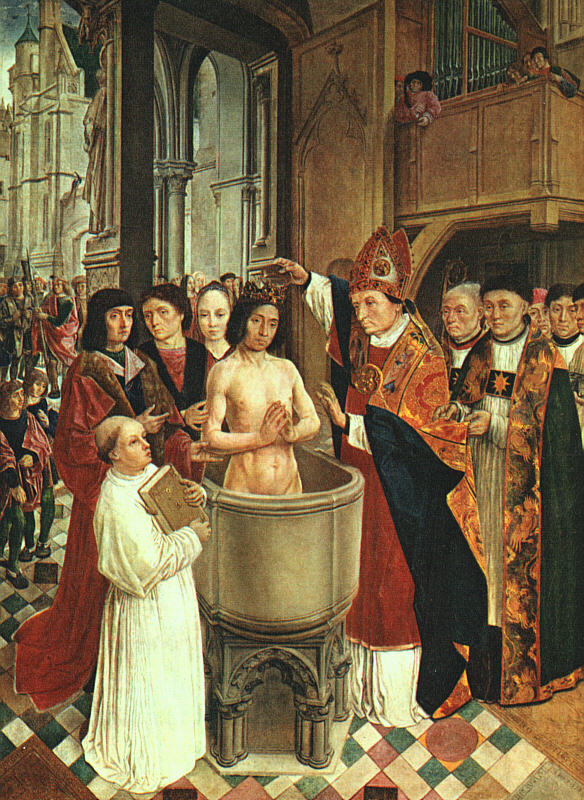
He chose as his wife Clotilda, a devout Catholic and the orphaned daughter of a brother of the Burgundian king Gontebaud; Gregory of Tours later suggested that Clovis's choice of spouse was meant to unnerve Gontebaud, who had supposedly murdered Clotilda's father. In any event, Clotilda had attempted to convert the pagan Clovis at the time of their marriage, but it wasn't until Clovis found himself having trouble with the Alemanns that Clovis relented. He vowed to become a Christian if he defeated the Alemanns; and after he defeated them, he received baptism amid great pomp and circumstance from St. Remigius on Christmas Eve, 496 -- becoming the first Christian king of the Franks and enjoying the cooperation of the Church thereafter.

Conspiracy theorists suggest that Clovis' baptism was actually the consummation of a bargain struck by the Roman Catholic Church -- that in exchange for the Church's support in temporal affairs, Clovis and his progeny would renounce the Merovingian claim that the family line began with the union of Jesus Christ and Mary Magdalen. If conspiracy theories about Roswell, Marilyn, Kennedy and Elvis have got you scratching your head, imagine what motivates a modern mind to hatch a conspiracy theory focusing on the baptism of a Frankish king from the 5th century. Today's Merovingian partisans mourn the reign of the independent-minded Dagobert II (676-9) as the last true Merovingian king under the bargain, and regard the papally-supported Carolingian coup which relegated Merovingian figurehead Childeric the Lazy to a monastery in 751 as the last semi-bloody deed in the silencing of the radical Christianity of Jesus' half-brother, James the Just; on the other side of the coin, the anti-Merovingians claim that the Merovingians went underground through organizations such as the Knights Templar and are at present the unseen powers behind international industry and finance.

Clovis subsequently took on and defeated Clotilda's uncle, Gontebaud, king of the Burgundians and one of the last sponsors of the Roman emperors, in 500, and went after the Visigoths, killing Alaric II, king of the Visigoths, at Toulouse in 507 -- thereby extending the Frankish kingdom to include much of modern France and Germany. He established his court at Paris, thereby establishing the city as the preferred capital of Gaul (or France) for centuries, where he promulgated the earliest Frankish canon of written laws and meddled poorly in church affairs. According to custom, when Clovis died (on this date in 511 in Paris at the age of about 46) his kingdom was split among his four sons, two of whom (Childebert I and Chlotar I) emerged as dominant kings of the Frankish realm for a time.

Labels: , , ,

Sunday, November 26, 2006

Peanuts


Charles M. Schulz was born on this day in 1922 in Minneapolis, Minneapolis.

A shy, awkward World War II veteran known to his friends as "Sparky" (named after "Spark Plug," the horse in Billy DeBeck's cartoon Barney Google), Schulz drew a one-panel cartoon for the St. Paul Pioneer Press called Li'l Folks, but could not manage to get it accepted for syndication until lowly United Features bought it in 1950, renaming it Peanuts (a name, by the way, that Schulz could not stand).

The strip, drawn simply without much background detail, focused on the adult-sounding conversations of a neighborhood of children -- principal among them Charlie Brown, the hopeful misfit loser; Linus, the little savant with a security blanket; Linus' sister Lucy, the challenging "fussbudget"; and Charlie's cool, multifarious beagle Snoopy. During the 1950s, his comic strip was a critical and campus pleasure, but as culture and politics roiled amid violent changes during the late 1960s, Schulz's gentle comic strip -- blending the pain of unrequited love and occasional bursts of anger at being misunderstood, with gnomic wisdom and compassionate humor -- became the most popular of all newspaper comic strips in the U.S., read alike by conservative adults and the rebellious youth. While Tom Stafford commanded Apollo 10 to the moon, with a command module named Charlie Brown and a lunar module named Snoopy, clear across the pop culture landscape the Grateful Dead's keyboardist Ron McKernan adopted the name of another Peanuts character, "Pig Pen." As commentators would observe, Schulz's Peanuts was an area of common ground for feuding generations.

By 1969, Peanuts became a multi-media phenomenon, with an Emmy-winning Christmas special (A Charlie Brown Christmas, 1965, featuring the piano jazz score of Vince Guaraldi), a musical (You're a Good Man, Charlie Brown, 1967, starring Gary Burghoff and Bob Balaban as Charlie Brown and Linus) and a feature-length movie (A Boy Named Charlie Brown, 1969). Books, dolls, lunchboxes, T-shirts and countless other promotional items eventually netted United Features over $1 billion a year, and collections of Schulz's comics eventually sold over 300 million copies in 26 languages. Although Schulz was earning $40 million a year at the height of Peanuts' popularity, he remained a reclusive homebody, giving millions to charity while preferring to work away at his drawing table.

During the 1980s and 90s, Peanuts was no longer the touchstone it had once been, but it still invariably occupied the place of honor at the top of the front page of the comics in nearly every newspaper in the U.S. Schulz was diagnosed with Stage-4 colon cancer and announced his retirement on December 14, 1999, admitting in a TV interview, "It is amazing that they think that what I do was that good . . . I just did the best I could."

Schulz passed away on the evening before the appearance of the last comic strip he created, on February 12, 2000 in Santa Rosa, California. On Saturday, May 27, 2000, his fellow newspaper cartoonists honored Schulz in an unprecedented fashion by including a reference to Peanuts in each of their strips.

Labels:

Sunday, November 19, 2006

Giving Christmas Back to the Chipmunks


We had barely recovered from Halloween in Napa, its inevitable San Francisco repercussions, and the great grinning mania of Election Day -- when sitting in our local grill the other day, looking up from our pints of Bass Ale, my wife and I suddenly noticed that the bar had already been decorated for Christmas. Silent Night played softly in the background, while someone on Fox News was announcing that Steny Hoyer had been elected House majority leader. "All is calm, all is bright . . ."

Okay -- so it seemed a little early to be thinking about Christmas, but that's a well-worn cliche at this point. The question is why -- why do our friends in commerce feel the need to initiate the celebration of Christmas some time after Election Day and well before Thanksgiving? And why do I have the sneaking suspicion that Christmas will start being celebrated just before Labor Day by 2010?

I think the main reason for "Christmas drift" has to do with the size of Christmas today, as compared with the size of Christmas 35 years ago. When I was a kid, we threw up a tree and put the big colored lights on the facie of the house, we practiced the school Christmas show for a week, sang some songs, and opened up presents on Christmas Day. That was it. Today, the logistics and scale of Christmas for the average family seems to have exploded from that simple sequence into something that compares favorably to a major public construction project. It is now, of course, de rigueur for every middle-class American family to have its own personal Holiday on Ice pageant, combined with the Macy's Thanksgiving Day Parade, Space Mountain and The Price is Right -- until, all swirled up, it feels a lot more like a holiday edition of Survivor. In one's own family room. You can't pull that off in just a week.

This is no different, in fact, from what has happened with presidential election campaigns. In 1952, Adlai Stevenson wasn't even sure he was running for president as late as April -- a mere seven months before he nearly won the popular vote in the general election. Fast forward to 2006: we've just had a mid-term election, the coffin lids haven't even been nailed down on losing incumbents like George Allen and Rick Santorum yet, and here, 22 months before the 2008 presidential election, we have John McCain, Rudy Giuliani and Tom Vilsack already forming exploratory committees. Spending on all campaigns for federal office has mushroomed from less than $250 million in 1952 to $3 billion in 2000. Bigger almost always means more time.

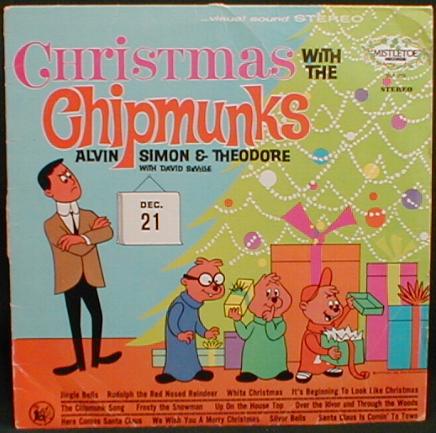
But I digress. As I started to think about the simplicity of my own childhood Christmases, inevitably my mind turned back to a classic among Christmas music albums, a tiny gem of an LP that we would play on our little portable turntables in our little suburban bedrooms. I am speaking, of course, about Christmas with the Chipmunks (Vol. I), originally released in 1962.

This was pure low-tech fun of the kind today's children can barely appreciate. In fact, once you got the hang of what producer Ross Bagdasarian was doing with recording and playing speeds, you could turn all your parents' Andy Williams or Vikki Carr albums into Chipmunks records by flipping the turntable speed switch from 33-1/3 to 45. Try doing that on your iPod. (As comedian Patton Oswalt has famously observed, you could also turn your Chipmunks album into "three normal, monotone guys singing a song about Christmas," with Ross Bagdasarian as the Chipmunks' impresario, David Seville, sounding like a "demon from the ninth level of murderers and traitors," by turning the switch from 33-1/3 to 78. He's not lying.)

How can you not just break out into a silly smile listening to the album's first song, "The Chipmunk Song (Christmas Don't Be Late)"?:

(All right you Chipmunks! Ready to sing your song?
-I'll say we are!
-Yeah!
-Let's sing it now!
Okay, Simon?
-Okay!
Okay, Theodore?
-Okay!
Okay, Alvin? Alvin? ALVIN!
-OKAY!!!)

Christmas, Christmas time is near
Time for toys and time for cheer
We've been good, but we can't last
Hurry Christmas, hurry fast
Want a plane that loops the loop
Me, I want a hula hoop
We can hardly stand the wait
Please Christmas, don't be late.

(Okay fellas get ready.
That was very good, Simon.
-Naturally.
Very good Theodore.
-Ahhh.
Ah, Alvin, you were a little flat, watch it.
Ah, Alvin. Alvin. ALVIN!
-OKAY.)
That, my friends, was a song that spent four weeks on the top of the charts. Critic Stanton Swihart says the tune has "the allure of an old Italian love song."

With fine familial harmonies, Alvin, Simon and Theodore have always seemed to me like a cartoon version of the Beach Boys. This was brought home to me in high relief with the release of the Help Me Ronda Sessions not too long ago, in which Murry Wilson, father of Brian, Carl and Dennis, arrives in the middle of the session and manhandles the boys, drunkenly berating and humiliating them by turns for their lack of discipline. "David Seville" did much the same thing with the Chipmunks, only without the Chivas on his breath, and perhaps without so much out-and-out abuse or such far-reaching psychological effects on his young charges.

Whatever the psychodramatic backstory, here it certainly produces some charming results. The Chipmunks' covers of "Frosty the Snowman," "Here Comes Santa Claus" and "Over the River and Through the Woods" are startlingly wide-eyed and innocent in their embrace of the Christmas holiday -- they are irresistibly quirky reminders of an elegantly simple flavor of a child's Christmas Past that lasted little more than a decade or so within American culture . . . a kind of Eisenhower Christmas before the intrusion of the Holiday Industrial Complex, if you will.

If I could get away with it, I would block Christmas out of my mind until December 19 or so, and then enjoy it to the hilt by wrapping gifts and listening to albums like Christmas with the Chipmunks. As you may recall, however, I sold all of my LPs to make room for my wife's collection of Christmas decorations. So if anyone needs me today, I'll be out front reassembling the digital holographic audio-animatronic nativity scene.

Labels: , , ,

Saturday, October 14, 2006

Superman


"Superman, I've always thought, is an angel. Probably the angel stories found in all of the world's religions are traces of the work in our world of Superman and his relatives. Who is to say I'm wrong?" -- Andrew Greeley.

Jerry Siegel -- born on this day in 1914 in Cleveland, Ohio -- was a nerdy teenager with a passion for science fiction when he met his future lifelong collaborator, budding artist Joe Shuster. Together they self-published a variety of fantasy stories before they finished high school -- Jerry providing the stories and Joe providing the drawings.

In 1933, Siegel published a story called The Reign of Superman, in which the title character was a villain; indeed, the prevailing connotation of the word "superman" at that time was negative, being closely associated with the philosophy of Friedrich Nietzsche and its invocation by Nathan Leopold and Richard Loeb at their celebrated 1924 murder trial.

The concept of a man with a super-human powers stayed with Siegel, however, and with inspiration from Edgar Rice Burroughs' "John Carter," Siegel roughed out the character of a fighter for truth, justice and the American way who came to be known as "Superman." Rocketed from the exploding planet Krypton to Earth as a baby, he was adopted by the Kent family, who raised him as "Clark Kent." Kent worked as a mild-mannered, bespectacled reporter for the "Daily Planet," but when danger arose, Clark Kent would shed his meek veneer to become Superman -- "faster than a speeding bullet, more powerful than a locomotive, able to leap tall buildings at a single bound."

Siegel tried to peddle his character as a comic strip, drawn wearing a blue, tight-fitting costume and a red cape by Shuster, but to no avail. By 1937, Siegel and Shuster were producing stories for the Slam Bradley series at Detective Comics (DC), and after much prodding, DC finally agreed to run Superman as a feature in its new comic book series, Action Comics, in 1938. Superman became the first huge comic book success, virtually spawning the super hero genre and launching hundreds of imitators.

Meanwhile, Siegel and Shuster sold the rights to their creation for $130 (by contrast, a copy of the first issue of Action Comics could fetch up to $145,000 at the time of Siegel's death). They continued to produce Superman comics (and Siegel created another popular comic hero, The Spectre) until World War II, when the two left for military service. While they were gone, DC spun off a Superboy series without compensating Siegel and Shuster, so they sued DC and won a settlement of $100,000. Out of spite, DC failed to renew their contracts in 1948, and Siegel and Shuster struggled along, producing a comic strip for awhile, until DC re-hired the down-on-his-luck Siegel in 1958.

In 1978, DC's new corporate parent, Warner Communications, made amends to both Shuster and Siegel, restoring their creators' credit and giving them a yearly stipend, as Warner rolled out the first of its big budget Superman films with Christopher Reeve. Siegel died on January 28, 1996.

Of all the fictional characters created by the likes of Homer, Shakespeare and Dickens -- Siegel and Shuster's Superman is probably known to more living humans in more distant corners of the world than any of them.

Labels:

Monday, September 18, 2006

Dogs Playing Poker


Cassius Marcellus Coolidge was born on this day in 1844 in Jefferson, New York.

Coolidge, an itinerant cartoonist and sign-painter, is remembered almost solely for his iconic Dogs Playing Poker series of paintings (including A Friend in Need, based on Georges de La Tour's human-populated The Cheat with the Ace of Diamonds), created for the St. Paul, Minnesota advertising firm Brown & Bigelow in 1903. Long-maligned as the ultimate in low-brow art, two of Coolidge's Dogs Playing Poker paintings were auctioned in 2005 for $590,400.

He married late and spent his last years being supported by his young wife who worked as a Manhattan legal secretary. He is also said to have pioneered the use of life-sized boardwalk cutouts (into which one could place one's own head, thereby allowing one to be photographed as the character depicted in the cutout), and wrote an opera about a plague of mosquitoes in New Jersey.

He died on January 13, 1934 in Staten Island, New York.

Labels: , ,

Tuesday, August 22, 2006

Krazy Kat


Cartoonist George Herriman, Creole creator of the comic strip Krazy Kat (beginning in 1914), was born on this day in 1880 in New Orleans.

Krazy Kat -- an ironic, surreal fantasy set in a fictional Southwestern desert mesa known as Coconino, in which Krazy, a romantic addle-brained optimist, carries a torch for the beady-eyed realist Ignatz Mouse, despite the fact that Ignatz's favorite activity is throwing bricks at Krazy's noggin.

The strip was long appreciated by critics, who noted Herriman's devotion to Cervantes' Don Quixote de la Mancha throughout his work; at the height of its popularity, art critic Gilbert Seldes, in his book The Seven Lively Arts (1924), called Krazy Kat "the most amusing and fantastic and satisfactory work of art produced in America today." Herriman's comic strip also inspired a jazz-pantomime ballet, scored by John Alden Carpenter (1922), and an apocalyptic novel, by Jay Cantor (1987).

Herriman died on April 25, 1944 in Hollywood.

Labels: