Monday, December 25, 2006

You Better Watch Out, You Better Not Cry


Leave it to my Irish in-laws to teach me something about Pennsylvania Dutch culture.

A few years ago, when I first started accompanying my future wife to the Jersey Shore for the holidays, I was puzzled by the hirsute little figures that were hanging all over Aunt Patty’s Christmas tree. “Those are Belschnickels,” she said. “Haven’t you ever heard of them?”

The Belschnickel (also spelled as “Belsnickel” or “Peltznichol”) -- something that translates loosely as “Nicklaus in furs” -- is apparently a favorite Pennsylvania Dutch Christmas legend. He’s a kind of “Anti-Claus,” a wild, scary-looking creature with a long scraggly beard, dressed in a raggy robe of fur and wearing a furry hood or a hat. Sometimes he wears a robber’s mask, too, and he carries with him a sack of mischief in one hand and a switch or a whip in the other.

The Belschnickel visits children at Christmastime, and if he finds that they have not been good all year, he might smack them with the switch, or leave coal in their stockings – or both. If they’ve been good enough, they might get a piece of candy from him. (I just hope he keeps them separated in his sack – coal dust on your candy can’t be good for you.)

If Santa Claus represents parental patience, kindness, generosity and love -- the unconditional love that we all want from our mothers and fathers, especially during Christmas time -- the Belschnickel is a holiday fable born of sober reality. He’s your boss watching over your shoulder with a Christmas bonus in one hand, and a stack of unfinished business in the other … or that frowning major client of yours who needs you to finish his year-end project or else he’s not going to be paying your bill until the next fiscal year … he’s your father, keeping you in line with carrot-and-stick discipline, telling you to eat your peas or else you won’t be getting a bicycle under the tree this year.

The sources tell us that the Belschnickel is not so well-liked by children, but beloved by Pennsylvania Dutch parents. No doubt it is a useful tool for them. At the same time, for those of us who have lost touch with our Pennsylvania Dutch roots – or, in the case of my wife’s family, who never had any Pennsylvania Dutch roots – the Belschnickel represents a welcome opportunity to acknowledge our missteps and laugh heartily at them. Even our two-year old little cousin understands the ritual power of this kind of annual confession. When we ask him what he’s getting for Christmas this year, he replies, “Nussing. I don’t listen to my mommy and daddy, and I take off all my clothes.”

Along with the other family traditions I’ve adopted since get married (such as saying we’re not exchanging gifts and doing it anyway; singing songs we’ve written to the tunes of familiar Christmas carols about all the misfortunes our family has suffered during the year; and gathering around the chimeneya on the front deck in 47° weather, knocking back Rolling Rock ponies), I’ve joined my family in collecting Belschickels for the tree. We get ours from a cherished source, hand-made for our Christmas trees by a second-generation Belschnickel-maker from the heart of Pennsylvania Dutch country.

As of this Christmas, I now have two of them. But -- as Aunt Patty reminds me -- I’d better be a good boy next year, or Santa won’t be bringing me another one.

Labels: ,

Merry Christmas, 2006


At a Borders Books near us, the staff apparently thought it was appropriate, during this holiday season, to stock The Life of Jesus next to a book about Pilates -- not Pontius Pilates, mind you, but the similarly-named fitness regimen.

For a reminder of what Christmas is all about, see last year's post on the childhood of Jesus.

Merry Christmas to all!

Labels:

Sunday, November 19, 2006

Giving Christmas Back to the Chipmunks


We had barely recovered from Halloween in Napa, its inevitable San Francisco repercussions, and the great grinning mania of Election Day -- when sitting in our local grill the other day, looking up from our pints of Bass Ale, my wife and I suddenly noticed that the bar had already been decorated for Christmas. Silent Night played softly in the background, while someone on Fox News was announcing that Steny Hoyer had been elected House majority leader. "All is calm, all is bright . . ."

Okay -- so it seemed a little early to be thinking about Christmas, but that's a well-worn cliche at this point. The question is why -- why do our friends in commerce feel the need to initiate the celebration of Christmas some time after Election Day and well before Thanksgiving? And why do I have the sneaking suspicion that Christmas will start being celebrated just before Labor Day by 2010?

I think the main reason for "Christmas drift" has to do with the size of Christmas today, as compared with the size of Christmas 35 years ago. When I was a kid, we threw up a tree and put the big colored lights on the facie of the house, we practiced the school Christmas show for a week, sang some songs, and opened up presents on Christmas Day. That was it. Today, the logistics and scale of Christmas for the average family seems to have exploded from that simple sequence into something that compares favorably to a major public construction project. It is now, of course, de rigueur for every middle-class American family to have its own personal Holiday on Ice pageant, combined with the Macy's Thanksgiving Day Parade, Space Mountain and The Price is Right -- until, all swirled up, it feels a lot more like a holiday edition of Survivor. In one's own family room. You can't pull that off in just a week.

This is no different, in fact, from what has happened with presidential election campaigns. In 1952, Adlai Stevenson wasn't even sure he was running for president as late as April -- a mere seven months before he nearly won the popular vote in the general election. Fast forward to 2006: we've just had a mid-term election, the coffin lids haven't even been nailed down on losing incumbents like George Allen and Rick Santorum yet, and here, 22 months before the 2008 presidential election, we have John McCain, Rudy Giuliani and Tom Vilsack already forming exploratory committees. Spending on all campaigns for federal office has mushroomed from less than $250 million in 1952 to $3 billion in 2000. Bigger almost always means more time.

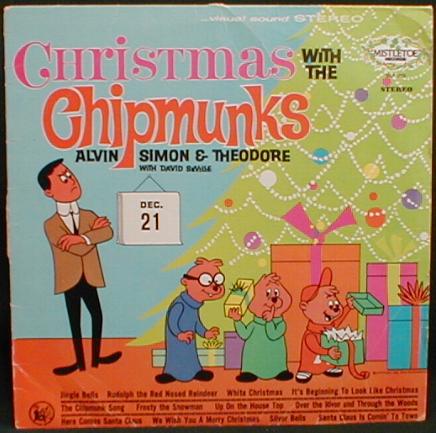
But I digress. As I started to think about the simplicity of my own childhood Christmases, inevitably my mind turned back to a classic among Christmas music albums, a tiny gem of an LP that we would play on our little portable turntables in our little suburban bedrooms. I am speaking, of course, about Christmas with the Chipmunks (Vol. I), originally released in 1962.

This was pure low-tech fun of the kind today's children can barely appreciate. In fact, once you got the hang of what producer Ross Bagdasarian was doing with recording and playing speeds, you could turn all your parents' Andy Williams or Vikki Carr albums into Chipmunks records by flipping the turntable speed switch from 33-1/3 to 45. Try doing that on your iPod. (As comedian Patton Oswalt has famously observed, you could also turn your Chipmunks album into "three normal, monotone guys singing a song about Christmas," with Ross Bagdasarian as the Chipmunks' impresario, David Seville, sounding like a "demon from the ninth level of murderers and traitors," by turning the switch from 33-1/3 to 78. He's not lying.)

How can you not just break out into a silly smile listening to the album's first song, "The Chipmunk Song (Christmas Don't Be Late)"?:

(All right you Chipmunks! Ready to sing your song?
-I'll say we are!
-Yeah!
-Let's sing it now!
Okay, Simon?
-Okay!
Okay, Theodore?
-Okay!
Okay, Alvin? Alvin? ALVIN!
-OKAY!!!)

Christmas, Christmas time is near
Time for toys and time for cheer
We've been good, but we can't last
Hurry Christmas, hurry fast
Want a plane that loops the loop
Me, I want a hula hoop
We can hardly stand the wait
Please Christmas, don't be late.

(Okay fellas get ready.
That was very good, Simon.
-Naturally.
Very good Theodore.
-Ahhh.
Ah, Alvin, you were a little flat, watch it.
Ah, Alvin. Alvin. ALVIN!
-OKAY.)
That, my friends, was a song that spent four weeks on the top of the charts. Critic Stanton Swihart says the tune has "the allure of an old Italian love song."

With fine familial harmonies, Alvin, Simon and Theodore have always seemed to me like a cartoon version of the Beach Boys. This was brought home to me in high relief with the release of the Help Me Ronda Sessions not too long ago, in which Murry Wilson, father of Brian, Carl and Dennis, arrives in the middle of the session and manhandles the boys, drunkenly berating and humiliating them by turns for their lack of discipline. "David Seville" did much the same thing with the Chipmunks, only without the Chivas on his breath, and perhaps without so much out-and-out abuse or such far-reaching psychological effects on his young charges.

Whatever the psychodramatic backstory, here it certainly produces some charming results. The Chipmunks' covers of "Frosty the Snowman," "Here Comes Santa Claus" and "Over the River and Through the Woods" are startlingly wide-eyed and innocent in their embrace of the Christmas holiday -- they are irresistibly quirky reminders of an elegantly simple flavor of a child's Christmas Past that lasted little more than a decade or so within American culture . . . a kind of Eisenhower Christmas before the intrusion of the Holiday Industrial Complex, if you will.

If I could get away with it, I would block Christmas out of my mind until December 19 or so, and then enjoy it to the hilt by wrapping gifts and listening to albums like Christmas with the Chipmunks. As you may recall, however, I sold all of my LPs to make room for my wife's collection of Christmas decorations. So if anyone needs me today, I'll be out front reassembling the digital holographic audio-animatronic nativity scene.

Labels: , , ,

Sunday, December 25, 2005

The Childhood of Jesus of Nazareth


Now that Christmas has arrived, many of us in the Northeast U.S. are right this very minute huddled around the Christmas tree, clutching our robes about us for warmth, as we poke our hands through dry fir needles in search of the next brightly wrapped gift for giving. Whether we know it or not, however, this holiday's most essential activity involves spending uninterrupted time with the children in our lives -- if not our own (as in my case, since I don't have any), then those of our loved ones.

With sugary treats, new toys and tinsel drifting around our living rooms like confetti, within one 24-hour period we have the opportunity to see the great gamut of childhood's humours: the wide-eyed excitement, the wild, unfocused kinetic energy, the selfishness, the rash misjudgments -- but also, the gratitude, the love, and the peaceful sleep that follows a day of thrills and spills. Everything that our children are can be found in this one day -- which is probably why so many adults who are not so used to being around children sometimes dread Christmastime.

This day also reminds us that Jesus of Nazareth, the oft unnamed subject of today's festivities, was once a child, too. But what was he like as a child?

The historical Jesus is a shadowy figure, one not easily revealed even by the most literal reading of the Gospels of Matthew, Mark, Luke and John, given the narrative contradictions, gaps and pointed allusions to Old Testament prophecy. The most obvious and formative of the latter is the New Testament’s identification of Jesus as the Messiah who would lead his people to glory, a fulfillment of the visions of the prophets that a great king, descended from the line of David, would be born in Bethlehem and "execute judgment and righteousness on the Earth" (Jeremiah 23:5, Micah 5:2).

Whether or not Jesus was born in Bethlehem is even a matter of dispute within the Gospels themselves (St. John apparently thinks not), but millions of us Christians have been schooled in the story of how an angel came to Mary (who was betrothed to Joseph, a carpenter) and told her that by a miraculous virginal conception she would bear the son of God; and that the couple traveled to Bethlehem from Nazareth together to appear for a Roman census, and there Mary gave birth to Jesus in a manger, among the sheep and the shepherds as their was no room in the local inn.

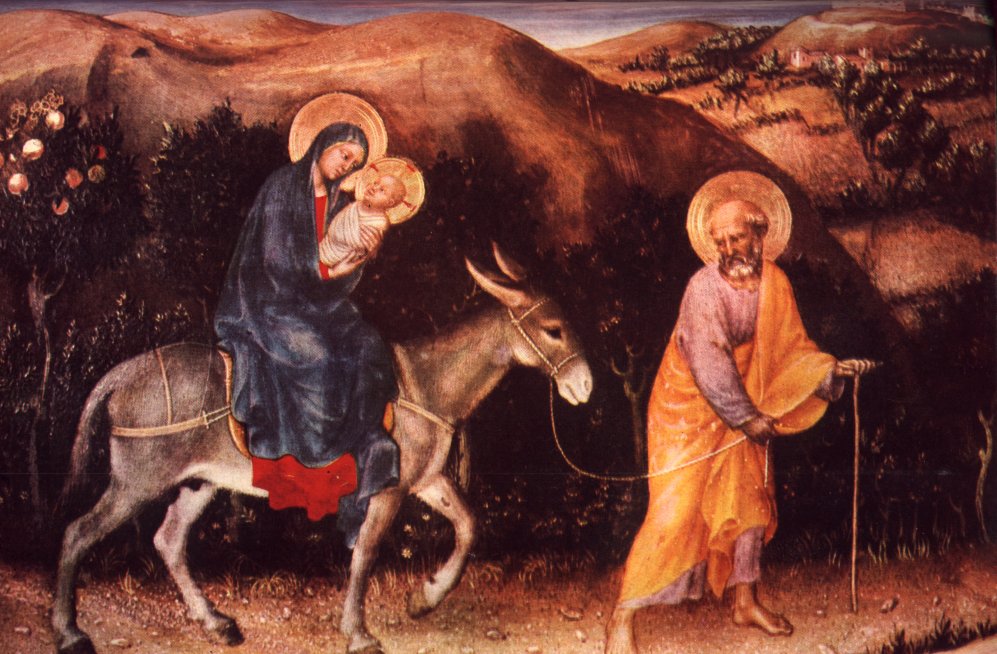
Following in the prophetic vein, Matthew relates that Herod, king of Judea, heard about the birth of a future great king in Bethlehem and ordered a massacre of all male children in Bethlehem under the age of 2. Fleeing from Herod’s butchery, Mary and Joseph took their infant son (foster son, in Joseph’s case) and hid in Egypt.

After the flight to Egypt, the Gospels tell us little of Jesus’ youth, but the Apocryphal Gospels of Thomas and James give life to other uncomfortable legends, illustrating Jesus’ awareness of his own divinity and his impatience with ordinary mortals. The stories tell of how he frequently scared his playmates by performing minor miracles, once even turning the neighborhood children into goats, causing their mothers to cry; of how he exhausted the patience of his teachers by professing to know more than them; and how his parents had to suffer eviction by suspicious landlords due to Jesus’ supernatural mischief, until they finally returned to the back country in Nazareth. These legends are indeed uncomfortable, for we are unaccustomed to seeing Jesus acting in this way, but they are nonetheless familiar. It is the kind of normal childhood petulance that we encounter every day, with the added feature of Jesus' divinity fueling its volume.

St. Luke next finds Jesus when he was 12, at the traditional age of one's bar mitzvah, on a trip to Jerusalem with his parents. When his parents leave to return to Nazareth, Jesus stays behind, and 3 days later they find him in the Temple, firing sharp questions at the rabbis.

"Why are you looking for me?" Jesus asks. "Did you not know that I must be in my father’s house?" His vocation, it seems, is taking hold in him.

All of this gives us something to remember when we assess the humours of our own precocious, mischeivous children on this day filled with unusual holiday treats: there will come a time when, like this Jesus in the Temple, a sense of purpose will take hold in them, and our young man or young woman will decide for themselves to "put aside childish things." It may not happen at age 12, but it will happen -- in some measure, some day.

In the meantime, most of us need not worry about our children turning the other neighborhood children into goats -- so at least we can be thankful for that.

Labels: ,

Sunday, November 27, 2005

Top 10 Things You Don't Want to Hear Around Thanksgiving Weekend

10. "Well, we won't know for sure without an X-ray, but you probably don't have pneumonia."
9. "The water pump is making a funny sound."
8. "It looks like the blizzard should hit just about the time our guests are due."
7. "I'm not sure, but I think we've run out of water."
6. "Well, we won't know for sure without an X-ray, but your toe is probably not broken."
5. "It looks like there's a lot of smoke in the living room."
4. "What do you mean we can't flush the toilet?"
3. "Happy Thanksgiving. You have reached Water on Wheels. We'll be open again on Friday . . ."
2. "No, we can't deliver any water unless the outside temperature reaches at least 30 degrees."
1. "Wake up, dear -- it's 7 a.m., and you need to go to the store and buy more water."

Labels:

Monday, October 17, 2005

Best Work Ever

Yesterday we attended a neighborhood block party hosted by friends of ours in the Pittsburgh suburb of Sewickley. What I didn’t realize until I arrived (the husband is, of course, the last to know about the ramifications and significance of any social occasion), is that one of the themes of the event was pumpkin-carving. Shortly after we arrived I was standing in our friends’ kitchen, Bloody Mary in hand, watching about a dozen children carve pumpkins on our friends’ back deck.

A short time later (say, another Bloody Mary or so), the weather turned cold and windy, and the kids all rushed in. My wife chose that opportune moment to ask if I would go out and carve our pumpkin. “Our pumpkin?,” I sputtered. “I thought that was a kids’ event.”

“I thought it would be nice if we had a pumpkin, too.”

But, since I’m always being told that I’m the artistic one, “we” meant “me.” My lack of training in the fine arts is often all too evident (my little drawings of Foucault, Gish and Hubbert should provide ample evidence of this), but my friend Kevin was encouraging. “Didn’t Rodin get his start carving pumpkins?”

“He may have gotten his start eating pumpkins.”

So there I was, hunched over a pumpkin in 25 mph winds, two-Bloody-Marys-or-so down, carving a pumpkin for my wife and myself.

After a good 20 minutes of silent toil, I heard a note of disapproval from my wife from inside the kitchen and regained some consciousness. Looking at my pumpkin as for the first time, I concluded that it was the worst looking mess I’ve ever seen: two fretful, roundish eyes and a giant, lopsided Edward G. Robinson mouth. Thereafter, I couldn’t stop laughing at my own sorry creation for some time. If I had gotten around to taking a picture of the thing, I might have been permanently paralyzed with laughter, and for the sake of my own composure, there will be no home-carved pumpkin gracing our doorstep this Halloween.

I was so pleased with myself that I couldn’t help but remember the piece of work that Mark Twain once said was the laugh-out-loud funniest thing he had ever created, his self-designed “Map of Paris,” published in the Galaxy in November 1870. Although, I'm fairly certain that his creation was probably on purpose.

MARK TWAIN'S MAP OF PARIS.

I published my "Map of the Fortifications of Paris" in my own paper a fortnight ago, but am obliged to reproduce it in THE GALAXY, to satisfy the extraordinary demand for it which has arisen in military circles throughout the country. General Grant's outspoken commendation originated this demand, and General Sherman's fervent endorsement added fuel to it. The result is that tons of these maps have been fed to the suffering soldiers of our land, but without avail. They hunger still. We will cast THE GALAXY into the breach and stand by and await the effect.

The next Atlantic mail will doubtless bring news of a European frenzy for the map. It is reasonable to expect that the siege of Paris will be suspended till a German translation of it can be forwarded (it is now in preparation), and that the defence of Paris will likewise be suspended to await the reception of the French translation (now progressing under my own hands, and likely to be unique). King William's high praise of the map and Napoleon's frank enthusiasm concerning its execution will ensure its prompt adoption in Europe as the only authoritative and legitimate exposition of the present military situation. It is plain that if the Prussians cannot get into Paris with the facilities afforded by this production of mine they ought to deliver the enterprise into abler hands.

Strangers to me keep insisting that this map does not "explain itself." One person came to me with bloodshot eyes and a harassed look about him, and shook the map in my face and said he believed I was some new kind of idiot. I have been abused a good deal by other quick-tempered people like him, who came with similar complaints. Now, therefore, I yield willingly, and for the information of the ignorant will briefly explain the present military situation as illustrated by the map. Part of the Prussian forces, under Prince Frederick William, are now boarding at the "farm-house" in the margin of the map. There is nothing between them and Vincennes but a rail fence in bad repair. Any corporal can see at a glance that they have only to burn it, pull it down, crawl under, climb over, or walk around it, just as the commander-in-chief shall elect.
Another portion of the Prussian forces are at Podunk, under Von Moltke. They have nothing to do but float down the river Seine on a raft and scale the walls of Paris. Let the worshippers of that overrated soldier believe in him still, and abide the result -- for me, I do not believe he will ever think of a raft.
At Omaha and the High Bridge are vast masses of Prussian infantry, and it is only fair to say that they are likely to stay there, as that figure of a window-sash between them stands for a brewery. Away up out of sight over the top of the map is the fleet of the Prussian navy, ready at any moment to come cavorting down the Erie Canal (unless some new iniquity of an unprincipled Legislature shall put up the tolls and so render it cheaper to walk). To me it looks as if Paris is in a singularly close place. She never was situated before as she is in this map.

MARK TWAIN.
_____

TO THE READER.

The accompanying map explains itself.

The idea of this map is not original with me, but is borrowed from the "Tribune" and the other great metropolitan journals.

I claim no other merit for this production (if I may so call it) than that it is accurate.
The main blemish of the city-paper maps of which it is an imitation, is, that in them more attention seems paid to artistic picturesqueness than geographical reliability.

Inasmuch as this is the first time I ever tried to draft and engrave a map, or attempt anything in the line of art at all, the commendations the work has received and the admiration it has excited among the people, have been very grateful to my feelings. And it is touching to reflect that by far the most enthusiastic of these praises have come from people who know nothing at all about art.

By an unimportant oversight I have engraved the map so that it reads wrong end first, except to left-handed people. I forgot that in order to make it right in print it should be drawn and engraved upside down. However, let the student who desires to contemplate the map stand on his head or hold it before her looking-glass. That will bring it right.

The reader will comprehend at a glance that that piece of river with the "High Bridge" over it got left out to one side by reason of a slip of the graving-tool, which rendered it necessary to change the entire course of the river Rhine or else spoil the map. After having spent two days in digging and gouging at the map, I would have changed the course of the Atlantic ocean before I would have lost so much work.

I never had so much trouble with anything in my life as I did with this map. I had heaps of little fortifications scattered all around Paris, at first, but every now and then my instruments would slip and fetch away whole miles of batteries and leave the vicinity as clean as if the Prussians had been there.

The reader will find it well to frame this map for future reference, so that it may aid in extending popular intelligence and dispelling the wide-spread ignorance of the day.

MARK TWAIN.
_____

OFFICIAL COMMENDATIONS.

It is the only map of the kind I ever saw. U. S. GRANT.

It places the situation in an entirely new light. BISMARCK.

I cannot look upon it without shedding tears. BRIGHAM YOUNG.

It is very nice, large print. NAPOLEON.

My wife was for years afflicted with freckles, and though everything was done for her relief that could be done, all was in vain. But, sir, since her first glance at your map, they have entirely left her. She has nothing but convulsions now. J. SMITH.

If I had had this map I could have got out of Metz without any trouble. BAZAINE.

I have seen a great many maps in my time, but none that this one reminds me of. TROCHU.

It is but fair to say that in some respects it is a truly remarkable map. W. T. SHERMAN.

I said to my son Frederick William, "If you could only make a map like that, I would be perfectly willing to see you die -- even anxious. WILLIAM III

Labels: