Thursday, August 25, 2016

Face-to-Face, Person-to-Person

Radio and TV journalist Edward R. Murrow, was born Egbert Roscoe Murrow on April 25, 1908 in Greensboro, North Carolina; died of lung cancer, April 27, 1965 in Pawling, New York. 

Edward R. Murrow is recognized as the dean of 20th century broadcast journalism. Before Murrow, broadcast journalism was an unwanted stepbrother of the newspapers, and most radio reporters were writers by trade. Murrow’s high standards for reporting and superb narrative skills -- his aim being to report for the ears, not for the page -- raised the bar for all broadcast reporters who would follow him. 

A student orator at Washington State College who served as president of a national college students’ organization, Murrow backed into radio as an educational radio show producer. His duties took him to Europe in 1937, and with World War II brewing, Murrow found himself on the air feeding the hungry demand for news about Hitler as one of America’s first radio foreign correspondents. 

He first captivated American audiences, though, with his dramatic eyewitness reports from London during the Nazi blitzes of 1940. With bombs and air-raid sirens sounding in the background, Murrow would intone with his deep, rich voice, "THIS is London . . . it’s a bomber’s moon out tonight."  Very quickly his influence as a journalist began to eclipse that of the print correspondents, not only because he was beating their reports by several hours, but because millions of listeners soon began to empathize with this man whose voice was coming to them in their living rooms from the heart of the action. Later, Murrow provided commentary while flying in an Allied bombing run over Germany, and accompanied U.S. troops as they liberated the Buchenwald concentration camp. 

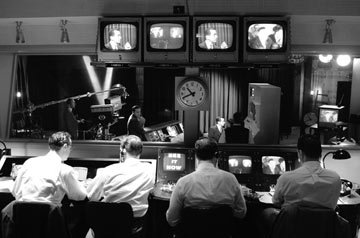
After the War, Murrow became CBS news director, and led CBS into the television age with his weekly news program See It Now (1951-58), covering such stories as the Korean War, human rights in South Africa and the polio vaccine. During these programs, Murrow exuded the same kind of cool, casual image that he had developed on radio, typically with a lit cigarette in hand and a cloud of smoke around him. After spending two episodes exposing the abusive red-baiting methods of Senator Joseph McCarthy with snippets from McCarthy’s own speeches, McCarthy demanded equal time and accused Murrow of spreading "propaganda for communist causes." As it turned out, Murrow gave McCarthy the chance to ruin himself; public opinion turned dramatically against McCarthy after his angry response, and within a year McCarthy had been censured by the Senate. 

In 1954, Murrow had also introduced a celebrity interview show, Person to Person (1954-59) which featured in-depth interviews of such people as Eleanor Roosevelt, Groucho Marx, Marilyn Monroe and Duke Ellington. Advertisers began to pull their support from See It Now in 1955 due to the controversial nature of Murrow’s reports, leading Murrow to launch an attack against the institution of television in a speech to TV and radio news directors.  Arguing that commercial interests were using the medium to "distract, delude, amuse and insulate" viewers. In 1958, CBS cancelled See It Now, but Murrow continued to do occasional news documentaries, such as his highly-acclaimed report on the conditions of migrant workers, "Harvest of Shame" (1960). 

In 1961, Murrow left CBS to accept an appointment by John Kennedy as head of the U.S. Information Agency, which had as its mission informing the world about American culture and democratic principles; he served there until 1964. George Clooney’s film about the Joe McCarthy feud, Good Night, and Good Luck (2005), named for Murrow’s sign-off slogan and starring David Strathairn as Murrow, is highly recommended.

"It has always seemed to me the real art in this business is not so much moving information or guidance or policy five or ten thousand miles. That is an electronic problem. The real art is to move it the last three feet in face-to-face conversation." -- Edward R. Murrow. 


Labels: , ,

Wednesday, March 25, 2009

The Disappearance of Agnes Lowzier


The last time I saw Agnes Lowzier, it was a misty night in L.A. She had just bargained a dowdy shamus out of a couple of Cs in exchange for some information on the whereabouts of the blonde wife of a mob boss. After performing her part of the bloodless exchange and asking the detective to wish her luck, she simply drove away into the night in her gray Plymouth, never to be seen again. Until now.

“Wish me luck,” she said, before she put her pointed toes down on the gas pedal. “I got a raw deal.”

“Your kind always does,” said the detective.

The detective was Philip Marlowe, played by Humphrey Bogart in Howard Hawks’ 1946 adaptation of Raymond Chandler’s novel, The Big Sleep. The movie has grown in stature over the years. It was initially faulted by critics for the untidiness of its labyrinthine plot, but now it is seen as a classic example of film noir, in which story takes a backseat to process, mood and atmosphere. Another way of describing the film, which is one of my favorites after all, is that it is a canvas for a collection of cold-blooded murders and beatings, some fascinating character encounters, and a constant volley of wisecracks.

And who was Agnes? Agnes Lowzier was a slender, pretty “brunette with green eyes, kind of slanted” as Marlowe describes her (Chandler had her down as Agnes Lowzelle, a blonde), who cracked wise in her every scene. The first time we see her she is pretending to be a sales clerk at Geiger’s Rare Books, a shop that Marlowe supposes is actually a front for a bookie’s joint. Marlowe comes in to check things out, and poses as a collector. After establishing that Agnes doesn’t know too much about rare editions and anyway doesn’t seem to have any in stock, thus confirming his suspicions about the place, Marlowe asks, still in character as a collector, “You do sell books, hmm?” Agnes replies, gesturing carelessly at a random row of books: “What do those look like, grapefruit?”

Marlowe returns to the bookshop and reveals himself as he sees that the back of the store is being emptied. Agnes tells him to come back “tomorrow” if he wants to see Geiger. “Early, then?,” Marlowe asks with a note of sarcasm, letting her know that he knows the place will be empty tomorrow. “Yes, early,” she snarls, disgustedly acknowledging Marlowe’s cleverness.

Critic David Thomson calls what transpires between Marlowe and Agnes as a kind of “nagging marriage” – providing the film with one of its funniest subtexts. Marlowe sees Agnes’ shoes behind a curtain leading to another room in the apartment of a grasping, small-time hood named Joe Brody (Louis Jean Heydt). “Why don’t you ask your friend with the pointed toes to come out of there – she must get awful tired of holding her breath.” He calls her “Sugar” over and over again, because he knows it annoys her.
By the time Marlowe has disrupted Brody’s attempt to blackmail the Sternwoods and has generally humiliated everyone involved, Agnes almost seems willing to trade sides, registering her impatience with Brody’s incompetence. “Hm!,” she grunts. “What’s the matter, Sugar?,” Marlowe asks. Agnes replies: “He gives me a pain in my –“ and she is interrupted by Brody. “Where does he give you a pain?” Marlowe asks. “Right in my –“ and again, Agnes is interrupted by Brody. “That’s what I always draw,” Agnes says, “Never once a man who’s smart all the way around the course. Never once.” Referring to an earlier moment when he wrestled a gun away from her, Marlowe asks Agnes, who is rubbing her wrist, “Did I hurt you much, Sugar?” “You and every other man I’ve ever met,” she says.

Brody is killed by Geiger’s bodyguard a few seconds later, and Marlowe is on to other things, but Agnes comes back into the story when one of Brody’s associates, a dour little man named Harry Jones (Elisha Cook, Jr.), comes to Marlowe with a proposition. “So Agnes is on the loose again,” Marlowe cracks. “She’s a nice girl,” Jones says, “we’re thinking of getting married.” “She’s too big for you,” Marlowe says, but then thinks better of the remark and apologizes. He’s still wary of the way she insinuates herself into the schemes of one small-time grafter after another, hoping to make a quick buck, and when Mr. Jones suggests he’d be willing to stand up to a police grilling for Agnes’ sake, the still skeptical Marlowe remarks that “Agnes must have something I didn’t notice.”

Witnessing Harry’s murder at the hands of a mob brute named Canino (Bob Steele) while protecting Agnes’ whereabouts is Marlowe’s last straw where Agnes is concerned. “Your little man died to keep you out of trouble,” he tells her over the phone. He squints contemptuously and says, “I got your money for you. Do you want it?” When Marlowe meets her near the corner of Rampart and Oakland to give her the two Cs, she asks him, “What happened to Harry?” “There’s no use going into that – you don’t really care anyway. Just put it down your little man deserved something better.” At the moment that Marlowe seems to hate her the most, Agnes has never looked lovelier.

There are a small bevy of both credited and uncredited actresses who make splendid little impressions in the movie, but Thomson and numerous others single out the work of Sonia Darrin as Agnes. Thomson writes:

There is Agnes Lozelle [sic], in Geiger’s shop, dumb on books but hip with grapefruit, and later the dreamgirl for Joe Brody and Harry Jones, both of whom (if you’ll pardon the remark) are too small for her. Indeed, Marlowe has sized her up and knows how to whip her with words – he understands the b*tch, and she looks at him with the bruised gratitude of someone who knows she’s been understood. What ever happened to Sonia Darrin, who played Agnes?

Darrin is officially uncredited in her role. As Hawks’ biographer, Todd McCarthy, tells the story, Darrin was originally a contender to appear in the film as Carmen Sternwood, the nymphomaniacal sister of Lauren Bacall’s character, Mrs. Rutledge. Ultimately, however, the mercurial Hawks settled on a former model, Martha Vickers, for the Carmen role, relegating Darrin to the supposedly smaller role of Agnes. Although Carmen is pivotal within the film, some of Vickers’ work ended up on the cutting room floor due to censorship concerns and other reconfiguring. As a result, perhaps, Agnes becomes a much more memorable character, especially as she is played by Darrin.

Roger Ebert writes:

One of the best-known of all Hollywood anecdotes involves the movie's confusing plot, based on the equally confusing novel by Raymond Chandler. Lauren Bacall recalls in her autobiography, “One day Bogie came on the set and said to Howard, ‘Who pushed [Owen] Taylor off the pier?’ Everything stopped.” As A.M. Sperber and Eric Lax write in Bogart, “Hawks sent Chandler a telegram asking whether the Sternwood's chauffeur, Owen Taylor, was murdered or a suicide. ‘Dammit I didn't know either,’” Chandler recalled.

It is refreshingly consistent with the on-screen persona of Agnes that, as told by McCarthy, Sonia Darrin also had a wry sense of humor:

A sarcastic young woman herself, Darrin was on the set when it was asked who killed Owen Taylor, and she burst out, “It must have been Hawks.”

Thomson’s curiosity about Darrin is echoed by other fans of The Big Sleep. On the IMDB message board for Sonia Darrin, for example, one fan writes: “This is one of the big Hollywood mysteries, considering the importance of The Big Sleep. Note also that she did not receive any credit in the movie, despite the fact that her role was infinitely more important than e.g. Dorothy Malone's, and despite the fact that only Bogart and Bacall (I think) got more screen time than her!! Something really smells here...” Others chime in with similar sentiments, and there are other websites that raise the same question: what happened to Sonia Darrin?

The annals of film history – carelessly curated by the Hollywood studios and pressed piecemeal into tawdry scrapbooks by adoring fans like me – have left us few clues to the identity of Sonia Darrin. She appeared in minor roles in a few more films, but after 1950, she is gone. For awhile one of the only clues was a reference I found to her being involved as a “guest artist” at the Los Angeles Labor Zionists' 4th annual Bikkurim Festival in Griffith Park, held June 10, 1945, in support of a free and democratic Jewish state in Palestine. Other guest artists at the event included Bette Davis, Ernst Deutsch and Joseph Szigeti. I dutifully entered the reference into the Internet Movie Database, hoping that some other Sunday researcher would be able to make something out of it. They never did. Another clue came up in a bit of syndicated gossip from the summer of 1946, in which it was reported that Sonia Darrin, “Warner fledgling,” was seen in the company of press agent Arthur Pine and was “coming East to see him soon.”

I could write my own Big Sleep about how I found Sonia Darrin, but it lacks mood and atmosphere. There’s no misty L.A. in it. There are no unsolved murders and no bookies; I don’t get beat up in it; and frankly, I don’t look so hot in a fedora.

Rock critic Gail Worley writes in her blog in 2007:

If you were, say, over age ten in the early to mid '70s and living in the United States, you will remember [Mason Reese] as the adorably precocious 7 year old spokesperson for Underwood Deviled Ham in the commercial that swept the nation by storm and had everyone mispronouncing the word ‘Smorgasbord.’

Our scene switches from “EXT. MISTY LOS ANGELES STREET - NIGHT” to “INT. ON THE SET OF A DAYTIME TALK SHOW. It is Halloween, October 31, 1973. Mason Reese, a red-headed 3’-8” gnome who talks like he’s a 32-year old trapped in a little boy’s body – using big words and the attitude of a seasoned commentator – is co-hosting for the fourth time with the reigning king of daytime variety/talk, Mike Douglas. Today’s guests are Leonard Nimoy, astronaut Buzz Aldrin, game expert John Scarne, and the beatnik poet/gadfly Tuli Kupferberg and his partner in pop/countercultural crime, Sylvia Topp. Before the week is over, Mason will have the opportunity to quiz the likes of Art Buchwald, Ralph Nader and Theodore H. White, author of The Making of the President 1972.

Mason Reese became a bit of a TV phenomenon in the early to mid-1970s, doing commercials not only for Underwood Deviled Ham (through which “Borgasmord” became a household word), but for Dunkin’ Donuts, Ralston Purina, Ivory Snow, Birdseye Frozen French Fries and Thick and Frosty, winning seven Clio awards for his work. Mike Douglas took him on, first as a one-time guest, and later as a temporary co-host, finding his appeal irresistible. He became a children’s reporter for WNBC-TV, worked on a prime-time show with Howard Cosell, and even did a pilot for his own TV series.

Also on hand for some of the Mike Douglas appearances was Mason’s mother, Sonia (see photo below). As Mason writes in his “autobiography,” published at the height of his fame in 1974:

Mommy has red hair, too. When she was a little girl, she lived in Hollywood and became a beautiful actress. She doesn’t act any more, but she’s still beautiful.

Somewhere along the line, Sonia Darrin left Hollywood and did, in fact, go East, meeting and marrying Bill Reese, a one-time theater set designer who eventually ran his own marketing services company, specializing in 3-D design work. She and Bill raised at least 4 children in a stylish place on West End Avenue in Manhattan – Mason, the youngest; daughter Suky; and two older sons, Lanny and Mark.
Mason’s fame faded as he grew older, and eventually he and his family settled into a less visible existence. Mason eventually went into the restaurant business, owning and co-owning a number of places around lower Manhattan, including Nowbar on Seventh Avenue South, Mason’s on Amsterdam Avenue, and Paladar on Ludlow Street.
Hollywood bad-boy director Brett Ratner briefly brought both Mason and Sonia out of retirement in 1990. When Ratner was a film student at NYU, he had a chance meeting with the instantly recognizable Mason Reese on the street. This led to the creation of a bizarre 12-minute film Ratner made as a student project, Whatever Happened to Mason Reese (1990) in which Reese appears as an ex-child star who hangs around with models in limousines and eventually gets gored by a fan whom Reese has humiliated. Reese hurt his leg during the filming, got into some kind of fight with Ratner, and allegedly threatened to tie up the film in litigation; Reese’s voice was later dubbed in by Anthony Michael Hall when the film was finally finished, apparently with dollars begged from Steven Spielberg. It can now be seen as an “extra” on the DVD of Ratner’s hit Hollywood movie, Rush Hour. And Sonia Darrin even got a film credit out of it – “Thanks … Sonia Reese.”

While all of that gives us an inkling of what Sonia Darrin has been up to since
The Big Sleep, we’re still left to wonder – where did she come from?
“EXT. – A SAN DIEGO BEACH – THE 1930s.” Sonia Paskowitz sits in the sand and watches as her eldest brother Dorian, a lifeguard, looking like Charles Atlas, chats up a few adoring female sunbathers. “You know, the girls would be drowning,” says Sonia. “They wanted to be rescued by him.”
Louis and Rose Paskowitz landed at Galveston, Texas in the early years of the 20th century, when Galveston was a common port of entry for Russian Jews. They married and had three children: two sons, Dorian and Adrian, and a daughter, Sonia. Louis opened a dry goods store, but it didn’t survive. Dorian claims that he convinced his parents to move to San Diego after seeing a postcard of some San Diego surfers. In any event, the family moved there in 1934, and Louis found work as a shoe salesman.
Dorian went to Stanford and became a doctor. Adrian studied music, and became a respected music teacher and violinist. Sonia drifted toward Hollywood, and acting.

The realization that Sonia Darrin has been hiding in plain sight all these years, even a couple of years after I managed to draw the connection between Sonia and her son Mason Reese, really hit me with the release of Doug Pray’s documentary Surfwise (2007), in which the unorthodox life of Dorian “Doc” Paskowitz, his wife Juliette and their 9 children is chronicled. In it, we learn that Doc Paskowitz led his family on a relentless quest for freedom and health, moving from beach to beach in their 24-foot camper and eventually opening a surf camp in Southern California. We watch as Doc, Juliette and each of the 9 children tell us, from their own individual perspectives, about their nomadic, bohemian lifestyle, their strict “health food” diet (no fat, no sugar, no exceptions), and the requirement that each and every one of them surf, as often as possible.Also on hand, providing her outsider’s view of Dorian Paskowitz and his family, is Sonia Darrin, Dorian’s little sister. Sonia talks about her brother’s stubbornness and the harsh conditions his family sometimes suffered, and explains how she took in two of Dorian’s sons in New York when they decided to rebel against their father’s iron regime.She has red hair now – just like her son Mason wrote in his autobiography. Her green eyes light up with that sly intelligence when she smiles, and the years cannot hide that melodic quality in her voice, the one that you can hear in each line she delivered in The Big Sleep, over 60 years ago. Sonia Darrin – truly hiding in plain sight -- appearing on The Mike Douglas Show in the 1970s and in a documentary film about her brother in 2007, risking detection but somehow escaping it.The word on the street is that Sonia Paskowitz Reese, better known as Sonia Darrin, is around 80 years old (which would’ve meant she was around 17 when she was making The Big Sleep) and that she is now living in New York. I’m sure she has even better stories about her life than the ones we can glean through public sources.It is kind of tempting to think of Agnes Lowzier speeding off into the desert on that misty night in L.A., meeting up with a traveling theater troupe as the clouds parted somewhere outside of Barstow, sidling up to a tall, handsome stage carpenter and eventually settling down and having a child who would be known for his expressive wisecracks … ah, but that is conflating fiction with reality -- and really, do we need to do that here? Sonia Darrin’s reality has enough twists and turns and notes of interest that there is probably no need for it.

Labels: , , ,

Monday, May 21, 2007

Never, Never Believe It


"If you are lucky enough to be a success, by all means enjoy the applause and the adulation of the public. But never, never believe it." -- Robert Montgomery.

Robert Montgomery was born Henry Montgomery, Jr. on this day in 1904 in Fishkill Landing, New York, the son of a rubber company executive.

Montgomery is remembered today, if at all, as the father of Bewitched star Elizabeth Montgomery, but his film and TV career is notable in its own right, for his contributions both on and off the screen.

After a few years acting on Broadway, Montgomery arrived in Hollywood for the beginning of the Sound Era, and as a prep-school educated boy with patrician good looks, he fell easily into the role of the devil-may-care, tuxedo-wearing playboy. He managed to rise above the bluntness of his typecasting in a few films here and there, including The Big House (1930), Private Lives (1931), Hitchcock's comedy Mr. & Mrs. Smith (1941) and They Were Expendable (1945), and was nominated for best actor Oscars for his performances as a psychotic murderer in Night Must Fall (1937) and as the boxer in a playboy's body in Here Comes Mr. Jordan (1941) --the inspiration for Warren Beatty's Heaven Can Wait (1978).

He served four terms as president of the Screen Actors Guild, beginning in 1935, during a time when Hollywood producers weren't interested in letting actors unionize under any circumstances. The fate of the fledgling organization was uncertain, but under Montgomery's leadership, the Screen Actors Guild boycotted the 1936 Academy Awards and voted to strike on May 10, 1937, causing the major studios to sign the first SAG minimum wage contract, one that applied equally to stunt men and extras under Montgomery's insistence.

Montgomery also managed to stare down a threat from the Capone mob. Capone had his hooks into the International Association of Theatrical Stage Employees (IATSE), which had managed to extract tribute money from Hollywood producers around the time that SAG was being born. Seeing SAG as a threat to his neat little arrangement, Capone tried to intimidate Montgomery by sending thugs around to slash his tires. Montgomery stood firm, however, invited the FBI into the mix, and ultimately cooperated with the Feds to get Capone's lieutenant Willie Bioff sent to prison.

The same sense of public duty that inspired him in his role with SAG was aroused by the conflict in Europe, and in 1940, Montgomery secretly went to France for several weeks to drive an ambulance. Shortly after he returned, he and Douglas Fairbanks, Jr. enlisted in the U.S. Naval Reserve, and Montgomery was placed in the Intelligence Section in London. Later, he served as an operations officer on a destroyer during the D-Day invasion, saw action at Guadalcanal, and commanded a PT boat in the South Pacific. He retired from the Navy with the rank of commander in 1944.

While continuing to act, he made his mark as an actor-director in Lady in the Lake (1947), the first Hollywood film to employ the subjective camera point of view of its protagonist for an entire feature. Montgomery starred as detective Philip Marlowe, but was seen on screen only at the odd moment when he might catch his own reflection in a mirror. "YOU do get into the story and see things pretty much the way the protagonist, Phillip Marlowe, does, but YOU don't have to suffer the bruises he does," noted the New York Times. "Of course, YOU don't get a chance to put your arms around Audrey Totter either. After all, the movie makers, for all their ingenuity, can go just so far in the quest for realism." Overall, the film was received as a curiosity, an interesting failure as a Hollywood film, but one that certainly confirmed Montgomery's willingness to take an artistic risk.

In the 1950s, Montgomery became the first effective political media consultant of the television age as an adviser to President Eisenhower, helping the ex-general to harness the new medium. In a particularly spectacular coup during the run-up to the 1956 election, Montgomery managed to convince CBS to air a birthday tribute to the president's wife Mamie in March 1956 -- never mind that the first lady's birthday was actually in November. Seeing Nixon's disastrous performance in the 1960 presidential debates against John Kennedy, Eisenhower is reported to have remarked that "Montgomery would never have let him look like he did in that first television debate."

Montgomery died on September 27, 1981 in New York City.


Labels: , , ,

Wednesday, April 04, 2007

Takes a Licking, Keeps on Ticking


Timex watch pitchman and pioneer TV news broadcaster John Cameron Swayze was born on this day in 1906 in Wichita, Kansas.

"It takes a licking and keeps on ticking" is what the affable announcer was remembered for, but early TV viewers were more accustomed to hearing him say, "Ladies and gentlemen, and a good evening to you" as host the first nightly news program, Camel News Caravan on NBC (1948-56). Swayze read the news during a 15-minute broadcast, sponsored by R.J. Reynolds Tobacco Company, in what was little more than a TV picture of a radio news program. Lacking the technology to present film or taped segments, Swayze would simply narrate from notes on paper, with a lit cigarette in an ashtray visible on his desk at the instruction of the sponsor.

In 1956, NBC shed the cigarette company sponsorship (at least in name) and hired Chet Huntley and David Brinkley, recently successful as commentators on televised coverage of the 1956 Democratic and Republican conventions, to replace Swayze.

Giving a tobacco company the "naming rights" to a network news program seems preposterous by today's standards, but in the early days of television, the "news" was mainly concerned with highly visible affairs of state (TV had not yet learned how to rake muck, or wallow in it), and health concerns about cigarettes had not yet entered pop consciousness. The relationship between TV news and big tobacco has remained respectful, however, notably forcing 60 Minutes host Mike Wallace to kill, at least temporarily, the broadcast of an interview with former tobacco research exec Jeffrey Wigand about industry knowledge of the addictive properties of nicotine in 1994.

After being replaced on NBC, Swayze moved to ABC to anchor its evening news broadcast for a year in 1957 before becoming the on-air spokesman for Timex for 20 years. Swayze died on August 15, 1995 in Sarasota, Florida.


Labels: , ,

Monday, April 02, 2007

Just the Facts


Jack Webb was born on this day in 1920 in Santa Monica, California.

Webb began his career as a radio announcer in San Francisco, but very shortly thereafter he was producing and starring in his own radio police-drama series, Dragnet (1949-52). Although he appeared in movies from time to time (in Dark City, 1950, he was a giddy, pencil-necked jazz fiend named "Augie"), Webb was a bona fide law enforcement groupie, and he made Dragnet his life's franchise, debuting it on television in 1952.

As the laconic "Sgt. Joe Friday" Webb wore gray suits with white shirts and narrow ties, trundling (almost marching) down the corridors of the L.A.P.D., his arms stiff at his sides. "Casual clothes" meant a white shirt with the top button open, revealing a white crewneck T-shirt underneath, and "being casual" meant listening to the hi-fi and grilling steaks at his spartan bachelor flat. Friday did not give the impression of being a master of detection or psychological gamesmanship, as Peter Falk would be as "Columbo"; rather, Joe Friday was an average Joe, pursuing "just the facts" without distraction, getting the job done. He's so square, he's cool.

During the first incarnation of the TV series, Ben Alexander played Friday's main partner, "Officer Frank Smith" (1953-59); after 8 years on hiatus, Webb revived the series in what became its better remembered version (1967-70), co-starring Harry Morgan as his quirky partner "Bill Gannon." Webb also produced Emergency (1972-77), a series about Los Angeles paramedics (co-starring his ex-wife Julie London and her husband Bobby Troup) and Adam-12 (1968-75), a show about L.A. patrol cops (with Martin Milner and Kent McCord).

Webb passed away on December 23, 1982 in West Hollywood.


Labels: ,

Friday, November 10, 2006

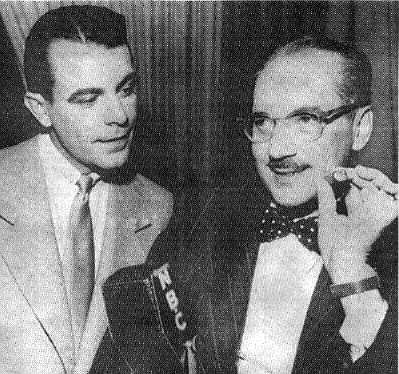
Fenneman


TV announcer George Fenneman was born on this date in 1919 in Beijing, the only child of an American accountant and his missionary wife.

A clean-cut good sport with a rich broadcast voice and courtly manner, George Fenneman was plucked from radio obscurity to be Groucho Marx's announcer and comic foil on Marx's quiz show, You Bet Your Life, beginning on radio in 1947 and continuing on television from 1950 to 1961. Fenneman died on May 29, 1996 in Los Angeles.

"Groucho called him the male Margaret Dumont. George took it as the highest praise. Groucho called him the perfect straight man." -- F. Ferrante.

Labels:

Monday, October 09, 2006

Gavel to Gavel


Brian Lamb was born on this day in 1941 in Lafayette, Indiana.

A former Pentagon spokesman and assistant to the director of the Office of Technology Policy in the Nixon White House, mild-mannered Brian Lamb had the temerity to try to convince America's steely-eyed major cable television operators to finance a non-profit cable TV network to cover public affairs in Washington. Before the days of 500+ cable channels, the cable companies turned out to be eager to find additional programming; so with Lamb at the helm, C-SPAN (the "Cable Satellite Public Affairs Network") became the first bona fide cable network that was not simply a "movie channel."

C-SPAN was launched on March 19, 1979 with gavel-to-gavel coverage of the U.S. House of Representatives, beginning with a speech by a young Democratic congressman named Al Gore. By 1984, backbenchers such as Republican Newt Gingrich had devised ways of making the cameras work for their benefit, delivering long speeches over the free air, denouncing the Democrats to an otherwise empty House chamber. By giving the podium to unknown freshmen and sophomores, C-SPAN activated the "young turk" movement within the post-Nixon Republican Party, as well as giving life to the previously marginalized centrist Democratic Leadership Council -- party factions that had previously failed to receive the support of traditional party leaders outside the glare of the TV klieglights.

It was only in 1986, when Senate majority leader Robert Byrd realized the members of the U.S. Senate were losing some of their celebrity status to the members of the House, that C-SPAN was allowed to cover the Senate.

Since its humble beginnings, C-SPAN has grown from one network staffed by 4 full-timers and a phone to 3 TV networks and a radio network with a $40 million annual budget, watched by 34.5 million cable subscribers every week, providing coverage not just of the House and Senate, but of major political speeches in any venue, as well as books, American history and even the proceedings of the British Parliament. Because 90% of its viewers are likely voters, C-SPAN's non-commercial, non-partisan, "just the facts" window on Washington has become one of the influential media sources within American politics.

Labels:

Thursday, September 14, 2006

When Reporters Knew How to Write


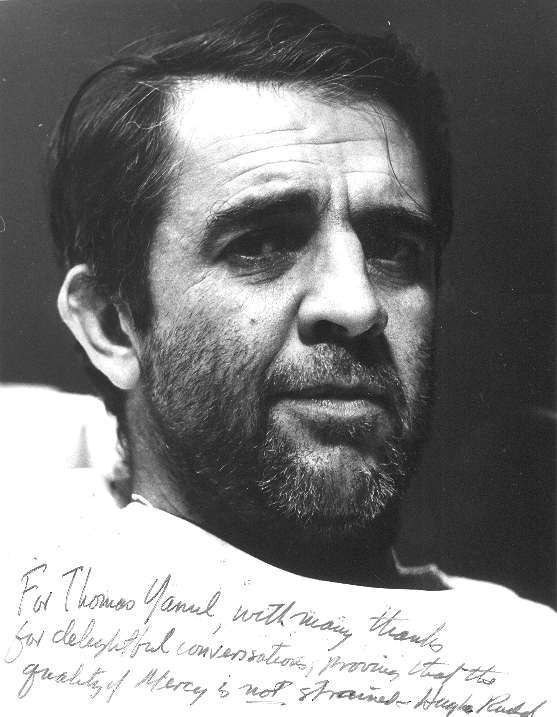
"I remember watching the CBS Morning News one day thirty-two years ago and hearing Hughes Rudd refer to something that had happened during what the Pentagon had described as a 'routine B-52 raid.' At the end of the item, Rudd looked up and said, 'There is nothing routine about a B-52 raid. From a mile away it looks like the end of the world; if you happen to be any closer than a mile away, it is the end of the world.' I knew even then that I would never, ever forget that moment nor how perfectly it illustrated the power of effective use of our language." -- "Reiser," Sept. 16, 2005, on Banned for Life.

Hughes Rudd was born on this day in 1921.

Rudd was best known as the anchorman of the CBS Morning News (1973-77; co-anchor with Sally Quinn, 1973-4). Prior to that, Rudd served as a foreign correspondent for CBS News, including stints in Berlin, Bonn and Moscow, during the 1950s and 60s. Regarding his TV presence, columnist Brooks Peterson recalled, "In addition to being a superlative journalist, Rudd had another quality that especially endeared him to legions of hollow-eyed non-morning-persons: Rumpled, a little grouchy, and defiantly un-chipper, he looked and sounded every bit as crabby about having to be up at such an hour as the rest of us."

A talented storyteller, Rudd's 1966 book, My Escape from the CIA (And Other Improbable Events), was praised by none other than Thomas Pynchon, who wrote: "Without copping out behind idle metaphors or irrelevant plot devices, Mr. Rudd has succeeded in telling, with all his reporter's love of accuracy, and mastery of detail, and irony, and grace, and sometimes terrifying precision, exactly what the hell having to be an American, now, during the years of total war, epidemic anxiety and mass communications whose promise has been corrupted, is really about; where it's really at."

Given Rudd's "reporter's reporter" misgivings about the modern media, it is perhaps a little surprising that he would be invited to anchor the CBS Morning News; it has been suggested that he got the job by being a good drinking buddy to William Paley. After leaving CBS in 1979, he worked as a correspondent for ABC's World News Tonight until retiring to France in 1986. He died on October 13, 1992 in Toulouse, France.

Labels: , ,

Wednesday, July 26, 2006

'Kefauver Hearings'


Democratic U.S. senator and presidential candidate (Carey) Estes Kefauver was born on this day in 1903 in Madisonville, Tennessee.

Known on the campaign trail for his trademark coonskin hat, horn-rimmed glasses and broad grin, Estes Kefauver was an Ivy-educated country boy with an insatiable appetite for publicity. A track star and student newspaper editor at the University of Tennessee, Kefauver returned to his home state after Yale Law school to practice in Chattanooga, where he entered politics by organizing a local government reform movement and securing an appointment as chairman of the local planning board. In 1939, he was elected to Congress, where he supported New Deal programs such as the Tennessee Valley Authority and became a thorn in the side of the old conservative guard of Tennessee Democrats.

When he ran for U.S. Senate and won in 1948, he successfully toppled the Memphis political machine of Boss Crump, who had attempted to brand Kefauver as a "pet coon" to Communists; responding to the charges, Kefauver went to Memphis and donned his coonskin hat, declaring, "I may be a pet coon, but I'm not Boss Crump's pet coon!"

Shortly after he reached the Senate, Kefauver became chairman of the special committee on organized crime in interstate commerce, a post he used, a la Joseph McCarthy, to secure for himself the new spotlight offered by live television. His amoebic investigations of organized crime focused not only on big city mobsters like Frank Costello and Tony Accardo, but also on the pop culture eruptions they supposedly inhabited and financed, such as boxing and gambling, as well as pulp porn and comic books. Although the investigations were not particularly successful (none of the 22 contempt citations issued by the committee held up in court, and almost none of the committee's recommended bills passed), they did succeed in hounding a few marginal players out of business and getting the comic book industry to adopt self-censorship, and they made Kefauver a household name. He also won one of the first-ever Emmy awards, for "outstanding public service."

He parlayed his fame in a run for the Democratic presidential nomination in 1952 and beat President Truman in the New Hampshire primary, causing Truman to announce his intended retirement; but the Democratic establishment passed over the rambunctious Kefauver in favor of the more demure Adlai Stevenson. He tried again in 1956, but dropped out early and snagged a spot as Stevenson's running mate; the two lost to Eisenhower and Nixon.

As a senator, Kefauver was one of only two Southern Senators (the other being Albert Gore, Sr.) who refused to sign the "Southern Manifesto" (1957), a statement against the U.S. Supreme Court's desegregation decision in Brown v. Board of Education; stood alone in the Senate against a measure that made it a crime to belong to the Communist Party (1954); and sponsored the Kefauver-Harris Drug Control Act (1962) which, in response to the thalidomide crisis, required the FDA to determine that a drug is both safe and effective before licensing it for sale.

Unbeknownst to the public, Kefauver apparently had a gargantuan sexual appetite and frequently had his staff procure prostitutes for him during his lecture and campaign tours -- ironically enough, since prostitution was a subject his committee investigations also touched upon.

Kefauver died on August 10, 1963 in Bethesda, Maryland, after collapsing from a heart attack on the Senate floor.

Labels: , ,

Thursday, July 20, 2006

Mrs. Peel


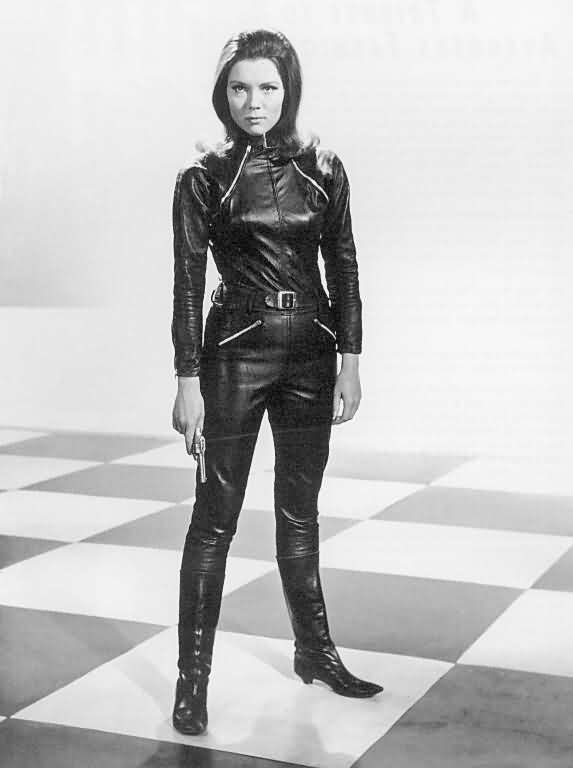
Actress and icon of cool Diana Rigg was born on this day in 1938 in Doncaster, England.

After a childhood spent in India, in 1957 Diana Rigg landed on the York Festival stage as "Natasha Abashwilli" in the Royal Academy of Dramatic Art production of Bertolt Brecht's Caucasian Chalk Circle. Soon afterward, she became a fixture of the Royal Shakespeare Company (e.g. as "Cordelia" in Peter Brook's production of King Lear), seemingly destined for a career of prestigious literary revivals.

When she left RSC in 1964 for a job on a jokey TV crime-fighter adventure series (replacing future Bond girl Honor Blackman), eyebrows raised. Critics sniffed, but with Rigg on board The Avengers (co-starring Patrick Macnee as "John Steed") became one of the most popular British entertainment exports of the 1960s. As "Mrs. Emma Peel," Rigg had "a disarming sexiness, the best leather wardrobe in the history of television and a mean karate chop" (R. Dougherty, Salon). She was a TV revolutionary, too, in the sense that she was a charming woman with a piercing intelligence, acting in a man's world and frequently bettering men at their own games, a woman whose judo moves and physical prowess enabled her to make an impact with her body without merely being a slinky sex kitten. Steed and Mrs. Peel also captured the essence of 1960s London as stylish, eminently civilized, sophisticated crime-fighters who traded clever bon mots and toasted their successes with champagne.

After The Avengers, Rigg made other passes at pop culture (as James Bond's only bride in On Her Majesty's Secret Service, 1967, with George Lazenby, and in her own NBC sitcom, Diana, 1973-4), but also cycled easily back from pop icon to the stage, always with that cool, rich voice and indelibly acute intellect -- starring, for example on London and/or on Broadway in Abelard and Heloise (1971, Tony nomination), Phaedra Britannica (London Theatre Critics best actress, 1975) and Medea (1994, best actress Tony). She returned to series television as the host of Mystery!, the PBS anthology series (replacing Vincent Price), in 1989, and did star turns in the miniseries Mother Love (1990) and Rebecca (1996, best supporting actress Emmy).

Labels: , ,

Tuesday, July 11, 2006

Home Run Derby & Celebrity Toss


There used to be a cheap little black-and-white TV show called Home Run Derby that ran from 1959 to 1961. Hosted by Mark Scott, it pitted sluggers againts other sluggers in head-to-head competition -- like Gil Hodges vs. Willie Mays. Every show would begin and end with an announcer naming a litany of baseball stars who'd appeared on the show or would appear on the show, capped off by the words ". . . and many others" -- leading many young schoolchildren to wonder, no doubt, when that Latin slugger, Manny Uthers, would be on the show. But -- it was the 50s, and the Latin slugger hadn't quite been invented yet in America.

The patter on the show was classic Americana. In a typical episode, exchanges such as the following could be heard:

Scott: Boy, Mickey, Kenny Boyer sure hit that ball a long ways.
Mickey Mantle: He certainly did, Mark.
That's back when America surely assumed that Mickey Mantle went home after the show was over and had cookies and milk.

I'd never have guessed that from this meager beginning, Major League Baseball's Home Run Derby would emerge, and that it would be so much fun to watch. Last night was the 21st anniversary of MLB's version, so I guess it has some staying power. In front of a packed PNC Park crowd, Ryan Howard of the Phillies came back from behind, after little David Wright of the Mets surprised the crowd with 16 dingers in the first round, beating Wright in the 3rd round with a monster homer to left-center that bounced off of a Master Card sign, awarding a lucky fan 500 free airplane flights. Howard and David Ortiz put several home run balls into the Allegheny River outside PNC Park, initiating an impromptu game of bobbing-for-baseballs among kayakers paddling nearby.
As a backdrop to the conspicuous display of slugging, there were plenty of celebrities around at which to gawk. Directly in front of our section sat the MLB big-wigs and their guests, including baseball commissioner Bud Selig, who apparently travels with a big guy who opens bottles for him and stuff; George Will and his family; Lynn Whitfield; and many others (not "Manny Uthers"). George is, of course, known to be one of the foremost baseball fans on Sunday morning TV, but he got so excited when he appeared in a film clip on the Jumbotron, talking about Ted Williams, that he jumped and pointed at it, apparently doing his best to convince his sons that he's all-that when it comes to baseball.
Speaking of all-that, before the game, Alyssa Milano put in a cameo appearance down near the dugouts, shilling a line of ladies' baseball gear, trading body-checks with Derek Jeter and posing for photos with fans. A line of ladies' baseball gear? Because . . . when you think of Alyssa Milano, you think of baseball -- right? Anyway, that's one appearance I was not too happy about. Somebody should tell me when there's a chance that Alyssa and I are going to the same party -- we're not currently speaking to each other. Don't ask me about it, it's just too painful to talk about.

Labels: , ,

Monday, June 12, 2006

Heidi Bowl


Novelist and children's writer Johanna Spyri was born Johanna Louise Heusser on this day in 1829 in Hirzel, Switzerland. She died on July 7, 1901 in Zurich.

Although Heidi (1880-1, in 2 parts), is considered to be one of Switzerland's best loved pieces of literature, her appeal has lost some its luster over the years. A TV adaptation of Heidi starring Maximilian Schell became the infamous focal point of a network TV gaffe on November 17, 1968 when, with 50 seconds to go in a football game between the Oakland Raiders and the New York Jets, NBC cut away from the game to its previously scheduled broadcast of Heidi; in less than 48 seconds, the Raiders came back from a 3-point deficit, scoring 2 touchdowns to beat the Jets 43-32. While Heidi crawled across a mountainside to reach her grandfather, an NBC message crawled beneath her across the screen announcing the result of the game. Outraged fans deluged the NBC switchboard with complaints, causing the NFL to include a "whole game" clause in future TV contracts.

The "Heidi Bowl" aside, a more recent film interpretation of Heidi by Markus Imboden (2001) depicts Heidi as an alienated modern latchkey kid, sending text messages and emails back and forth to her pal Peter and his friends at a Berlin cybercafe. Future Heidis will no doubt have all the web-enabled tools necessary to determine the final score of any NFL game.

Labels: , , ,

Sunday, June 04, 2006

The 2008 Race: Whither SNL?


This might only be a midterm election year, but recent experience tells us that the 2008 presidential campaign is probably already under way – even if the media is only covering it for a few minutes every Sunday morning. Heck, experience tells us that the 2008 presidential campaign has probably been under way since early last year.

Thus, it is not too early to begin to think about how Saturday Night Live will be man-handling the 2008 election. True, SNL ceded its primacy on the whoopee cushion at the nexus of "Presidential Politics" and "TV Comedy" to The Daily Show some time ago (if the news goes on for 24 hours a day, satires of the news should be going on at least 4 nights a week), and many people complain bitterly that SNL is not what it used to be. Well, the same goes for presidential politics. Nevertheless, SNL still has the power to surprise us – particularly when the SNL crew has among its ranks one or more gifted impersonators.

Some of the best presidential candidate impersonators of the last 30 years have been born on SNL. Even as recently as 2004, Seth Meyers' John Kerry was spot on – seeming to come out of nowhere from one of the new guys who didn't at that time seem all that promising – and while Jeff Richards' Howard Dean may have left a little to be desired, Darrell Hammond as Gephardt, Kenan Thompson as Al Sharpton and, of all people, Amy Poehler as Dennis Kucinich, were a hilarious set of caricatures.

Going back over the parallel histories of SNL and presidential campaigns since the show's inception in 1975, we see a variety of approaches to political impersonation. Of course, in the beginning (episode #4 of the first season, if you're counting), there was Chevy Chase doing President Gerald Ford. Chase's Ford wasn't so much an impression as the re-creation of a stock character -- the out-of-touch bumbler, Inspector Clouseau without the French accent and get-up -- a guise that fit Chase's comedic instincts like a glove. There was no attempt to make Chase look or sound like Ford – which was part of the joke. Here are the "Not Ready For Prime Time Players" – we have no budget for talented impressionists or elaborate make-up effects. We're just kids putting on a show.

Chase's Ford was funny because it played into the then prevailing perception of Ford, among both supporters and detractors, as someone who was out of his element in the presidency, and for whom nothing came easy. (Remember: "It was my understanding, that there would be no math in this debate.") The then-mustachioed Dan Aykroyd, who unlike Chase, was a gifted impressionist and character comic, was actually a perfect foil and a good follow-up to Chase's Ford with his own Jimmy Carter impersonation – with an easy smile, a pronounced comfort in his own skin, and a freakish command of obscure details (as in the "Ask President Carter" phone-in show with Bill Murray's Walter Cronkite, moving seamlessly from automated letter sorting systems to a form of "barrel-shaped" LSD called "orange sunshine"). By the end of the Carter administration, however, Aykroyd's impression became a scaffold for elaborate hemorrhoid jokes (i.e., a State of the Union address about the "constant swelling" of inflation). Aykroyd also did a decent Nixon, steeped in paranoia, but that was well after doing Nixon ceased to be a matter of topical humor. After Aykroyd, there was no returning to the Chevy Chase model of doing jokey non-impressions of political figures.

There would be no Carter-Reagan debate sketch, either. Instead, on one episode in 1980, we were treated to a sketch about various presidential primary hopefuls doing chores for a prospective Iowa caucus-goer. Neither Carter nor Reagan make an appearance there, but we did get an awfully nice Ted Kennedy from Bill Murray. (Phil Hartman's later Ted Kennedy is priceless, but to me, the edge goes to Murray; he played Kennedy with an air of familial earnestness -- like he grew up with Irish brothers, which he did.) The show's only impersonation of John Anderson came in a Weekend Update report, in which Charles Rocket tried to avoid telling Anderson (played by Joe Piscopo) that he had lost the 1980 election.

Chevy Chase did a Chevy Chase-model Ronald Reagan during the first season, playing unhip piano in a lounge somewhere, but there were fleeting Ronald Reagan portrayals throughout the 1980s – by Harry Shearer, Charles Rocket, Joe Piscopo, Randy Quaid and finally, by Phil Hartman. Hartman's Reagan was the first to show something underneath the laid-back exterior we were all familiar with: in "Reagan the Mastermind," Phil Hartman's Reagan turns out to have been putting all of us on, taking charge behind the scenes and losing patience with his lackeys, as well as with Jimmy Stewart (played by Dana Carvey). By and large, however, it has to be said that SNL gave Ronald Reagan a wide berth – as evidenced by the paucity of Reagan material to be seen in the quadrennial SNL political anthologies. (There's one appearance by Robin Williams as Reagan that I'd love to track down some day, though.)

The mid-1980s are always thought of as the weakest era for SNL (with fellows purportedly named Gary Kroeger and Tim Kazurinsky playing folks like Walter Mondale and Gary Hart), and it has to be said, it was a pretty weak decade for Presidential Politics as well. The 1984 Democratic primary cycle yielded few surprises as the decidedly non-caricaturable (i.e. bland) Mondale stroked his way to the nomination. SNL paused only briefly to survey the doomed candidacy of John Glenn, played by guest Tom Smothers; it was an icon of sorts playing an icon of sorts, the tongue-tied, subversive folksinger playing an astronaut-hero whose spacecraft had by that time drifted into political mediocrity. Mary Gross did put in a few appearances as a particularly perky Geraldine Ferraro, and various folks politely tried their hand with Jesse Jackson (among them, guest host Carl Weathers, in 1988) – all of which seems now like a missed opportunity.
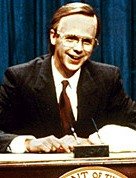
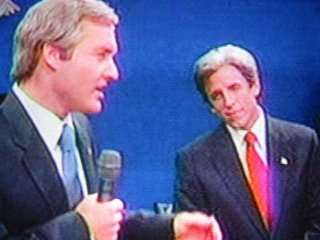
In 1988, with full-blown Republican and Democratic primary races, and a resurgent SNL (with a political humor course being set by the presence of Dennis Miller in the Weekend Update anchor chair), things started to click again. Before Dana Carvey started doing George H.W. Bush, most of the nation thought of Bush as Reagan's normal-guy, next-door-neighbor understudy, but Carvey drew out the previously unnoticed, or perhaps unarticulated quirks in Bush's delivery. Carvey's "Nah ganna daw" became as much of an identifier of the elder Bush as anything Bush's media team had ever devised; "read my lips" certainly didn't do the Bush team any favors.

While many of the candidate portrayals of that season are forgettable (Kevin Nealon seems to have been saddled to stand in as every white guy no one else wanted to do – from Biden to Gore to Pete DuPont to Lloyd Bentsen), some would occasionally rise above the middle, such as Al Franken, in his bow-tied Senator Paul Simon and his astonishing Lyndon LaRouche, or the idea of a child (Jeff Renaudo) showing up as the youthful Dan Quayle on five different episodes. Although the Gary Hart debacle dominated early primary coverage in 1988, SNL did not send up Hart directly; rather, they chose to send up Donna Rice (played by Nora Dunn and Victoria Jackson, successively), sidestepping Hart and displaying a perhaps not unexpected comedic double standard.
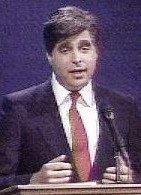
The 1988 SNL debate between George ("stay the course . . . a thousand points of light") Bush and Michael ("I can't believe I'm losing to this guy") Dukakis (played by "little swarthy" Jon Lovitz), however, was a classic – a reminder to the writers at SNL that political humor was really possible. With Carvey playing Bush, Phil Hartman playing a smooth Bill Clinton (with interludes featuring Al Franken as Paul Tsongas and Carvey as Jerry Brown) – and ultimately, Carvey playing Ross Perot, SNL found itself completely qualified to present itself as a wacky alternative universe to the wacky 1992 presidential campaign. The most memorable moment of SNL's mangling of the 1992 sojourn, however, was the Ross Perot drive in the country with Admiral Stockdale (played by Hartman again), with Perot critiquing Stockdale's debate performance using his favorite superlatives ("world class!") before dumping him out on the road.

Bill Clinton presented SNL with a ton of material, especially once the Lewinsky scandal was in full bloom. By that time, the gifted Darrell Hammond had taken over the role from Hartman, giving him a frat boy vibe that had been missing before, and that was perfectly in keeping with the circumstances. Standout sketches during this period would have to include the Bill-and-Hillary GAP commercials (with Hillary played by Ana Gasteyer), and, of course, Janet Reno's Dance Party, with Will Ferrell as the attorney general. The 1996 campaign yielded a few gems as well: with the outrageously funny David Koechner as Pat Buchanan, one of the great underrated SNL impersonations; Kids-in-the-Hall refugee Mark McKinney as a dead-ringer for Steve Forbes; Cheri Oteri filling in for Carvey as Perot; and finally, Norm MacDonald as Bob Dole in one of the most biting and ferocious of all SNL political impersonations. It showed extraordinary style and magnanimousness when the real Bob Dole showed up on SNL to stand alongside Norm as the fake, scary Bob Dole. MacDonald had played him throughout his run with Captain-Queeg-like mean-spiritedness in such classics as the 'Bob Dole on The Real World' sketches.

During the 2000 primaries, SNL didn't really know what to do with Bill Bradley or John McCain, but by the time the general election rolled around, political humor, and political impressions, were very nearly the raison d'etre of SNL. Will Forte, whose post-2000 George W. Bush has grown old faster than the real thing, did well during the 2004 campaign, but despite his talent as a performer (his 'Tim Calhoun' character is a scream), my vote will always be for Will Ferrell's Bush during 2000; his furrowed brows accomplished what no other Bush impersonator has accomplished by showing the slow-moving inner-mechanism of the man behind the podium ("Strategery!"). Not to be outdone, Darrell Hammond's Al Gore ("Lockbox") also hit the mark with precision, playing to Gore's unfortunate tendency during the 2000 campaign to put his intelligence out on patronizing display.

So, what happens in 2008? Forte's done, except for the fact that he was also the primary portrayer of John Edwards in 2004. Meyers might be back as Kerry; but most pundits are currently predicting that Amy Poehler will be getting a lot of juice out of Hillary Clinton, with Horatio Sanz doing a snapshot of Bill Richardson and as yet unnamed folks pitching in as Joe Biden, Evan Bayh and Mark Warner (where is Kevin Nealon when you need him?). Some people are hoping, however, that Hammond gets to dust off that old Al Gore wig. On the Republican side, we're in a bit of a fix. Among "front runners," there are no definitive John McCains, Rudolph Giulianis, George Allens, Bill Frists or Newt Gingriches in this crowd – let alone a Chuck Hagel or a Mitt Romney – although if Condi runs (improbable), we have the reliable Maya Rudolph on hand.

With no incumbent, no heir apparent, and contested primaries on both sides of the aisle, SNL may have to expand its cast to 20 or so regulars just to keep up. Or then again, maybe we can just rely on the real candidates to provide the laughs.

Labels: , ,

Tuesday, November 15, 2005

Spokesmammals


There's a TV commercial for a credit counselor that never ceases to make me laugh when I see it. Two women are standing near a water cooler, stationed incongruously in the middle of a green, placid field. One woman has a baboon on her shoulder, but she seems not to notice this. Instead, she is talking with her colleague about her beautiful, expensive jewelry. The colleague suggests that the woman should "do something" about the "debt monkey" she has on her back, but the woman merely blinks and says, "What monkey?"

OK, I'll admit it: I like seeing monkeys on TV. Let's face it, some people do. My wife, not so much -- but I truly used to enjoy those Tim Kazurinsky chimp sketches on SNL, as well as Lancelot Link, Secret Chimp and those ads for CareerBuilder.com, featuring one poor guy working with a bunch of chimps in an office. Call it a weakness.
I was surprised to learn the other night, however, that one of our friends, who works for a local film/TV production company, actually helped to produce the "debt monkey" ad. Her "backstory" of the ad was slightly fascinating. Pennsylvania apparently has a law that prohibits commercial activities in which certain exotic animals (baboons included, I guess) have contact with people who are not animal training or zoo professionals. Since actors in commercials are not exempt from this law, it is pretty much settled that no monkey commercials can be filmed in Pennsylvania.
Casting about for a nearby alternative, our friend called authorities in West Virginia, who apparently confirmed that anyone can do just about anything they want with a monkey in that fair state -- so the entire production crew, along with actors, baboon and baboon wranglers, drove south to an unnamed West Virginia college campus, where the ad was shot. (There was no particular reason for the ad to be set in a green, placid field, other than the fact that this was the ad agency's conception. I'd still like to see them in the office, personally.)
It's not as easy as you might think to put a baboon in your commercial, in case you were thinking of it. There was a list of rules provided by the trainer that the entire production staff had to abide by in order to keep from irritating the baboon, including avoiding eye contact with the baboon. The shoot went off without a hitch, however, as the baboon was apparently able to size up the situation quickly, determine the "Alpha male" status of the ad's director and roll with the director's whims.
The baboon shoot was a piece of cake, however, compared to a recent ad that our friend helped to produce for a Florida real estate developer. Playing on the theme of being an "environmentally friendly" developer, the ad shows squirrels and deer in a "white-room" background. For this ad, our friend sent for two "professional" squirrels, Louis and Millie, that were recently featured in the film Charlie and the Chocolate Factory. The squirrels, based in Florida, were flown to Pittsburgh in cages and brought to a South Side studio, ready for their close-ups. While they take direction decently enough, it has to be remembered that they are wild animals, a fact discernible in the scratches all over the neck and chest of the squirrels' professional handler.
Getting the deer for the shoot was a little more challenging. Apparently Pennsylvania has a law (of course they do) that prohibits the importation of live deer to the state, so our friend had to search around the state for captive, docile deer, and a sympathetic owner. In call after call, deer owners simply laughed at our friend, until one eastern Pennsylvania deer owner decided to step up to the plate, bringing her young bucks Robbie and Mikey to the South Side. Robbie and Mikey had never been in a commercial before, but acquitted themselves quite well under the circumstances, with some professional training help from the aforementioned scratched-up squirrel trainer. Our friend said they were as docile and friendly as puppies.
It does seem like a lot of trouble to get spokesmammals on camera, but I guess as long as dunderheads like me keep laughing at monkeys on TV, they'll be going to the trouble to do it.
Oh, and in case you are wondering, the squirrels stayed in a room at the Hilton before returning to Florida, but the deer had to be content to stay in a trailer in the parking lot while their owners stayed in a Greentree motel before making their return trip home.

Labels: , ,

Saturday, November 05, 2005

Trouble with Body Parts

British TV star Danniella Westbrook (born on this day in 1973 in Walthamstow, England) -- known to fans of EastEnders as "Sam Mitchell" (1990-3, 1995-6, 1999-2000) -- has had some notorious trouble with her body parts. She apparently had such a serious addiction to cocaine since the age of 14 that she snorted away the septum of her nose, leaving her with the ghastly appearance of having one nostril. The BBC dutifully filmed around her nose, shooting her from above to conceal the injury (and the habit), but all was revealed in June 2000 when she was photographed by a paparazzo leaving an awards ceremony. The next day, her nose and the extent of her habit were laid bare for all to see in the tabloids. By 2002, she was post-rehab and trying to put the episode behind her, permitting herself to be the subject of a scaring-straight Channel 4 documentary, Danniella Westbrook: My Nose and Me, and making plans for reconstructive surgery (which, by all accounts, was not going to be easy). In June 2002, however, tabloids reported that Danniella was rushed to the hospital after the rupture of one of her saline breast implants.

Some people might be better off locking themselves in Tupperware and only coming out for meals and work.

Labels: ,

Monday, October 31, 2005

Good Night, Good Luck -- and What’s Stephen Colbert Up To, Anyway?


George Clooney’s Good Night, and Good Luck reminds us that some of the best movies come from short stories rather than novels. Not that an actual short story was actually the inspiration of this film about CBS newsman Edward R. Murrow’s courageous battle against the witch-hunting tactics of Senator Joe McCarthy -- but the historical incidents which form the basis of Clooney’s little tale are far better suited to short-story treatment rather than being decked out in the trappings of an epic.

Writer/director Clooney (who also plays Fred Friendly, Murrow’s producer and later the sage convener of some lively and provocative televised seminars on journalism ethics) and co-writer Grant Heslov (who plays staffer Don Hewitt, later 60 Minutes’ producer) center most of the action of the film within the walls of one building, CBS’ Madison Avenue headquarters, over a span of what ultimately shakes out as several weeks during 1953 and 1954. The compressed space and schedule of storytelling within the film, of course, enhance the atmosphere of terror that must have pervaded the hallways of CBS, like many other corridors in America, during the height of McCarthy’s influence – the tension wafts through each pressure-cooked scene like the omnipresent cigarette smoke of each of the film's characters.

Yet the film still has the feel of an old newshound’s reminiscence over the aforementioned cigarettes and a few glasses of scotch – something which emerges from the depiction of the courtly camaraderie among the people in Murrow’s newsroom, and also from Dianne Reeves’ beautiful soundchecks (in which she sings such tunes as “Who’s Minding the Store,” “Straighten Up and Fly Right,” and “You’re Driving Me Crazy”), coming at natural resting spots along the way, commenting on the newsroom behind-the-scenes action with a kind of gleeful yet un-judgmental detachment, not unlike the way real New York reporters of yore might have commented on Washington behind-the-scenes action. She functions, in a way, as the reporter on the reporters.

The performances handily sell Clooney’s vision of the piece – David Strathairn’s Murrow is note for note correct, as dry and determined and alone as one would expect, and Ray Wise, as the pathetic news anchor Don Hollenbeck, manages to embody the pervading fear in his few scenes, smiling so hard it hurts behind eyes peeled back with gulping dread. The only misfire in the cast seems to have come in the form of documentary footage of Joe McCarthy – who, as one of my friends observes, is “just too over-the-top to be believable.”

A number of reviewers have observed that Good Night, and Good Luck’s depiction of the goings-on of a real TV newsroom is unrivalled, although I would submit that while its depiction of a newsroom that produces a show with the intelligence and integrity of Edward R. Murrow’s programs is spot-on, such activity in actuality bears little resemblance to what goes on in today’s TV newsrooms. In fact, it is much more likely that the activity in today’s newsrooms is better suited to turn out the kind of broadcast that Stephen Colbert parodies in his new 4-nights-a-week program, The Colbert Report, on Comedy Central.

While Jon Stewart’s Daily Show (of which Colbert is an alum) parodies a newscast, Colbert is taking on the Alpha-male, self-righteous commentators that take up space between news breaks on cable news networks. But mostly, he’s taking on Bill O’Reilly -- because, let’s face it, O’Reilly’s the ripest of the bunch.

Colbert is a deft and clever writer, and as a performer, he manages to carry off his portrayal of “Stephen Colbert, host” without the slightest wink to his true identity. It’s a fearless approach, a real high-wire act, that makes his show much more akin to the productions of Ali G than of Jon Stewart – and while critics seem to love what’s going on, as quickly as they give praise they wonder if it all can be sustained.

Jon Stewart’s success came as a complete surprise to those who watched him fill the shoes of The Daily Show’s founding “anchor,” Craig Kilborn. In fact, however, it was Kilborn’s stridently detached hipness – all sarcasm, without the mitigating goofiness of Kilborn’s progenitor, David Letterman – that shut down Kilborn after he left The Daily Show. Stewart showed up Kilborn by being a genuinely good-natured human being and by permitting himself to be humiliated from time to time. He is also, unexpectedly to those of us who had our doubts (recalling his ill-fated tenure at MTV), a consummate performer of the old school – a superior mimic, and a take-artist to out-Benny Jack Benny.

So far, Colbert’s real strength comes as an interviewer. In a recent segment with CNN’s Lou Dobbs, Colbert ran roughshod over Dobbs’ pet issues – immigration and outsourcing – by suggesting to him that the U.S. should just outsource all those jobs that those illegals keep coming here for. Even Dobbs had to laugh. Colbert’s schtick -- which combines a singleness of satiric purpose with a disarming (though non-winking) playfulness -- does require otherwise serious people to play along, but when it happens, it is as satisfying as anything on TV these days.

I do not worry so much about Colbert’s ability to keep his on-screen characterization afloat over the long term. I worry more about the defensive humorlessness of those he would hope to book for his show. While Stephen Colbert is having as much fun as anyone should be allowed to have on TV, I can imagine that his booking agent is walking around looking like Ray Wise as Don Hollenbeck in Good Night, and Good News – dodging the post-McCarthyite terror and precious image management that pervades American political TV today.

Labels: , ,