Saturday, March 29, 2008

Barack Obama at Greensburg Town Hall Meeting

... on March 28, 2008, at the Hempfield Area High School gymnasium.


Labels: , , ,

Sunday, June 04, 2006

The 2008 Race: Whither SNL?


This might only be a midterm election year, but recent experience tells us that the 2008 presidential campaign is probably already under way – even if the media is only covering it for a few minutes every Sunday morning. Heck, experience tells us that the 2008 presidential campaign has probably been under way since early last year.

Thus, it is not too early to begin to think about how Saturday Night Live will be man-handling the 2008 election. True, SNL ceded its primacy on the whoopee cushion at the nexus of "Presidential Politics" and "TV Comedy" to The Daily Show some time ago (if the news goes on for 24 hours a day, satires of the news should be going on at least 4 nights a week), and many people complain bitterly that SNL is not what it used to be. Well, the same goes for presidential politics. Nevertheless, SNL still has the power to surprise us – particularly when the SNL crew has among its ranks one or more gifted impersonators.

Some of the best presidential candidate impersonators of the last 30 years have been born on SNL. Even as recently as 2004, Seth Meyers' John Kerry was spot on – seeming to come out of nowhere from one of the new guys who didn't at that time seem all that promising – and while Jeff Richards' Howard Dean may have left a little to be desired, Darrell Hammond as Gephardt, Kenan Thompson as Al Sharpton and, of all people, Amy Poehler as Dennis Kucinich, were a hilarious set of caricatures.

Going back over the parallel histories of SNL and presidential campaigns since the show's inception in 1975, we see a variety of approaches to political impersonation. Of course, in the beginning (episode #4 of the first season, if you're counting), there was Chevy Chase doing President Gerald Ford. Chase's Ford wasn't so much an impression as the re-creation of a stock character -- the out-of-touch bumbler, Inspector Clouseau without the French accent and get-up -- a guise that fit Chase's comedic instincts like a glove. There was no attempt to make Chase look or sound like Ford – which was part of the joke. Here are the "Not Ready For Prime Time Players" – we have no budget for talented impressionists or elaborate make-up effects. We're just kids putting on a show.

Chase's Ford was funny because it played into the then prevailing perception of Ford, among both supporters and detractors, as someone who was out of his element in the presidency, and for whom nothing came easy. (Remember: "It was my understanding, that there would be no math in this debate.") The then-mustachioed Dan Aykroyd, who unlike Chase, was a gifted impressionist and character comic, was actually a perfect foil and a good follow-up to Chase's Ford with his own Jimmy Carter impersonation – with an easy smile, a pronounced comfort in his own skin, and a freakish command of obscure details (as in the "Ask President Carter" phone-in show with Bill Murray's Walter Cronkite, moving seamlessly from automated letter sorting systems to a form of "barrel-shaped" LSD called "orange sunshine"). By the end of the Carter administration, however, Aykroyd's impression became a scaffold for elaborate hemorrhoid jokes (i.e., a State of the Union address about the "constant swelling" of inflation). Aykroyd also did a decent Nixon, steeped in paranoia, but that was well after doing Nixon ceased to be a matter of topical humor. After Aykroyd, there was no returning to the Chevy Chase model of doing jokey non-impressions of political figures.

There would be no Carter-Reagan debate sketch, either. Instead, on one episode in 1980, we were treated to a sketch about various presidential primary hopefuls doing chores for a prospective Iowa caucus-goer. Neither Carter nor Reagan make an appearance there, but we did get an awfully nice Ted Kennedy from Bill Murray. (Phil Hartman's later Ted Kennedy is priceless, but to me, the edge goes to Murray; he played Kennedy with an air of familial earnestness -- like he grew up with Irish brothers, which he did.) The show's only impersonation of John Anderson came in a Weekend Update report, in which Charles Rocket tried to avoid telling Anderson (played by Joe Piscopo) that he had lost the 1980 election.

Chevy Chase did a Chevy Chase-model Ronald Reagan during the first season, playing unhip piano in a lounge somewhere, but there were fleeting Ronald Reagan portrayals throughout the 1980s – by Harry Shearer, Charles Rocket, Joe Piscopo, Randy Quaid and finally, by Phil Hartman. Hartman's Reagan was the first to show something underneath the laid-back exterior we were all familiar with: in "Reagan the Mastermind," Phil Hartman's Reagan turns out to have been putting all of us on, taking charge behind the scenes and losing patience with his lackeys, as well as with Jimmy Stewart (played by Dana Carvey). By and large, however, it has to be said that SNL gave Ronald Reagan a wide berth – as evidenced by the paucity of Reagan material to be seen in the quadrennial SNL political anthologies. (There's one appearance by Robin Williams as Reagan that I'd love to track down some day, though.)

The mid-1980s are always thought of as the weakest era for SNL (with fellows purportedly named Gary Kroeger and Tim Kazurinsky playing folks like Walter Mondale and Gary Hart), and it has to be said, it was a pretty weak decade for Presidential Politics as well. The 1984 Democratic primary cycle yielded few surprises as the decidedly non-caricaturable (i.e. bland) Mondale stroked his way to the nomination. SNL paused only briefly to survey the doomed candidacy of John Glenn, played by guest Tom Smothers; it was an icon of sorts playing an icon of sorts, the tongue-tied, subversive folksinger playing an astronaut-hero whose spacecraft had by that time drifted into political mediocrity. Mary Gross did put in a few appearances as a particularly perky Geraldine Ferraro, and various folks politely tried their hand with Jesse Jackson (among them, guest host Carl Weathers, in 1988) – all of which seems now like a missed opportunity.
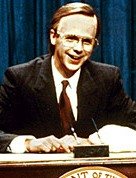
In 1988, with full-blown Republican and Democratic primary races, and a resurgent SNL (with a political humor course being set by the presence of Dennis Miller in the Weekend Update anchor chair), things started to click again. Before Dana Carvey started doing George H.W. Bush, most of the nation thought of Bush as Reagan's normal-guy, next-door-neighbor understudy, but Carvey drew out the previously unnoticed, or perhaps unarticulated quirks in Bush's delivery. Carvey's "Nah ganna daw" became as much of an identifier of the elder Bush as anything Bush's media team had ever devised; "read my lips" certainly didn't do the Bush team any favors.

While many of the candidate portrayals of that season are forgettable (Kevin Nealon seems to have been saddled to stand in as every white guy no one else wanted to do – from Biden to Gore to Pete DuPont to Lloyd Bentsen), some would occasionally rise above the middle, such as Al Franken, in his bow-tied Senator Paul Simon and his astonishing Lyndon LaRouche, or the idea of a child (Jeff Renaudo) showing up as the youthful Dan Quayle on five different episodes. Although the Gary Hart debacle dominated early primary coverage in 1988, SNL did not send up Hart directly; rather, they chose to send up Donna Rice (played by Nora Dunn and Victoria Jackson, successively), sidestepping Hart and displaying a perhaps not unexpected comedic double standard.
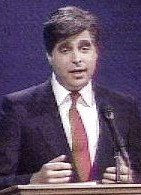
The 1988 SNL debate between George ("stay the course . . . a thousand points of light") Bush and Michael ("I can't believe I'm losing to this guy") Dukakis (played by "little swarthy" Jon Lovitz), however, was a classic – a reminder to the writers at SNL that political humor was really possible. With Carvey playing Bush, Phil Hartman playing a smooth Bill Clinton (with interludes featuring Al Franken as Paul Tsongas and Carvey as Jerry Brown) – and ultimately, Carvey playing Ross Perot, SNL found itself completely qualified to present itself as a wacky alternative universe to the wacky 1992 presidential campaign. The most memorable moment of SNL's mangling of the 1992 sojourn, however, was the Ross Perot drive in the country with Admiral Stockdale (played by Hartman again), with Perot critiquing Stockdale's debate performance using his favorite superlatives ("world class!") before dumping him out on the road.

Bill Clinton presented SNL with a ton of material, especially once the Lewinsky scandal was in full bloom. By that time, the gifted Darrell Hammond had taken over the role from Hartman, giving him a frat boy vibe that had been missing before, and that was perfectly in keeping with the circumstances. Standout sketches during this period would have to include the Bill-and-Hillary GAP commercials (with Hillary played by Ana Gasteyer), and, of course, Janet Reno's Dance Party, with Will Ferrell as the attorney general. The 1996 campaign yielded a few gems as well: with the outrageously funny David Koechner as Pat Buchanan, one of the great underrated SNL impersonations; Kids-in-the-Hall refugee Mark McKinney as a dead-ringer for Steve Forbes; Cheri Oteri filling in for Carvey as Perot; and finally, Norm MacDonald as Bob Dole in one of the most biting and ferocious of all SNL political impersonations. It showed extraordinary style and magnanimousness when the real Bob Dole showed up on SNL to stand alongside Norm as the fake, scary Bob Dole. MacDonald had played him throughout his run with Captain-Queeg-like mean-spiritedness in such classics as the 'Bob Dole on The Real World' sketches.

During the 2000 primaries, SNL didn't really know what to do with Bill Bradley or John McCain, but by the time the general election rolled around, political humor, and political impressions, were very nearly the raison d'etre of SNL. Will Forte, whose post-2000 George W. Bush has grown old faster than the real thing, did well during the 2004 campaign, but despite his talent as a performer (his 'Tim Calhoun' character is a scream), my vote will always be for Will Ferrell's Bush during 2000; his furrowed brows accomplished what no other Bush impersonator has accomplished by showing the slow-moving inner-mechanism of the man behind the podium ("Strategery!"). Not to be outdone, Darrell Hammond's Al Gore ("Lockbox") also hit the mark with precision, playing to Gore's unfortunate tendency during the 2000 campaign to put his intelligence out on patronizing display.

So, what happens in 2008? Forte's done, except for the fact that he was also the primary portrayer of John Edwards in 2004. Meyers might be back as Kerry; but most pundits are currently predicting that Amy Poehler will be getting a lot of juice out of Hillary Clinton, with Horatio Sanz doing a snapshot of Bill Richardson and as yet unnamed folks pitching in as Joe Biden, Evan Bayh and Mark Warner (where is Kevin Nealon when you need him?). Some people are hoping, however, that Hammond gets to dust off that old Al Gore wig. On the Republican side, we're in a bit of a fix. Among "front runners," there are no definitive John McCains, Rudolph Giulianis, George Allens, Bill Frists or Newt Gingriches in this crowd – let alone a Chuck Hagel or a Mitt Romney – although if Condi runs (improbable), we have the reliable Maya Rudolph on hand.

With no incumbent, no heir apparent, and contested primaries on both sides of the aisle, SNL may have to expand its cast to 20 or so regulars just to keep up. Or then again, maybe we can just rely on the real candidates to provide the laughs.

Labels: , ,

Thursday, October 20, 2005

The Newt Gingrich Candidacy


While everyone else seems to be awaiting the shoes to drop in the Plame Leak investigation, I sit around thinking about 2008. In my spare time. Typically at 3 a.m. during a sleepless night.

Call it inspiration, call it nocturnal spasms, or call it evidence of brain atrophy – but I actually know who the Republican presidential nominee in 2008 will be -- barring a cataclysmic event, like a new vice president or something. And, be certain, dear readers, I will deny this if reminded of it in harsh circumstances come the summer of 2008. I may even have occasion to deny this next week.

The 2008 Republican presidential nominee will be Newt Gingrich. Listen to the pin dropping, folks.

Here are my top 4 reasons why Newt is It for 2008:

1. He’s Tan, He’s Rested, He’s Ready: Newt has been out of office and out of the limelight since 1999. While he had high negative poll ratings nationally at various times during his Speakership (i.e. 60%+ thought he may have been the spawn of the devil), he’s been filing down his horns -- his recent ubiquitous TV appearances as humble elder statesman and commentator have softened his image. It took Nixon 8 years to live down his red-baiting, Checkers-speechin’, used-car-salesman image as Eisenhower’s veep; it took Reagan 12 years to live down his reputation as a cranky political fluke with his last minute abortive run for the nomination in 1968 – but they did it, and they managed to look like the most statesman-like alternatives by the time they ascended to the Republican nomination. Like Churchill, each of them spent their time “in the wilderness” after a moment of public failure, writing and observing, before returning from isolation and reaching their zeniths as leaders. Gingrich appears to be laboring through the same mythologies.

2. He’s the Last Big Man Standing from the pre-Bush Age: Bush’s victory was considered a victory for conservatives in 2000, but here in 2005, you’ll hear a number of conservatives confess their disappointment with Bush and his team: in their eyes, Bush has become a big deficit spender who hasn’t thrown many bones to his base on social issues, and he has squandered the capital he might have used on fiscal reform, tort reform and social security reform on a poorly executed Iraq War. As numerous would-be candidates for the Republican nomination position themselves vis-à-vis the questionable Bush legacy -- either by running to the Left (McCain or Hagel, for example) or by maintaining their loyalty and arguing that things are better than you think (George Allen or Santorum), both of which are potentially risky strategies in a Republican primary campaign – Gingrich is an outsider today. As a leader of the Republican Revolution in Congress and progenitor of the 1994 midterm election watershed moment, the “Contract with America,” Gingrich may stand alone to the Republican base as an icon of pre-George W. Bush, politically-effective, conservative achievement.

3. He’s Preparing to Run to the Center: Was I nuts, or did I see Newt standing shoulder to shoulder with Hillary Clinton talking about health care technology? No, I wasn’t nuts, because it happened earlier this year – and as often as a TV talking head would use it as evidence of Hillary Clinton preparing to run to the center, where she needs to be once she is the Democratic nominee, I was thinking that Newt was using it for the same purpose. He’s recently begun staking out ground on the “progressive” issue of health care reform, proposing personal health care accounts and a version of universal insurance coverage by which he no doubt hopes to steal thunder from Democrats.

4. He Wants It: Gingrich has been spending a lot of time in Iowa and New Hampshire promoting his book, Winning the Future: A 21st Century Contract with America (aren’t all presidential candidates required to write books just before the campaign?). Asked last week if he was gearing up for a 2008 candidacy, he replied, “There are circumstances where I will run . . . My hope is that five or six candidates are going to jump up, steal all of my ideas, and I will be able to relax and go golf.” Funny, but I’ve never thought of Gingrich as a golfer. This all sounds a lot less like a cordial threat than a full-bore promise.

Labels: ,

Wednesday, October 12, 2005

A Few Bugs Here and There


On Monday, it was announced that the Republican National Committee had hired Patrick Ruffini to serve as its "eCampaign director," ostensibly to run the Party's website GOP.com.

Patrick has been the proprietor of a very useful website called 2008 Presidential Wire, which I have as a featured link on this blog. 2008 Presidential Wire is a mechanized web-wire service which apparently automatically picks up blog and mainstream media coverage of some 30 or so Democratic and Republican potential 2008 presidential candidates.

Yesterday, there was a headline on 2008 Presidential Wire that caught my eye: "Oak Creek Boy Dies When Stove Falls On Top Of Him." That's certainly an unusual headline for an article about a potential presidential candidate, I thought, so I couldn't resist checking it out. The article reads as follows:

An Oak Creek toddler died under a stove over the weekend. . . "We're looking at the possibility if there was neglect involved at any point that could have prevented this from happening," Oak Creek Police Lt. John Edwards said. . .

It is a tragic story, but one that I predict will not figure prominently in the 2008 race, unless it is determined that former U.S. Senator and Democratic veep candidate John Edwards is now moonlighting with the Oak Creek Police. I can't say I've seen too much of Mr. Edwards of late, so nothing would surprise me.

Today, there's another interesting one, listed as an article about Sen. George Allen, from my own backyard: "New Kensington Man Jailed for Alleged Stabbing." This one features the following:

Police say 44-year-old George Allen Jackson is charged with aggravated assault and reckless endangerment.

With or without the bugs, we wish Mr. Ruffini good luck in his new role with the RNC website.

John Edwards articles on 2008 Presidential Wire
George Allen articles on 2008 Presidential Wire

Labels: ,

Wednesday, October 05, 2005

'West Wing' to Test Market Immigration for 2008


Apparently on this Sunday’s episode of The West Wing, Senator Arnold Vinick, the Republican nominee for president (played by Alan Alda) will be confronting Congressman Matt Santos, the Democratic nominee (played by Jimmy Smits) on the issue of immigration. Santos’ inability to respond is complicated by the fact that Santos is a Latino, and for Latinos especially, the issues swirling around immigration are anything but simple.

It could be an instance of “art anticipating life.” Immigration could very well be one of the key “sleeper” issues of the 2008 race.

The U.S. currently accepts approximately 1 million legal immigrants and about 400,000 illegal immigrants each year. These numbers are not insignificant – they drive population growth in the U.S. more than any other factor, with the result that if present trends continue, the population of the U.S. is likely to be around 400 million by 2050.

The power of immigration reform as an issue derives from its ability to blow away bold ideological lines. It is the type of emotionally-charged issue that divides right from right and left from left. A few stereotypes may illustrate the point:
The Xenophobic Right: There has been a small but vocal class of conservative that has always argued for harsh restrictions on immigration, only thinly veiling its contempt for non-Protestant Western Europeans, from the Know-Nothings onward.

The Chamber of Commerce: Big business has always valued cheap labor, and immigrants, whether legal or excused illegal, tend to provide it in big numbers.

Old Liberalism: “Give me your tired, your poor, your huddled masses yearning to breathe free.” The old liberal guard believes strongly in the U.S. as a magnet for the oppressed around the world, and in multi-culturalism as a desirable aim.

The Eco-centric Left: “We live in a world of limited resources, and while we like to think of ourselves as invincible, the U.S. cannot withstand this rate of population growth for long.”

Populists always seem to thrive in a transcendent ideological meta-universe – but protectionist voices from both the right and the left have been heard to chant of late, “Stop letting in people who take jobs away from Americans,” which in some quarters can sound a bit like “Quit sending in all the foreign scab labor and defeating union strength even more.”

Classic liberals and big industry would seem to share some common ground as “open border supporters,” creating a fat, moderate middle-ground that should eclipse the extremes – the “hard-liners.” In 2008, however, that fat middle-ground may be compromised by the existence of two other circumstances – a continued decline in manufacturing jobs in the U.S., and the long shadow of 9/11. Such circumstances may, in fact, be responsible for awakening a sleeping giant.

Recent polls have suggested that the number of people who would like to see legal immigration reduced from current levels is climbing, with older Americans (those who typically vote in the highest concentrations) taking the hardest line against both legal and illegal immigration. (See the Hamilton College Immigration Survey, 2003, and the RoperASW Poll for Negative Population Growth, 2003). Much of the underlying polling suggests that post-9/11 security fears are driving public opinion in this direction.

Matt Santos’ ambivalence on the immigration issue in The West Wing reflects a divide among Latinos in the real world. The recent Pew Hispanic Center Poll finds that 34% of Latinos who were born in the U.S. believe that illegal immigrants hurt the economy (compared to 15% of foreign-born Latinos), and that only 55% of U.S.-born Latinos agree that illegal immigrants help the economy (compared to 76% of foreign-born Latinos). The Pew Poll summarizes: “Although an overwhelming majority of Hispanics express positive attitudes about immigrants, relatively few Hispanics favor increasing the flow of legal immigration from Latin America and a significant minority, concentrated among native-born Latinos, is concerned that unauthorized migrants are hurting the economy” -- suggesting that sticking to an “open borders” policy is not a slam dunk when it comes to wooing likely Latino voters.

The first and perhaps most interesting test on immigration views will no doubt arise in the Republican Party, where President Bush has taken a number of “open border” stances, including a proposal to provide legal status to 8 million illegal immigrants as “temporary workers.”

Where do some of the likely Republican candidates stand?

In George Allen’s home state of Virginia, immigration has been brought to the fore by Republican gubernatorial candidate Jerry Kilgore, who strongly denounced a tax-supported hiring center for day laborers, many of whom are assumed to be illegal aliens -- an opportunistic response to the rapid growth in immigrants in Northern Virginia. Democratic candidate Tim Kaine has called the hiring center a local matter, but suggests in a more measured way that the federal government is not doing its job in securing the borders. Kilgore is currently leading in the polls. Allen himself has been a “Chamber of Commerce” supporter of immigration and foreign workers, voting in favor of and co-sponsoring bills aimed at increasing foreign workers in the U.S., while supporting some border patrol augmentations and denying amnesty to illegal agricultural workers. While he is often acclaimed as the ideological heir-apparent to President Bush, it will be interesting to see if Allen’s Senate re-election run in 2006 will be affected by the recent dialogue on immigration reform within Virginia.

John McCain, whose home state is of course a border state, is currently co-sponsoring a bill with Ted Kennedy called the “Secure America and Orderly Immigration Act,” providing for the acceptance of 400,000 foreign workers in the U.S. each year, calling for specific protocols for dealing with illegal aliens (steep fines, followed by background checks, passage of an English exam and then amnesty), and stiffer punishment for employers who hire undocumented aliens. Although hard-liners are denouncing the bill as weak on border control, the move represents McCain’s effort to get in front on an issue that has plagued him to some degree within his own state and the Arizona Republican Party.

Prior to 9/11, Rudolph Giuliani was an “open border” politician in the classic liberal tradition, even going so far as mayor of New York City to sue the federal government to halt the practice of turning in illegal immigrants who seek government services such as police protection, hospital care and public education. Although it is an emotional issue for him, Giuliani is unlikely to want to damage his standing as a “homeland security” icon by making “open borders” a priority. If he enjoys front-runner status at any time during the primary campaign, watch his opponents go after him on this issue.

Massachusetts was the only state to lose population in 2004, although immigrants settling in Massachusetts kept the state from experiencing a decline in population for each of the previous four years. Mitt Romney has adopted several measures to ease transitions for foreign-born residents, including increasing state adult basic education funding for non-English speakers. Although he has gone on record stating he desires more immigrants to move to Massachusetts, he states that he is for “less illegal immigration” and that he recognizes the serious issues faced by state governments in California and Arizona, which will allow him to adopt some hard-line positions, if he chooses.

Sam Brownback, the Kansas senator and chair of the Senate Committee on Immigration, although a conservative, is perhaps the most "open" of any of these candidates on immigration. Possessed of an almost uniformly “open border” voting record, Brownback states that “the country grows on immigration,” describing it as essential to restoring vitality to de-populated areas of the U.S. He has backed plans to provide individual states with the authority to sponsor various types of immigrants including physicians, registered nurses and investors, and believes that the U.S. should be accepting a greater number of refugees, stating that U.S. refugee policy has not treated Africans fairly.

Although most of the likely candidates fall into the fat, though perhaps shrinking, moderate middle of this issue, one can easily imagine that immigration reform will become a flanking issue for independents and conservatives within the party, giving the opportunity for a trailing candidate to make hay at the expense of a front-runner.

It will be interesting to see how each of the Republican candidates plays his or her immigration cards in preparation for such flanking maneuvers as the 2008 race develops.
For further analysis, and the Democratic side of things, see "Democrats gain edge on border security" (Arizona Republic, 8/18/2005).

Labels: , ,
