Thursday, July 19, 2007

Parley Christensen


Parley P. Christensen was born on this day in 1869 in Weston, Idaho.

A Cornell law graduate, Christensen became the youngest ever county attorney for Salt Lake County, Utah, and was a prominent Republican organizer until 1912, when he defected to Theodore Roosevelt's Progressive or "Bull Moose" Party. In the aftermath of Roosevelt's defeat that year, Christensen found himself aligned with pro-labor independents, and as a founder of the Utah Labor Party became a staunch defender of members of the International Workers of the World (IWW, or Wobblies) against politically-motivated criminal charges brought against them during the period.

At the first convention of the Farmer-Labor Party in 1920, Christensen was nominated for president, and he campaigned largely on the platform of establishing the 8-hour work day, disarming the U.S. and nationalizing basic industries, but also prominently supported the release of political prisoners such as his rival, Socialist presidential candidate Eugene Debs, who had been imprisoned for sedition after giving a speech criticizing U.S. government crackdowns against political dissenters. More leftists saw fit to vote for Debs himself as the "real deal" rather than for Christensen; Christensen polled 265,411 votes (mainly in Montana, South Dakota and Washington) to Debs' 919,799 as Warren Harding easily won the election.

After a tour of Europe which included a meeting with V.I. Lenin, Christensen settled briefly in Chicago, where he ran for U.S. Senate as the candidate of the Illinois Progressive Party in 1926. Shortly thereafter he moved to California where he became involved in Upton Sinclair's campaign for governor in 1934, and eventually served as the most liberal member of the Los Angeles City Council (1935-37 and 1939-49), until he was defeated from the left by Edward Roybal, the first hispanic to be elected to Council since the 1880s. Christensen died on February 10, 1954 in Los Angeles.


Labels: , ,

Tuesday, February 27, 2007

12 Eateries in 12 Months, Part II


See Part I.
7. I grew up on rustic Southern California Mexican food, prepared by little old ladies in stifling kitchens inside little old East-of-East-LA holes-in-the-wall, so I’m always a little amused these days at how gentrified the whole Mexican cuisine scene has become. A happy case in point, though … tucked away near the Back Bay of Newport Beach -- in a strip mall, no less -- is a brightly-decorated and cozy joint called Taco Rosa. It’s really quite unpretentious; even if it claims to purvey “Spanish, French and Southwestern” food, it is mostly imaginative pan-Mexican cuisine, bursting at the seams with fresh ingredients and interesting taste combinations, from Oaxacan Pollo en Mole to Yucatanean Baked Carnitas Pibil to coastal Escabeche (pickled vegetable salad). Although the owners of Taco Rosa go to great lengths to remind people that Mexican cuisine is more than just tacos, burritos and enchiladas, their handling of the standard fare is pretty irresistible. One great favorite that my wife enjoyed is the Burrito Arizona, comprised of lobster, sautéed with spinach, mushrooms, red onions and tomatoes, wrapped in a whole wheat tortilla and topped with chipotle guajillo, tomatillo and tequila lime cream sauces.

8. We’re always a little skeptical of restaurants with great views – as a rule, they don’t have to try as hard in the kitchen if they know the view will keep ‘em coming. Along California’s Highway 1, however, there is a beautiful vista around every bend -- and yet, when we must eat, we must eat. Fortunately, Nepenthe is a wonderful exception to the rule. Situated high atop an 800-foot Big Sur ocean overlook, Nepenthe is built on the site of an impromptu World War II-era picnic that turned into a real estate deal for two Hollywood newlyweds, Orson Welles and Rita Hayworth. They grew tired of it, and each other, before much could come of it; so they sold it to the enterprising Fassett family, who hired Frank Lloyd Wright apprentice Rowan Maiden to build them a beautiful romantic retreat, from which they opened their restaurant in 1949. The fare is fresh and unfussy; specialties include the fat Ambrosiaburger and a pair of great salads, the Heirloom Tomato and Mozzarella Salad (with mache, frisee and arugula, dressed with sweet corn and basil vinaigrette) and the Three-Way Salad (a combination of garbanzo-bean salad, cole slaw and tossed greens; though they won’t say it, I suspect that the concept must have been inspired by the predilections of Nepenthe’s famous neighbor, writer Henry Miller). The wife enjoyed a house-cured salmon plate, and we both found Nepenthe’s Basket of Fries to be the perfect snack before hitting the rest of that great winding road.

9. Who goes to Napa Valley for the food? It’s a fair point; but nevertheless, amid the beautiful vineyards, there’s some pretty darn good meals to be had. I had an Ahi Tuna Salad at the Rutherford Grill (a cousin of Gulfstream, one of our Newport Beach favorites) that I’d be happy to nominate for salad of the year. However, the main attraction around these parts is the venerable La Toque, the intimate Country Cal-French restaurant that is attached to the Rancho Caymus Inn in Rutherford. For people who love good wine and love good food, the innovative wine-and-food pairing experience is heavenly: a five course prix-fixe menu (six, if you count the optional cheese course, which we did), with each course accompanied by a wine specially-chosen by in-house sommelier Scott Tracey. Although we love Napa wines, we were also pleasantly surprised to see Tracey going off the reservation, occasionally pairing our courses with a French sauterne or an Austrian Brundlmayer when the spirit moved him. The wife had the Tomato Soup, Marinated Black Cod, Ravioli topped with White Truffle (shaved tableside with much ceremony), Kobe Beef and Chocolate Gateau; while I had the Foie gras, the Cod, Twice-Cooked Pork, Salmon with Polenta Fries and the Apple Galette Tort with Buttermilk Ice Cream. And we both had a really good night’s sleep afterwards.

10. Just after Thanksgiving we gathered the whole clan (22 of us, if I’m counting correctly) for a celebration of my wife's grandfather’s 90th birthday at Steve and Cookie’s, in Margate, New Jersey, on the bay side of the island. The food is no-nonsense – crab cakes, steak, meatloaf – and we opted for set menu (a choice between filet mignon and salmon), a boatload of wine, and numerous fulsome toasts to the health of the fellow who will no doubt outlive us all. When the wife looks around the place, inevitably she thinks of christenings, showers, friends’ weddings … sometimes a restaurant can be a favorite simply because it has become an extension of your household. In a similar vein, the family has come to rely on Dino’s Sub & Pizza, a few blocks away, as an extra set of kitchen hands. No idea what to have for lunch? Let’s order subs. Lizanne’s coming in from Boston? Let’s order subs. Hangover this morning? Let’s order subs. The wife likes the grilled veggie with provolone, while I usually opt for the cheesesteak with grilled onions, both with lots of hot peppers on the side.


11. We couldn’t find a mediocre meal in Asheville, North Carolina earlier this month. Limone’s, a Mexican-Californian joint on Eagle Street, offered a giant selection of Tequilas, and a tasty entremesa of Goat Cheese Poblano Pepper Empanadas, while the Sunny Point Café seems to be Asheville’s definitive breakfast place, featuring locally-grown goods, a mellow bohemian clientele, a killer Pecan-Encrusted Fried Green Tomato Sandwich and life-affirming plates of Huevos Rancheros. (We were tempted by the Sunny Point Oatmeal Brulle and the Cocoanut Pancakes, but it was just the wrong time of day for a smorgasbord.) One of the other bright spots was a breezy little bistro in Biltmore Village called Fig, which co-owner Treavis Taylor told us stands for “Food is Good.” And it is: a contemporary blend of French, American and Italian tastes, we had Mussels in a Curry Broth, Lemon Risotto with Rock Shrimp, Free-Range Chicken Breast over Lemon-Lime Cous Cous, and Fried Veal Sweetbreads, all accompanied by an excellent wine list and a friendly, informative staff.

12. For my birthday this year, we had dinner with good friends at one of my favorite Pittsburgh area restaurants -- Vivo, a small, romantic BYOB Italian restaurant situated in the unlikeliest of locales, the bland and unassuming North Pittsburgh neighborhood of Bellevue. Once inside, you can easily forget that you’re on a street otherwise populated by an inordinate number of funeral homes and chiropractors; comfy chairs, muted lighting and terracotta-washed walls covered with black-and-white family photos give us the feeling of having a meal in someone’s old Italian rowhouse. The menu is a waitress’ unprinted monologue of seven starters and seven entrees that changes daily, and the overall experience features the appetizer course (we had Fresh Oysters and a splendid Three-Mushroom and Chorizo concoction), then a small plate of pasta, followed by the entrée (among our crew, there was veal, lobster, lamb and beef, each prepared with personality and panache) and the salad course. Side dishes are served with the entrée at room temperature, antipasto style, and on the night we were there, chef/owner Sam DiBattista had outdone himself with the Wheat Berries and the Green Beans. We capped our meal with a dessert of berries and cannoli filling pressed between two vanilla pixelles – which is about as great a birthday present as I can think of.


Labels: , , ,

Friday, February 16, 2007

Golden Arches


Dick McDonald, co-founder (with brother Mac) of the original McDonald's drive-in fast-food hamburger stand in 1948, was born on this day in 1909.

Brothers Dick and Mac McDonald were tired of paying car hops and dishwashers at the hamburger restaurant they owned in 1940, so on the eve of the car boom in suburban Southern California, they designed a new kind of restaurant, with a small standardized menu, unprecedentedly fast service (under a minute), low prices (15-cent hamburgers, 10-cent french fries), no waitresses and no tipping -- fast food, to go, for a go-go-go culture. By 1952, the reborn McDonald's restaurant was so successful that it was featured on the cover of American Restaurant magazine and could boast 6 million hamburgers sold.

Mac, as operations chief, came up with the idea for a no-frills burger assembly line (inspired ultimately by Henry Ford's assembly line for the Model T) that came to be McDonald's, just as Henry Ford's vision of a car-clogged American countryside was coming to fruition after World War II.

While Mac was designing the burger assembly line, Dick was the marketing whiz. Dissatisfied with an architect's rendering of the proposed restaurant, Dick sketched the "M" which became the world famous "golden arches" -- at once historically the symbol for money used by Karl Marx as well as the symbol for "millions," now erected in bright yellow neon around the world, transformed into a symbol for American economic imperialism by the end of the 20th century as McDonald's marched triumphantly into 91 countries.

Before that could happen, though ... in 1955, Ray Kroc bought the rights to franchise and develop McDonald’s drive-ins in the U.S., and in 1961 came back for the entire package – trademarks, test secrets, and the McDonald’s system, along with the worldwide franchise rights -- for $2.7 million. The McDonald brothers kept their original store in San Bernardino, renaming it Mac's Place (since they no longer owned their own name), but the restaurant was eventually put out of business by the megalomaniacal Kroc, who opened a McDonald's across the street.

For his own part, Dick McDonald never seemed to mind the fact that $2.7 million in hindsight looked like a discount price, or the closing of his San Bernardino place -- what he minded was the rewriting of history: "Suddenly, after we sold," said McDonald, "my golly, he elevated himself to the founder."

Dick McDonald died on July 14, 1998 in Manchester, New Hampshire.

Labels: , , ,

Monday, September 11, 2006

'There It Is -- Take It!'


After bouncing around as a merchant seaman, lumberjack, miner and injun-fighter, William Mulholland (born on this day in 1855 in Belfast) found his destiny in 1878 in a shack near a beloved old sycamore tree within spitting distance of Los Feliz and Riverside Drive in Los Angeles, digging ditches for the local private water company. A self-taught hydraulic engineer, Mulholland learned the manner in which the small pueblo assiduously, if primitively, managed its limited water resources with a byzantine system of ditches and clay pipes; but he was one of the first to realize, after the drought of the 1890s, that Los Angeles would always remain a small pueblo without a new water supply.

As superintendent of L.A.'s newly-created DWP in 1904, Mulholland and ex-mayor Fred Eaton rode north to the green and fertile Owens Valley, nestled at 4,000 feet amid the Sierra Nevadas and the White Mountains. Mulholland's secret scheme was to dam the Owens River and create an aqueduct which could carry water for a million people down to L.A. without pumps or power. Mulholland and Eaton quietly bought land and water rights from the local irrigation farmers and ranchers, and what they couldn't buy, they snatched away through bribes and undue influence, foiling the plans of the local business boosters to establish their own water district. With the deeds in his pocket, Mulholland succeeded in convincing President Theodore Roosevelt to help clear the path of his proposed aqueduct through federal land.

It took Mulholland 6 years with 5,000 workers to complete the 233-mile aqueduct -- the longest in the world -- and on November 5, 1913, thousands gathered to watch the Owens Valley water roar into the San Fernando Valley. "There it is!," Mulholland said, addressing the crowd, "Take it!"

As Los Angeles grew, and the Owens Valley itself became economically extinct, Mulholland was hailed as a hero, until March 12, 1928, when his St. Francis Dam on the Santa Clara River collapsed, causing a flood that killed 450 people. Mulholland took the blame for the tragedy (although in 1992, an association of engineers posthumously exonerated him), and he stepped down from the leadership of the DWP, living an increasingly reclusive life until he passed away at 80, on July 22, 1935 in Los Angeles, California.

For all those who see the growth of L.A. as an uncontrolled plague and long for the innocent California of yore, Mulholland's great water grab was certainly a sinister achievement, and the fictional murder of a character loosely based on him in Roman Polanski's Chinatown (1974) stands as poetic revenge.

Labels: ,

Saturday, July 01, 2006

No Place Like Home


California savings and loan magnate Howard F. Ahmanson was born on this day in 1906 in Omaha, Nebraska.

One of the towering names in Southern California business, Ahmanson's Home Savings & Loan loaned money to more home buyers than any other S&L, and was one of the driving forces behind the Southern California housing boom after World War II. He started in insurance, and became wealthy during the Depression by dealing in foreclosures. In 1947 he bought a modest little S&L, Home Savings of America, for $162,000, and through additional acquisitions and internal growth he managed to create the nation's largest S&L, with more than $1 billion in assets by 1961.

It was his instincts as a salesman, however, that steered him to success. Realizing that Depression-era depositors were looking for stability in their chosen savings institution, Ahmanson cultivated an image of permanence for Home Savings by commissioning the construction of over 60 monumental stand-alone edifices for the branches of the S&L around Southern California -- a contrast to the dingy rented storefronts occupied by other S&Ls. Designed by California painter/architect Millard Sheets, Ahmanson's Home Savings buildings, with their massive, exaggeratedly dignified gold-accented exteriors, expansive courtyards containing bronze, accessibly-modern sculptures of playful nuclear families (by Albert Stewart), grand mosaic murals by Sheets himself and grandiose marble interiors, became instantly identifiable fixtures of the Southern California landscape, and were undoubtedly influential on the design of stand-alone buildings for banks and other financial institutions as the car 'burbs sprouted drive-in business districts. (Perhaps as a form of retribution, in 2000 the Santa Monica Landmarks Commission refused to grant landmark status to the Home Savings branch at 2600 Wilshire, calling it a "mediocre" example of "Italian Fascist architecture.")

TV commercials featuring earnest ex-comic straight-men such as Harry Von Zell and George Fenneman telling future homeowners that there was "no place like Home" rounded out the Home Savings image of dependability.

When Ahmanson died on June 17, 1968 in Los Angeles, the S&L had assets of $2.5 billion; in 1999, it was acquired by Washington Mutual Savings. Ahmanson's son, Howard, Jr., is a major California philanthropist, sometimes called the "paymaster to the political right" for his support of Christian conservative think-tanks -- a West coast Scaife, as it were.

Labels: , ,

Friday, March 24, 2006

Kapurats


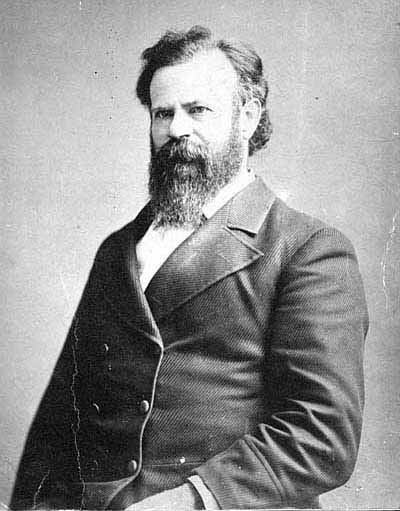
John Wesley Powell -- geologist, ethnologist and explorer -- was born on this day in 1834 in Mount Morris, New York.

With little formal education and a lot of spare-time exploring, young John Wesley Powell developed an interest in natural history and archaeology, collecting Indian artifacts, rocks and fossils around his home in Illinois. Prior to the Civil War, he farmed and occasionally taught school; but with the War's onset, at age 27 he joined the 20th Illinois Volunteer Infantry for the North as a private, and within a year he was captain of an artillery unit. At Shiloh, under U.S. Grant, he lost his right arm below his elbow to a musket ball, but returned to fight at the siege of Vicksburg and the battle of Nashville, receiving his discharge in 1865 with the rank of major.

On the basis of his reputation as an amateur naturalist, after the War Powell became a lecturer in natural history at Illinois Wesleyan College and Illinois Normal University -- but he still had an eye for adventure. With some of his students, he began staging reconnaissance expeditions in the Colorado Rockies, and in the winter of 1868, he explored the upper tributaries of the Colorado River, studying the culture of the Utes and seeking grants from his universities, the Smithsonian and the U.S. Army for a full-fledged journey down the Colorado.

On May 24, 1869, the intrepid one-armed Powell and his crew of 9 other men embarked on what would become one of the last epic explorations of the continental U.S., a treacherous boat trip down the Colorado, through the monolithic gorges of the Southwest that had scared off prior expeditions. By the time he emerged from the Grand Canyon (so named by Powell himself) on August 29, 1869, Powell had succeeded in laying the groundwork for a good map of the Colorado, at the cost of 3 men who were killed along the way; developed an influential theory of how the Colorado preserved its level; established relations with the Utes and Shivwits of northern Arizona and southern Utah (who recalled Powell as "Kapurats," or "right-arm-off"); and was hailed as a hero in the East.

Congress responded by funding Powell to map and study large areas of the West. In 1872, Powell was appointed special commissioner of Indian Affairs, but in addition to providing advice to the government as one of the nation's foremost experts on Native American culture in the West, he began to concern himself with the natural limits of the American settlement of the West.

In his prophetic Report on the Lands of the Arid Regions of the United States (1878), he observed that the region to the west of the 100th meridian (roughly running through present-day Erick, Oklahoma, among other places) lacked the abundant water that had supported the growing populations in the East and Midwest. Therefore, he argued, for the West to grow within the bounds of its resources, the U.S. government would be required to carefully control homesteading, limiting it to self-reliant (not federally subsidized) communal authorities gathered around water and natural watershed areas where irrigation ditches might easily transport water to crops. Powell argued that this kind of control was required to encourage conservation, minimize conflicts over water rights, and reduce inefficiencies inherent in transporting water over long distances.

Powell's Report fell on deaf ears, however: while newspapers and speculators, aided by crackpot scientists, promised that water would somehow appear wherever civilization chose to install itself, politicians in Washington bristled at the notion of imposing so much control over the settlement of the West, arguing that it would interfere with free enterprise.

Between 1880 and 1930, the population of the Western states would increase by almost 10 times without a federal water conservation policy; within the same period, a city like Los Angeles would swell from a sleepy pueblo to a metropolis of 2 million people on the back of William Mulholland's nefarious Owens Valley aqueduct scheme, supplemented every decade or so by greedy grabs of additional water sources further and further Eastward and by billions of dollars of federal dams and reservoir projects; and by 2000, a city like Las Vegas, which would not have even existed under Powell's plans, would become the fastest growing city in the country -- with the highest per capita (and most conspicuous) water use in the West, an overdrawn aquifer, and fewer and fewer options other than to drill for water on federally-protected lands. So much for conservation and self-reliance.

With Powell's visionary plans doused, however, he was consigned to the federal bureaucracy; but as head of both the Bureau of Ethnology (from 1879) and the U.S. Geological Survey (from 1881), he turned his agencies into model government science organizations, fostering the publication of numerous classics of Native American anthropology, as well as topographical maps and land studies. His continual attempts to get in the way of unfettered development in the West ultimately got him fired in 1894, and he retired, somewhat bitterly, to write epistemological works that have been described by one writer as "abstruse." He died on September 23, 1902 in Haven, Maine.

Labels: , , , , , , ,

Monday, December 05, 2005

Disney


Walt Disney was born on this day in 1901 in Chicago, Illinois.

The man who revolutionized the art and business of animation lived an austere childhood, moving around the Midwest as his stern father, Elias Disney, failed at one career after another. Walt found solace in drawing, and studied at the Kansas City Art Institute while he was still in high school. At 16 he went to France as a volunteer ambulance driver for the Red Cross, and upon his return pursued a career in art over his father's objections, taking an apprenticeship at a commercial art studio in Kansas City.

There he met another young artist, Ub Iwerks, and the two 18 year-olds launched their own commercial art studio, which folded after a month. Together they worked at a film ad company, making crude animated commercials for movie theaters using jointed cut-out figures, but they longed to produce more sophisticated animation, like the films they saw by masters such as Winsor McCay. The two essentially taught themselves advanced animation technique by studying Carl Lutz's book Animated Cartoons (1920) and the human and animal motion photos of Eadward Muybridge, and began making animated films at night after work using a borrowed camera.

Their films sold fairly well to local theaters, so they formed the Laugh-O-Gram Company to produce short animated cartoons. This venture, too, soon failed, so Disney and Iwerks set out for Hollywood, where Disney, in partnership with his brother Roy (who was convalescing from tuberculosis in Los Angeles) and with Iwerks' creative help, formed the Disney Bros. Studio, producing a series of short films combining live action with animation -- the Alice films (1924-26). The Alice series succeeded, allowing Disney to move into a larger studio and hire more animators. His next animated series, demanded by his distributor Charles Mintz, featured Oswald the Lucky Rabbit (1927), a character designed by Iwerks; by 1926, Disney had given up drawing for production duty. After a year, Disney feared that quick, cheap animation was in danger of growing stale with movie audiences, and desired more money from Mintz so that he could produce more elaborate cartoons. Mintz balked and underhandedly hired away all of Disney's animators except Iwerks, effectively stealing Oswald away from Disney.

Disney bounced back, however, creating a new character, Mickey Mouse (a name suggested by Disney's wife, who disdained Disney's original choice, "Mortimer"), on a train ride back from seeing Mintz in New York. Disney made two silent cartoons featuring the jaunty, big-eared mouse (Plane Crazy and Gallopin' Gaucho, both 1927) before starring him in the first popular animated cartoon with sound, Steamboat Willie (1928, with Disney himself providing Mickey's voice -- it should be noted that Max and Dave Fleischer had been experimenting with sound cartoons since 1924). Steamboat Willie was a smash, saving the Disney Studio from Mintz's attempted sabotage.

From 1928 to 1940, Disney became the preeminent producer of animated cartoons in the world, and through his creative vision transformed the art. As Mickey Mouse became more popular (followed by the beloved characters of Donald Duck and Goofy), Disney launched his Silly Symphony cartoons during the 1930s, creating musical mood pieces unlike anything produced by the other studios -- a genre of cartoon which reached its apotheosis with his classic, controversial animated feature film, Fantasia (1940, featuring Leopold Stokowski and the music of Bach, Tchaikovsky, Dukas, Beethoven and others).

The idea of an animated feature was a Disney original: he risked his personal finances, reputation and all of his company resources producing the first full-length animated feature, Snow White and the Seven Dwarfs (1937). The film was a box office success, and earned Disney a special Oscar for screen innovation (he received one tall one and 7 miniature Oscars): the film made copious use of the multi-plane camera technique to simulate depth in a one-dimensional medium.

In 1941, a strike by animators severely crippled Disney's studio. While much of the strike was economic, some of the strikers complaints were artistic, as they voiced their opposition to Disney's insistence on a naturalistic drawing style. While Disney traveled to Latin America on a goodwill tour at the request of U.S. Inter-American Affairs chief Nelson Rockefeller, the strike was settled, but Disney lost a number of his key animators to an artist-formed company, UPA, and the free-and-easy creative atmosphere at the studio was never the same afterwards.

Disney's reaction to the strike was in part political: his political conservatism had been creeping into his art for some time. Following the strike, which he denounced as Communist-inspired, Disney's work became known for its patriotic, wholesome feel, and over the years the name "Disney" became synonymous with the concept of "family entertainment" -- movies and TV shows which eschewed the trends toward suggestive sex, explicit violence and liberal politics. In 1954, Disney launched a long-running TV series, Walt Disney, which he hosted until his death (his benign face becoming a weekly fixture in American homes for a decade), and in the following year revolutionized the concept of the amusement park when he opened his 160-acre "Disneyland" in Anaheim, California.

Years after his death on December 15, 1966 in Los Angeles (following surgery to remove a lung tumor), Disney's little cartoon studio had become a worldwide entertainment conglomerate -- following Disneyland with a larger, more elaborate resort in Orlando, Florida called "Disney World" in 1971; producing mainstream movies as well as new animated features; and eventually acquiring such diverse enterprises as ABC Television, the California Angels baseball team and the Anaheim Mighty Ducks hockey team. It is now indisputably a corporate behemoth -- a far cry from Walt and Roy's shoestring operation.

Disney was always interested in scientific innovation, but there is no truth to the persistent legend that Disney's body was cryogenically frozen; he was buried at Forest Lawn in Glendale, California.

Labels: , ,

Friday, November 11, 2005

'Let's Face Facts About Flying Saucers'

That glib exhortation was the title of an alleged exposé on unidentified flying objects by Gabriel Green, who was born on this day in 1924 in my home town of Whittier, California.

A lean, articulate and intensely serious bachelor, formerly a photographer with the Los Angeles school system, Gabriel Green received some crackpot attention for his accounts of being greeted by 5'-tall humanoids from the planet Korender during the 1950s and 60s in publications such as Let's Face Facts About Flying Saucers (1967) and his own Flying Saucers International magazine.
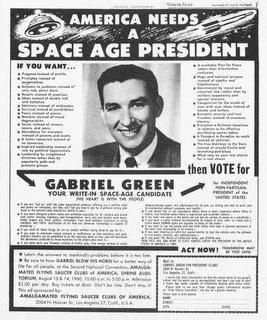
Early on, he claimed he had seen over 75 flying saucers and had actually spoken with extraterrestrial beings. He stared down skeptics by pointing to history: "They didn't believe the world was round. They didn't believe we could crack the sound barrier, and we cracked it. The reporters wouldn't even believe the Wright brothers' early flights." He was also a self-styled economist, an exponent of "Universal Economics," a non-monetary system of economics allegedly used by people on other planets, and the "United World," a theocratic world government based on universal spiritual laws and principles. In later years, he referred to the mission of space aliens as one of raising human consciousness so that we can "recognize our own Godhood."

In 1959, Green organized a "peace convention" of the Amalgamated Flying Saucer Clubs of America (AFSCA) at the Statler-Hilton Hotel in Los Angeles, announcing in advance of the event that an actual flying saucer from another planet would come and hover over the convention. When asked by reporters if the failure of a flying saucer to come to the Statler Hotel should be interpreted as good evidence that flying saucers didn't exist, Green replied, "Well, it doesn't prove you don't exist if you don't show up for work in the morning, does it?"

In 1960, Green decided to take his notoriety to the next level. At a press conference at the Biltmore Hotel -- attired in a conservative suit and bow-tie, albeit wearing bright red socks -- Green launched a candidacy for U.S. president as the nominee of the Universal, or "Flying Saucer" Party. Claiming to have been chosen to run for president by "space people," Green said that his advisors were from the Alpha Centauri system, but that they looked like ordinary Americans. During the campaign, he boasted: "With the help of space people, I believe I can carry millions of votes and many areas. They will help me, not necessarily at the precinct level, but by providing me with information." Although some reports indicate he later withdrew from his candidacy to support the ulitmate winner, John F. Kennedy, Green did manage to pick up over 170,000 votes in the general election. (If he did support Kennedy, I suppose that might mean that his space advisors were fairly effective, especially in certain Chicago precincts.)

Green ran for the Democratic nomination for U.S. Senate from California in 1962, campaigning against nuclear arms testing and placing third with 113,205 votes, but took a breather from politics (all the while continuing to publish his UFO magazines and building the membership of the AFSCA to 3,700 members) until 1972, when he managed to get himself on the Iowa ballot for U.S. president, again as the nominee of the Universal Party. That year, he received just 199 votes, all in Iowa.

After 1972, Green moved to the California desert and faded from the limelight, occasionally appearing at UFO conventions, and in Dan Curtis' documentary about the UFO sub-culture, In Advance of the Landing (1993) -- ever vigilant, watching the skies intently. He passed away on September 8, 2001 in Yucca Valley, California.

"They're watching us more carefully . . . Already they are becoming bolder, leaving imprints and other evidence of their landings on earth. When they are convinced that we can accept their reality they will formally make themselves known, and that will be fairly soon." -- Gabriel Green, on extraterrestrial beings, in 1966.

Labels: , ,

Saturday, November 05, 2005

Baxter's Choo-Choo

Baxter Ward -- TV newsman and Los Angeles County supervisor from 1972 to 1980 -- was born on this day in 1919 in Superior, Wisconsin.

A swaggering, silver-throated anchorman and news director at KHJ, KCOP and KABC-TV in Los Angeles, Ward ran unsuccessfully for mayor of Los Angeles against Mad Sam Yorty in 1969, but ultimately won election as a supervisor representing the Santa Clarita area in 1972. He became a vocal supporter of a $7-billion light rail system in Los Angeles. To diffuse the issue, Ward's fellow supervisors approved the $2-million purchase of an old train for refurbishing as a commuter train, which came to be derisively known as "Baxter's Choo-Choo."

The hopeless concentrations of cars on Southern California highways and carbon monoxide in Southern California skies at the end of the 20th century were nightmares-come-true, as predicted by Ward in the 1970s. By 1987, traffic saturations had forced the County to move forward on an $877 million, 22-mile light rail system, the Blue Line, which finally opened in 1990. By 2004, the Los Angeles County MTA was operating 73 miles of light rail public transportation services, at an overall construction and operating cost of $3.2 billion.

Nevertheless, Southern California remains a car culture. Worse yet, the 2001 Long Range Transportation Plan for Los Angeles County observes that in the next 25 years, the population of Los Angeles County is expected to increase by between 2.7 and 3.5 million people, increasing the time spent in daily trips on Los Angeles County streets and freeways by 30 percent. The Plan also recognizes that $94.8 billion that was already committed toward transportation projects in Los Angeles County through 2025 was not enough to solve the future capacity needs, and that even the unfunded projects proposed in the Plan will result in peak highway speeds of less than 20 miles per hour.

Ward passed away in 2002, having retired to the Seattle area -- but you can bet that if he were still around LA today, on TV or in the County chambers, he wouldn't be missing any opportunities to remind Los Angelenos to face up to worsening traffic and air quality conditions amid explosive population growth, and that putting off the spending now only makes it worse later.

Labels: , , ,