Monday, December 18, 2006

Moses Said So


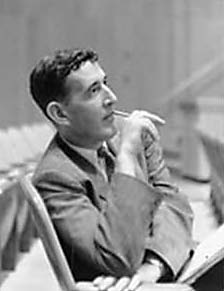
Robert Moses was born on this day in 1888 in New York City.

A Phi Beta Kappa political scientist from Yale, Oxford and Columbia, Moses was hired as a technical expert by the New York City Civil Service Commission in 1915 to implement the meritocratic (anti-patronage) reform ideas he had articulated in his doctoral thesis, but before he could make much headway, reform mayor John Purroy Mitchel was defeated for reelection. Governor Al Smith then hired Moses, eventually appointing him the president of the Long Island State Park Commission, marking the beginning of Moses' extraordinarily long career as a public builder.

Supervising the construction of parkways, bridges and highways around New York, Moses was publicly admired as an expert manager who conducted his business above the political fray, but behind the scenes he was a Machiavellian who wielded more political power over public works than any elected politician. One of his favorite strategies for doing so was extending the maturities of existing public bond issues, thereby restricting the legislature's ability to second-guess him without jeopardizing the state's role as fiduciary to the public bondholders. Even his detractors had to admire his energy, intellect and technical talents: as governor of New York and later as president, Franklin Roosevelt resented Moses' authority, but felt moved to pour millions of dollars into his projects, such as the remarkable Triborough Bridge (1940) and numerous zoos, parks and monuments which kept Depression-era construction laborers in full employment.

His skills as an organizer were not always matched with socially visionary judgment: his housing projects and expressways often fractured neighborhoods and displaced the underprivileged, resulting at times in increased racial and ethnic tensions in neighborhoods which had enjoyed relative peace and leading to the reorganization of large portions of New York from pastoral pedestrian niches to an often alienating car culture. When his projects succeeded, as they often did despite his estrangement from their social consequences, his autocratic management style was tolerated, but by the 1960s, as community involvement in planning decisions became a political flashpoint, Moses found himself being marginalized politically, particularly by the policies of New York City mayor John V. Lindsay and Governor Nelson Rockefeller.

Rockefeller finally drove Moses out of all his political posts when Moses was 75. Although he had taken his own paternalistic reform ideals to their logical limits, he ultimately fell victim to another reform movement, with ideals which focused on democracy and not exclusively on efficiency. He died on July 29, 1981 in West Islip, New York.

Labels: ,

Sunday, October 01, 2006

Holly Whyte and Small Urban Spaces


"I end then in praise of small spaces. The multiplier effect is tremendous. It is not just the number of people using them, but the larger number who pass by and enjoy them vicariously, or even the larger number who feel better about the city center for knowledge of them. For a city, such places are priceless, whatever the cost. They are built of a set of basics and they are right in front of our noses. If we will look." -- William H. Whyte.

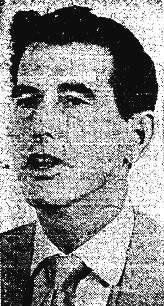
During his lifetime, Holly Whyte probably received his greatest notoriety as an anthropologist of American business through the publication of his best-selling appraisal of corporate culture, The Organization Man (1956), but it is a testament to the breadth of his creativity that he is now celebrated as one of the great 20th century scientists of urban spaces.

Born on this day in 1917 in West Chester, Pennsylvania, Whyte studied English at Princeton and won a collegiate playwright contest. After college, he worked for Vick Chemical as a marketing staffer until 1941, when he joined the Marines, serving as an intelligence officer at Quantico.

He came on board Henry Luce's Fortune magazine in 1946 and wrote articles on the corporate executive milieu, collected in Is Anybody Listening? How and Why U.S. Business Fumbles When it Talks with Human Beings (1952) and The Organization Man. The latter was an analysis of how modern corporate institutions stress safety and security at the expense of the kind of entrepreneurial risk-taking that made the American Industrial Revolution such an unprecedented financial and technological success. Coming on the heels of Riesman, Denney and Glazer's The Lonely Crowd (1950), Sloan Wilson's The Man in the Grey Flannel Suit (1956), Mills' The Power Elite (1956) and other fictional and non-fictional laments of the stifling effects of conformity, Whyte's book became a best-seller, enabling Whyte to retire from Fortune and take up his second career.

As an urbanologist, Whyte's approach was to study what worked, in the field, and use his findings as a means for evaluating the de novo concoctions of urban planners. His first campaign, against "urban sprawl" (a term he coined) in 1957, led to the passage of open-space legislation in several states, enabling cities to purchase vacant land on their perimeters to help stem the tide of unbridled development.

While working with the New York City Planning Commission, Whyte initiated the "Street Life Project," in which Whyte and students from Hunter College took to the streets to observe and film what was happening in under-used city plazas and crowded sidewalks. Among his conclusions, described in his influential book, The Social Life of Small Urban Spaces (1980), were that cities were inherently messy places, but that this was their advantage over the pristine, distrustful environments of the suburbs; that maximum commerce or "schmoozing" could be cultivated within cities by accommodating "honky-tonk," anything that invested sidewalks with hustle and bustle, creating a lively, inviting environment for city-dwellers; and that, in fact, we have a moral responsibility to create physical spaces that facilitate community interaction.

Although his observations were sometimes twisted by planners, his point of view with regard to the value of city life was embraced by American city planners and led to many of the urban regeneration projects of the 1990s.

Whyte died on January 12, 1999 in New York City.

Labels: ,

Monday, May 01, 2006

Jane Jacobs


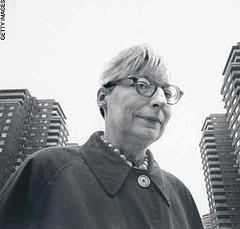
Self-taught, influential urban theorist Jane Jacobs passed away last Tuesday, April 25, in Toronto. She was born Jane Butzner on this day in 1916 in Scranton, Pennsylvania.

It should perhaps be no surprise that two of the most influential urban theorists of the 20th century -- William H. Whyte and Jane Jacobs -- should have begun their professional lives as journalists: their conclusions are based on living observations, from the street-curbs and within the bustle of neighborhood commerce, of the components of urban vitality.

Jane Butzner started as an assistant to the women's page editor at the Scranton Tribune, but left her hometown for New York City in the middle of the Depression, eking out a living as a freelance writer for the New York Herald Tribune and Vogue while working at a metals trade paper and in the Office of War Information. After marrying architect Robert Jacobs, she joined the staff of Architectural Forum, which became a testing ground for her brewing ideas on cities.

She published her ground-breaking critique of 1960s-style "urban renewal," The Death and Life of Great American Cities, in 1961; in it, she sought to shatter the "scientific" self-importance of the urban planning set with the observation that livable cities are organic in their evolution -- authentic to themselves and not cut from a drawing-board pattern, messy with "mixed uses" and densely packed with people rubbing elbows -- and that they thrive on the spontaneity and market intelligence which results from architectural, economic and human diversity. The book was a radical frontal assault on the collaborations between public works chieftains and real estate developers who proposed to erase vibrant neighborhoods and replace them with concrete office parks or shopping malls in the name of "urban redevelopment" (or, more stridently, in the name of "slum clearance").

In 1962, consistent with her concerns about whether cities should be built for people or for cars, she chaired the Joint Committee to Stop the Lower Manhattan Expressway, which successfully foiled Robert Moses' plan to cleave Manhattan neighborhoods with an elevated highway, and in 1968, she was arrested during a demonstration against a revived version of Moses' plan. Shortly thereafter, Jacobs and her family moved to Toronto (in order to keep her sons out of the Vietnam draft), where again she became actively involved in campaigns against "urban renewal" and highway building, participating in the protest against the building of the Spadina Highway.

In subsequent books (The Economy of Cities, 1969, Cities and the Wealth of Nations, 1984, and The Nature of Economies, 2000), Jacobs focused on city economies and their development, arguing ultimately that the disconnected economies of nation-states were inherently less stable and durable than those of the interwoven city, while her Systems of Survival (1992) was a platonic dialogue between two systems of political and economic morality -- a collaborative, open and productive "commercial moral syndrome" and a hierarchical, accretative and disenfranchising "guardian moral syndrome." She also authored a children's book and a book on Quebecois separatism, The Question of Separation (1980). By the end of her life she had become an elder statesperson of the anti-suburban sprawl movement, but at times her views have been twisted around to support the theories of New Urbanists and their planned suburban developments.

Labels:

Saturday, November 05, 2005

Baxter's Choo-Choo

Baxter Ward -- TV newsman and Los Angeles County supervisor from 1972 to 1980 -- was born on this day in 1919 in Superior, Wisconsin.

A swaggering, silver-throated anchorman and news director at KHJ, KCOP and KABC-TV in Los Angeles, Ward ran unsuccessfully for mayor of Los Angeles against Mad Sam Yorty in 1969, but ultimately won election as a supervisor representing the Santa Clarita area in 1972. He became a vocal supporter of a $7-billion light rail system in Los Angeles. To diffuse the issue, Ward's fellow supervisors approved the $2-million purchase of an old train for refurbishing as a commuter train, which came to be derisively known as "Baxter's Choo-Choo."

The hopeless concentrations of cars on Southern California highways and carbon monoxide in Southern California skies at the end of the 20th century were nightmares-come-true, as predicted by Ward in the 1970s. By 1987, traffic saturations had forced the County to move forward on an $877 million, 22-mile light rail system, the Blue Line, which finally opened in 1990. By 2004, the Los Angeles County MTA was operating 73 miles of light rail public transportation services, at an overall construction and operating cost of $3.2 billion.

Nevertheless, Southern California remains a car culture. Worse yet, the 2001 Long Range Transportation Plan for Los Angeles County observes that in the next 25 years, the population of Los Angeles County is expected to increase by between 2.7 and 3.5 million people, increasing the time spent in daily trips on Los Angeles County streets and freeways by 30 percent. The Plan also recognizes that $94.8 billion that was already committed toward transportation projects in Los Angeles County through 2025 was not enough to solve the future capacity needs, and that even the unfunded projects proposed in the Plan will result in peak highway speeds of less than 20 miles per hour.

Ward passed away in 2002, having retired to the Seattle area -- but you can bet that if he were still around LA today, on TV or in the County chambers, he wouldn't be missing any opportunities to remind Los Angelenos to face up to worsening traffic and air quality conditions amid explosive population growth, and that putting off the spending now only makes it worse later.

Labels: , , ,

Tuesday, September 20, 2005

Land Rush


Among the many surprises in President Bush’s speech from Jackson Square in New Orleans last Thursday was his proposal for a federal urban homesteading program for the Gulf Coast region. As he put it: “Under this approach, we will identify property in the region owned by the federal government, and provide building sites to low-income citizens free of charge, through a lottery. In return, they would pledge to build on the lot, with either a mortgage or help from a charitable organization like Habitat for Humanity. Home ownership is one of the great strengths of any community, and it must be a central part of our vision for the revival of this region.”

When spoken with the President’s Texas drawl, the word “homestead” cannot help but call forth in my mind the memory of that famous Oklahoma land rush scene from William S. Hart’s Tumbleweeds (seen above), one of the greatest and most realistic Western action sequences of the silent cinema. (The one in Tom Cruise’s Far and Away was a pretty walk in the park by comparison.) Since 1889, when the original Oklahoma Cherokee land-strip rush occurred, the government has gotten a little more sophisticated about how it doles out its homesteading land, however, so you can all put your horses back in the barn.

Commentators have generally been stymied by the proposal. Cokie Roberts referred to urban homesteading as a new idea in her NPR commentary on the speech earlier this week, stating that the 19th century Homestead Act that made land available in the West was “one of the most effective and popular ideas in this country,” but that “we’ve never tried it in urban centers.”

Actually, we have. Or at least we’ve seen variations on this theme. Three years before the Homestead Act itself was repealed in 1976, Wilmington (Delaware), Philadelphia and Baltimore started their own “citysteading” programs, taking city properties acquired in tax foreclosures and offering them for sale to the public at low prices. The federal government began the process of rechanneling its interests in homesteading the following year with the passage of the Housing and Community Development Act, re-selling properties acquired in FHA mortgage defaults; by 1980, 90 urban areas, from Benton Harbor, Michigan to New York City participated in such programs.

Unfortunately, by 1989, it had come to light that many urban homestead properties that were intended for “low income working people” had been transferred illegally to ineligible people (i.e. speculators with capital). Under the HUD Equity Restoration Act of 1989, the Secretary of Housing and Urban Development was given the power revoke home sales and impose civil penalties on well-heeled carpetbaggers. In 1997, President Clinton announced a new urban homestead initiative, attempting to improve city homeownership by “cutting mortgage closing costs, helping police officers buy homes, using rental subsidies for home purchases and cracking down on housing discrimination.” The Urban Homestead Initiative remained a part of the HUD strategic plan as late as 2000.

So, in one form or another, it’s actually an old idea.

However, I have seen surprisingly little study with regard to the success of either the federal programs or the myriad of state and local urban homesteading programs that exist to this day. It seems to be accepted as a given that such programs will help to facilitate urban revitalization. What seems less clear is that such programs do anything to improve the plight of the urban poor.

One of the interesting recurring anecdotes of the Katrina aftermath are the stories of New Orleans residents, now finding themselves in Houston or Florida or LA, confirming that they have no intention of returning to New Orleans. They perhaps sense that there is more opportunity for them in a new environment -- and judging by what we have seen, we can hardly blame them for that.

One wonders if an urban homesteading program would actually draw any of the people President Bush would hope to draw back into New Orleans, or whether drawing low-income people back into New Orleans just for the sake of having them there is an altogether good idea – particularly if job creation lags behind resettlement.

Although I have nothing against a nationwide urban homesteading initiative, it would perhaps be a better bet, for the short term, to find ways to fund the cost of moving and temporarily resettling people (giving the Katrina homeless financial assistance to deal with rental and utility deposits, for example) in areas where work and opportunity can be found -- followed by a more robust initiative addressing home ownership for low-income individuals, wherever they may be located. While the rebuilding of the Gulf Coast is a worthy and important goal, let’s hope that federal housing and urban policy focuses on some of the systemic problems that existed before Katrina hit (though illustrated in its wake) and that continue to exist in its aftermath.

Labels: , ,

Thursday, September 08, 2005

New Orleans Levees: Crushed By the Bipartisan Weight of Suburban Politics

As Ron Fournier of the Associated Press has reported, last year the Army Corps of Engineers asked for $105 million from Congress for hurricane and flood programs for New Orleans, but had its request slashed to $42.5 million; meanwhile, the recent $286.4 billion federal highway bill did manage to provide for such pet projects as a $231 million bridge to a “small, uninhabited Alaskan island.”

The failure of federal authorities to fix the problems, resulting in the devastating breach of New Orleans’ levees in the aftermath of Hurricane Katrina -- after years’ of unheeded warnings by scientists, the Corps and New Orleans’ leading institutions -- is unfortunately part of a broader pattern of bipartisan neglect of cities at the state and federal level that has been taking shape for two decades.

In a 1992 essay in his book Dead Cities entitled “Who Killed L.A.? A Political Autopsy,” Mike Davis observed that as voter demographics have changed, so has the attention paid by state and federal officials to the economic and infrastructural needs of the nation's larger urban areas. In 1992, the year that President Clinton was elected, the nation officially became a “suburban majority” nation, meaning that there were more suburban voters in the country than urban or rural voters. Apparently, suburban white voters had already been a majority of white voters since 1980.

As Davis put it:

The politics of suburbia, notes Fred Siegel in a recent article in Dissent, are “not so much Republican as anti-urban . . . [and] even more anti-Black than anti-urban.” Racial polarization, of course, has been going on for generations across the white-picket-fence border between the suburb and the city. But the dramatic suburbanization of economic growth over the last decade, and the increasing prevalence of strictly rim-to-rim commutes between job and home, have given these “bourgeois utopias” . . . unprecedented political autonomy from the crisis of the core cities . . .

Core cities, for their part, have helplessly watched the reapportionment of their once-decisive political clout in national politics . . . as Carter, Mondale and Dukakis each demonstrated, it was possible to sweep the urban cores and be crushed in the suburbs by the defection of so-called “Reagan Democrats,” a stratum largely consisting of blue-collar and lower-middle-class white refugees of the cities . . .

The Clinton campaign [in 1992] was, of course, the culmination of a decade-long battle by suburban and Southern Democrats to wrest control of the Democratic Party away from labor unions, big city mayors and civil rights groups . . .

. . . [T]here is no obvious reason why a campaign carefully designed to de-emphasize the cities should deliver a president suddenly fixed on their needs. In the aftermath of the Los Angeles rebellion, neither
Business Week nor the National Journal could locate a significant dividing line between the Clinton and Bush [Sr.] approaches to urban policy.
Along with the inexorable shift in political clout away from the cities to suburbs, cities have received less and less help from state and federal sources.

Just to take New York City as an example – in 1977, federal contributions constituted 19% of the city’s budget. In 1985, the federal contribution had fallen to 9%, and by fiscal 1997, it was apparently just under 5%. Combined with the dwindling tax base of most major urban areas due to the suburban flight of not only affluent individuals but healthy businesses, the result has been that many cities are finding it increasingly difficult to stay viable economically. Most often, the programs hardest hit by such budget cuts are subsidized housing, economic development assistance and job training, but infrastructure is a matter for increasing concern in most cities. As Tom Cox, deputy mayor of Pittsburgh, told me, just before Pittsburgh had to file for “distressed status” under Pennsylvania’s Municipalities Financial Recovery Act in 2003, “It isn’t as if we have fewer roads to maintain, or fewer feet of sewage line,” just because more people are leaving Pittsburgh for the suburbs and taking their votes and their tax dollars with them. (Myself included, admittedly.)

As the cable news cameras are making abundantly clear as they hover over New Orleans, inadequacies in our current method of funding infrastructure, housing and job creation in the nation’s cities are all issues that are inevitably swirled up by the tragedy of the breach of New Orleans’ levees.

[Please click the box to lend your support to Katrina victim relief.]

See also:

Mike Davis: Poor, Black, and Left Behind (September 24, 2004)


Labels: , ,