Monday, May 14, 2007

The Lone Wolf and his Instrument


"Bechet was an individualist, a lone wolf, the sharp who blows into town, cleans out the locals, and disappears again." -- J.L. Collier.

One of the great traditional New Orleans jazz artists, Bechet's style was nevertheless wholly his own, as singular in some ways as his nomadic, solitary career. Born on this day in 1897 to African-American Creole parents (although his mother was light-skinned enough to occasionally passeblanc), Bechet learned to play clarinet by practicing on his older brother's instrument when no one was looking. At 13, he was already playing professionally, and the following year, he began his life of wandering.

In 1918 he was in Chicago, then in New York, and in 1919 he was in Paris with Will Marion Cook's band, where he caught the attention of conductor Ernest Ansermet, who gushed: "There is in the Southern Syncopated Orchestra an extraordinary clarinet virtuoso who is, so it seems, the first of his race to have composed perfectly formed blues on the clarinet . . . I wish to set down the name of this artist of genius, as for myself, I shall never forget it -- it is Sidney Bechet . . . who is glad one likes what he does, but who can say nothing of his art save that he follows 'his own way' . . . perhaps the highway the whole world will swing along tomorrow."

Ansermet proved perceptive at least about Bechet's personality: he was a loner who went his own way, symbolized neatly by his 1941 overdubbed novelty recording of "The Sheik of Araby" in which he played all of the instruments by himself, including bass, drums and piano. Bechet became the most important jazz artist in Europe, playing with astonishing inventiveness, verve and his signature shimmering vibrato style in various groups in Paris and London, where he also took up the soprano saxophone, still a novelty in 1920. He was the first saxophonist of any consequence in the history of jazz.

At the same time, he was demanding and hot-headed, making him difficult to work with, and he occasionally ran afoul of the law: he was deported from London following a fight with a prostitute and imprisoned in France for 11 months following a gunfight with another musician outside a Paris cabaret. Back in the U.S., Bechet began his recording career, soloing with Clarence Williams Blue Five and the Red Onion Jazz Babies (featuring Louis Armstrong). Despite Armstrong's own virtuosity, Bechet dominated their recording of "Cake Walkin' Babies" (1924), showing a mature command of the still-developing rhythmic "swing" of jazz.

After spending the early 1920s back in the U.S. (where he also worked stints with Duke Ellington and James P. Johnson, had a brief affair with Bessie Smith and launched the career of Johnny Hodges), Bechet sneaked back into Paris with La Revue Negre (with Josephine Baker) in 1925. He promptly left the show, however, to tour Russia and Germany, and slowly slipped into obscurity, buried in Noble Sissle's orchestra.

During the late 1930s, as small-band jazz was in collapse, Bechet enjoyed a comeback with a hit recording of Gershwin's "Summertime" (1938), followed by "Wild Man Blues" (1940), a traditional New Orleans piece which he elevated with his own timeless invention; a transcendent masterpiece of slow jazz variations, "Blue Horizon" (1944); and "Les Oignons" (1949), a million-seller in Europe. Bechet had by this time returned to Paris (with some trepidation, given his history there), but he was welcomed as a hero, and lived there until his death, on this same day in 1959. He posthumously published a frank autobiography, Treat it Gentle, in 1960.


Labels: ,

Tuesday, February 27, 2007

12 Eateries in 12 Months, Part I


Over the past twelve months, we have enjoyed a wide variety of dining experiences – from wine and cheese with Amy and Steven at The Point in Corona del Mar to Ben’s seafood boil on the back deck in Corolla, from champagne and gobelins at Le Bar du Plaza Athénée (near the Seine) to schnitzel and weisswurst in the basement of the Shawnee Presbyterian Church (near the Delaware). Actually, to be perfectly frank, the wife didn’t really "enjoy" that last one so much.

At any rate, along the way, we discovered a few new restaurants, and rediscovered some old favorites. Here’s 12 Eateries, more or less, in 12 Months:

  1. Last February, we were hanging out in Philadelphia for my birthday. We will always have a soft spot in our hearts for Davio’s, site of an early romantic evening for us, but on this particular trip we literally stumbled in from the freezing cold at Sotto Varalli. Located in Philly’s theater district, Sotto Varalli is comfortably intimate, with imaginatively prepared seafood and a side dish of live jazz. We shared some fresh shucked oysters and a couple of dirty martinis, and I had the whole fish of the day, roasted with fennel, tomatoes, celery leaves, Yukon potatoes, lemon and extra virgin olive oil. Topping it all off, for dessert – a couple of scoops of the extraordinary gelato made by nearby Capogiro, Philadelphia’s own gelato artisans. Try the Bacio (chocolate-hazelnut) or, for something a little edgier, the Lime Cilantro.
  2. We enjoyed a trip to London last May, for a friend’s wedding. The old cliché about London is that British food is terrible. Having lived there for a couple of years earlier in this decade, however, I can tell you that, cuisine-wise, London ain’t your father’s Old London anymore – the city now boasts some of the best restaurants in the world. We didn’t go out of our way to visit the justly-praised Terence Conran establishments, or Jamie Oliver’s Fifteen, though. Instead, we chowed down more casually at Wagamama, the now-ubiquitous noodle bar that typifies the trickle-down effect of London’s explosion of cuisine. The Soho and Covent Garden locations were old haunts of mine, but this time the wife and I enjoyed lunch at the Tower Hill spot. Seating is family style, in a modernized echo of the best tradition of British chop houses, on long pine-and-aluminum bench tables, and the atmosphere is always bright, noisy and cheery. My long-standing favorite Wagamama dish is the Yaki Soba – “teppan-fried soba noodles with egg, chicken, shrimps, onions, green and red peppers, beansprouts and spring onions, garnished with black and white sesame seeds, fried shallots and red ginger” – with a bottle of Asahi Super Dry. The wife enjoyed the Seafood Ramen and some fancy fresh juice, while we shared some excellent gyoza. (Watch for two new Wagamama locations, the first in the U.S., opening in Boston later this year.)
  3. Osteria Basilico was a cramped but gregarious little gem we found in Notting Hill. Free yourself from all notions of personal space, embrace a spontaneous and lively sense of community with strangers, and you’ll do fine here. We spelunked our way through the narrow passages between the tiny, rustic dining tables to the antipasti buffet for starters, and it was definitely worth the trek: a tasty selection of cheeses, grilled vegetables, cured meats and olives, and insalata pomodoro. The entrees are hearty, pastoral Italian favorites, such as Ossobuco with Saffron Risotto, Homemade Tortelloni filled with spinach and ricotta and topped with tomato and fresh basil, and my choice for the evening, the Char-grilled Lamb Cutlets, with roasted vegetables and pine kernels. Add a couple of bottles of Barolo and a pair of good friends from Yorkshire, and you have yourself a great evening out.
  4. Paris offers tasty treats everywhere you look. For the mother of all splurges, however, on the recommendation of my wife's aunt we had to try Lasserre, on Avenue de Franklin Roosevelt, near the Champs-Elysees. With its gilt-trimmed décor and sober decorum, its almost pathologically attentive service, as well as in its classic menu and extraordinary wine cellar, Lasserre is the height of Old World French elegance. Opened in 1937 by Rene Lasserre, who passed away at age 93 only a few weeks before we visited, the restaurant was once an international celebrity haunt whose regulars included Dali, Malraux (who has a pigeon entrée there named in his honor), Audrey Hepburn and Marlene Dietrich; it has, in its old age, become a celebrity in and of itself. It was a drizzly evening in May when we were there, but the staff did us the favor of opening the retractable roof for a moment, giving us a peek at the clouds above Paris and a sense of what it must have been like to dine under the stars, with the stars, once upon a time. The old standbys – the duck a l’orange and so forth – can still be found on the menu, but hidden among them are updated surprises, such as the mouth-watering delicate Macaroni with foie gras and truffles, the Chablis-flavored oysters, and the Lemon-and-Ginger Côte deVeau. The wines are priced comparably to nights in a luxury hotel, but the good news is that the more you drink, the less you’ll worry about the bill when it’s all over.
  5. The wife spent more evenings out together in Washington, D.C. during our dating days than anywhere else, so we’ve developed a number of comfortable favorites there, including the Old Ebbitt Grill (the site of our post-wedding day brunch), Johnny’s Half Shell (in its old location in DuPont Circle) and Firefly. On one of our recent returns to D.C., however, we went with some good friends to a place that wasn’t even open when we were Capital regulars – Agraria, at Washington Harbour. Opened by the North Dakota Farmers Union in June “with the intent to promote and enable the American family farmer to capture a greater share of the food dollar,” the Washington Post called this restaurant a “culinary lobbying campaign,” situated on K Street as a constant reminder of the plight of the American family farmer. Don’t let the agricultural collective talk scare you away, though: the restaurant is beautifully appointed with an elegant minimalist design, and its Transcendental American fare is first-rate. We were there less than two months after it opened, a notoriously shaky time in the life of any restaurant, but we were willing to overlook minor gaps in service for the Cabbage Soup (with white beans, carrots and potatoes); the Beef Carpaccio (with arugula, parmesan, black pepper, olive oil and lemon); the grass-fed Rib-Eye Steak; the Buttermilk Mashed Potatoes; and the Scallops in bouillabaisse sauce with baby fennel. Desserts are mighty fine, too, including the Cocoanut Bread Pudding and Chocolate Terrine.
  6. In Las Vegas, of all places -- on the fringes of the great ringing and ch-ching-ing of the slots midway at Caesar’s Palace, a few paces away from all the chintzy plaid and glitter on the folks lining up to see Celine Dion in her Colosseum -- there is an unexpectedly refined and stylish eatery that gave us one of our most memorable dining experiences of the year, Bradley Ogden. Ogden, of course, has gained renown as a Bay Area chef-restaurateur, but his Las Vegas location truly seems to have knocked the establishment food critics for a loop; it was the only restaurant outside of New York to be nominated for the coveted James Beard “Best New Restaurant” award in 2003, and it beat ‘em all. The polished stone, glass and dark wooden beams of the sleek interior are evocative of Frank Lloyd Wright’s contemplative, organic Post-Prairie Style, which had the overall effect of spiritually transporting us far from the garish effrontery of the faux Roman motifs inside Caesar’s. The waiters, elegantly attired in gray suits and ties, are true professionals of the sort you rarely find in American restaurants. Our gentleman was extraordinarily well-informed about every facet of the restaurant, and a good listener, too; having quickly identified us as foodies, he gave us a tour of the kitchen at the end of the evening. And speaking of the food … it’s New American cuisine, upscale comfort food, meticulously presented for the eye as well as for the palate. We enjoyed a course of Oysters, unveiled in five imaginative tableaux; Farmer’s Market salad; Wood-fired Pork Loin; and to top it all off, an Apple Cobbler with custardy Homemade Vanilla Ice Cream.
See Part II.

Labels: , ,

Monday, February 12, 2007

Atget


"Often the central thought of an image by Atget consists in the confrontation of two opposing ideas: the grandiose and the humble, the elegant and the commonplace, the past and the present, the static and the moving, the light and the dark." -- J. Borcoman.

Eugene Atget was born on this day in 1857 in Libourne, France; he died on August 4, 1927 in Paris.

Orphaned at an early age, Eugene Atget was a loner and a drifter for much of his life: he worked on ships for awhile, then traveled as an actor in provincial theater groups and finally turned to photography, accepting routine commissions from architects and public bureaus to document Paris -- its streets, shops, historical monuments and parks -- during a period (1892-1927) in which large sections of old Paris were being demolished to make way for the redevelopments that were begun by Baron Haussmann in the 1850s. In 35 years Atget amassed over 10,000 documentary images, made as golden albumen and gelatin contact prints from 7 x 9-1/2 inch glass plates using a wooden bellows camera. When his simple, unpretentious compositions were "discovered" by Man Ray, Andre Breton and others during the 1920s (and preserved by Man Ray's assistant, photographer Berenice Abbott), Atget's reputation as a "folk" artist of unique vision, uninfluenced by the "art photography" movements that raged around him, began to emerge.

Atget was not the simple tradesman that his earliest proponents made him out to be, however; a frequent public lecturer on literary topics, it is more likely that in the course of his routine jobs he sought for his own purposes to reflect on a Paris of the literary past as imagined in the works of Hugo and Dumas pere and fils -- a landscape of dreams and portentous solitude, with the French countryside still coursing into the city's main arteries from the perimeters. Since he normally shot his Paris scenes early in the morning when there were few people in the streets, they are almost surrealistically empty, imbued with expressive, deep dawn shadows and soft haze. Despite the dream-like qualities of his work, there is also a sense of straight-forward presence in many of his photos; his depictions of horse-drawn tramways, restaurants, walls plastered with posters, and street vendors are also evocative of a vanishing civilization, but a civilization whose lashes still fluttered in Atget's daily sunlight.


Labels: ,

Friday, January 26, 2007

Eugene Sue and The Mysteries of Paris


"Our sole hope is that we will draw the attention of thinkers and of honest folk to some of the great afflictions of society." -- Eugene Sue.

Novelist Eugene Sue was born on this day in 1804 in Paris. The son of a successful surgeon in Napoleon's army and godson of the future Empress Josephine, Sue originally studied medicine and served as a surgeon in the French navy during the 1820s. After the death of his father, Sue took his inheritance and moved to Paris, devoting himself to womanizing, spending lavishly, and writing. His earliest published works were adventure novels with maritime settings (including Atar-Gull, 1831, and Le Salamandre, 1832), leading him to be praised as "the French James Fenimore Cooper." To put that in perspective, we must remember that at the time Cooper was one of America's best known adventure novelists -- although critical opinion about him was not necessarily uniform. As Mark Twain once observed: "In one place in Deerslayer, and in the restricted space of two thirds of a page, Cooper has scored 114 offenses against literary art out of a possible 115. It breaks the record."

In any event, following these successes, Eugene Sue showed his capacity for adapting to the prevailing literary tastes of his time, turning his hand to historical novels (such as Latreaumont, 1838) and eventually to the serial romance -- of which his serial autobiographical novel, Arthur, 1837-9, was an early precursor. His popularity growing, with the publication of the widely-read romance Mathilde (1841), Sue became the most successful serial-novelist in France, getting paid by the line for works of high melodrama appearing in installments in the newspapers.

In the 1840s, under the influence of his friend, the Socialist playwright Felix Pyat, Sue became deeply interested in the problems of economic injustice. The subject matter of his serials quickly turned from tales of the aristocracy to the lower classes, resulting in Sue's most famous work, The Mysteries of Paris (published as a serial in 1842): an enormously popular, vividly drawn picture of the Paris slums, it focused on the activities of a highly-principled, almost super-human avenging angel, Rodolphe, a wealthy German prince disguised as a common workman who dispensed rough justice to evil men who tormented the poor and socially disadvantaged.

His next best-selling novel, The Wandering Jew (1844-45; filmed in 1933, starring Conrad Veidt), was based on the legend of the Jewish cobbler who was condemned by Christ to wander throughout eternity for having refused to give him water on his journey to Golgotha, again explored the persecution of the poor.

In 1850, Sue won election to the National Assembly as a Socialist, but showed no stomach for public debate and was widely criticized for proofing the galleys of his novels while sitting in the Assembly chambers. After the 1851 coup d'etat which resulted in Louis Napoleon's accession to power, Sue left France for Savoy, dying in exile there on August 3, 1857.

Labels: , ,

Thursday, January 25, 2007

So Long As I Can Sing and Dance


"I belong to a race that sings and dances as it breathes. I don't care where I am so long as I can sing and dance." -- Florence Mills.

Florence Mills was born Florence Winfrey on this day in 1895, in either Washington, D.C. or Virginia.

The first African-American singer/dancer to headline at the New York Palace Theatre, Mills conquered Broadway before it was acceptable for African-Americans to appear in big time venues. Possessed of a high, quavery voice, she enchanted audiences with her brightness and elegant bearing as the star of Sissle and Blake's groundbreaking revue Shuffle Along in 1921. In 1926, Mills starred in Blackbirds, first in New York and subsequently in Paris (where it was Paris' first-ever all-black revue) -- a show that the Prince of Wales, for one, is said to have seen over 20 times.

She died on November 1, 1927 at the age of 32 while hospitalized for an appendectomy. As her funeral cortege marched down Seventh Avenue, a plane flew overhead, dipped its wings, and released a flock of bluebirds in tribute to her.

Labels: , ,

Saturday, August 19, 2006

Caillebotte


Gustav Caillebotte was born on this day in 1848 in Paris.

In his day, Caillebotte was thought of as an amateur painter and was much better known for organizing and financing some of the great exhibitions of Impressionist painting in Paris, showing side by side the works of such artists as Monet, Manet, Renoir, Pissarro, Degas, Sisley and Cezanne. Younger than the great painters, he was still a law student when Monet and Renoir started discussing the idea of a group exhibition. Caillebotte, who designed brightly sailed racing boats as a sidelight, befriended Monet, his neighbor at Argentueil, created a floating studio for him and infected Monet with his passion for gardening.

Behind the scenes in Paris, Caillebotte did more than almost anyone to further the Impressionist movement, raising funds to keep the artists clothed and sheltered and using his considerable skills at organization, diplomacy and advocacy to carve a niche of respectability for the rogue painters.

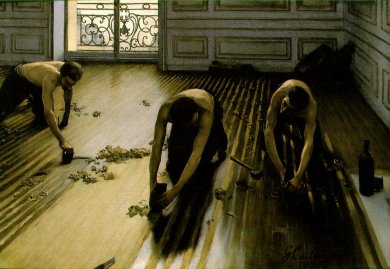
His own paintings, beginning in the 1870s, are powerful examples of the movement he helped to foster: in such works as Pont de l'Europe (1876), Paris Street: Rainy Day (1876-77) and The Floor Strippers (1875), Caillebotte shows a preference for viewing urban scenes from unusual viewpoints. Seemingly unstudied compositionally, Caillebotte paintings appear to be snapshots, catching ordinary people in unlikely spots within the frame of view: his figures often enter the foreground abruptly, or walk away with faces momentarily hidden by umbrellas or hats -- caring little for the artist's ordinary sense of order and harmony. Caillebotte combined this pictorial immediacy with a delicate sense of color and lighting effects, certainly less ethereal than his friend Monet, for example, and perhaps closer in spirit to the work of Manet or Degas.

When he died in 1894, Caillebotte bequeathed his personal collection of Impressionist works to the French government, which at the time was unfortunately unprepared to deal with such treasures, keeping them hidden from view for many years. Finally, most of the works in Caillebotte's bequest were permanently displayed at the Musee d'Orsay in Paris.


Labels: ,

Wednesday, July 12, 2006

Modigliani


Born to affluent Jewish parents on this day in 1884 in Livorno, Italy, Amedeo Modligliani, known as "Modi" to his friends, gathered his early artistic training in Italy -- steeping himself in Italian Renaissance traditions (including the work of Botticelli, who many critics see as Modigliani's spiritual ancestor), painting in a proto-Impressionist Macchiaioli style, and enjoying the life of a well-dressed playboy. In 1906 he arrived in Paris, where he became the model cafe-haunting bohemian, scratching out a living in a garret, womanizing and drinking to excess. Artistically, he became intrigued by the work of Cezanne and the experimentations of Picasso's "Negro Period," with its affinity for the elongated, stylized portraiture of African masks.

With these influences and a predilection for linear grace, he continued to paint in moderate obscurity until, under the influence of his friend Constantin Brancusi, he turned exclusively to sculpture in 1909, crafting limestone portraits under the influence of Greek kouroi as well as African masks. When sculpting materials became difficult to find with the onset of World War I, Modigliani returned to painting, although his style was now more boldly informed by his sculpting.

His paintings after 1914, almost exclusively portraits and nudes, had the feeling of sculptural objects -- detached from any realistic or definable background, contoured as with a chisel, with long necks, flat almond-shaped eyes, widely-set nostrils at the ends of profile noses in full face, and small, sad mouths, all enclosed within clearly drawn yet elegant outlines and roughly washed in thinly-applied paint. Unlike his inscrutable African mask antecedents, however, Modigliani's portraits were personal; they showed, without any sign of ham-fisted exaggeration, the moods and eccentricities of his subjects (such as his portraits of Max Jacob, Jacques Lipchitz and his wife, Jean Cocteau, and Chaim Soutine). His serene, subtly elongated nudes (such as his Nude, Courtauld Gallery, London, c. 1916, considered scandalous in its day and removed from a gallery window by order of the gendarmes; Nude on a Cushion, Collection Gianni Mattioli, Milan, 1917-18; and Reclining Nude, MOMA, New York, c. 1919) are of the same style, dominated by the delicate sweep of curved outlines and lushly graded flesh tones; they are in Arnason's words, "among the most beautiful and sensuous in the whole of art."

By the age of 35, however, Modigliani had descended deeply into alcohol and opium, and was plagued by tuberculosis. He had fathered a child by an teenaged art student, Jeanne Hebuterne, and she was pregnant with his second child when Modigliani succumbed to tubercular meningitis on January 24, 1920 in Paris. Just a few days after Modigliani's death, Jeanne committed suicide by throwing herself out of her parents' window.

Labels: ,

Croce-Spinelli


Balloonist and aeronautics engineer Joseph-Eustache Croce-Spinelli was born on this day in 1843 in Dordogne, France. Croce-Spinelli was deeply interested in manned flight and had not only made several balloon expeditions but had published articles on propeller design when on April 15, 1875, with Gaston Tissandier and an assistant named Henri-Theodore Sivel, he flew to 29,000 feet over India in the helium-balloon Zenith -- short of the altitude record set by James Glaisher and Henry Coxwell. Although the men had been advised by Paris physiologist Paul Bert about the supplemental oxygen required at such altitude, in the excitement they failed to heed the advice, and Croce-Spinelli and Sivel asphyxiated in the inhospitably thin air. Tissandier miraculously survived to tell the tale.

Croce-Spinelli's claim to fame, however, stems not so much from his contributions to aeronautics but from the design of his much-visited tomb at Pere Lachaise in Paris: the monument displays lifesized effigies of Croce-Spinelli and Sivel lying side-by-side, holding hands, bare-chested and otherwise covered in a shroud. The sculpture is obviously a tribute to their comradeship, but some have asserted, without further evidence, that Croce-Spinelli and Sivel were gay lovers. Heroic death in the company of one's peers was a heady theme for the post-Romantic French. Who's to say?

Labels: ,

Monday, July 10, 2006

Italy Wins, and Legends Roam Pittsburgh


On a penalty kick shoot-out, no less. Having witnessed first-hand the focus and attention of the French fans on the Champions League final in Paris in May, when there was no French honor at stake, I can only imagine what the scene must have looked like oustide those bistros on Rue St. Andre des Arts during the match. Afterwards, however, instead of triumphant football crowds marching down the Champs-Elysees, I'm sure there were more than a few mourners clutching their half-empty wine bottles and banging their heads against lamposts, moaning the name "Zinedine Zidane." Say it ain't so, Zinedine.

Meanwhile, Pittsburgh kicked off its All-Star Baseball celebration yesterday with a high-scoring minor league "Futures" All-Star game, pitting American-born minor league stars vs. "foreigners"; the U.S. won, 8-5. Excellent performances were turned in by game MVP-winner Billy Butler, a leftfielder from the Wichita Wranglers in the Royals' system, who hit a two-run homer; and Curacao's Wladimir Balentien (currently playing for San Antonio in the Mariners' system), the DH for the "World" team who hit a homer and two doubles. Having been there to see it, I must confess that another player, Cameron Maybin of West Michigan (a Tigers' farm club) looks like he might be the real deal, going 2-for-3 and grabbing five shots to centerfield. Hall of Famer Ferguson Jenkins managed the World club in the Futures game, while Hall of Famer Gary Carter managed the U.S. club.

It was a lot of fun seeing all the old-timers milling around PNC Park on Sunday evening, even if it was a little surreal watching them play softball in the "Legends and Celebrity" game with the likes of Jimmy Kimmel, Sarah Silverman, Dean Cain, Franco Harris (who can't hit a softball for beans, although he proved he could lay down a decent bunt), Rob Reiner and Danny Masterson from That 70s Show.

Ozzie Smith and Ernie Banks were as gracious as always -- it's second nature to those guys to be able to convey how grateful they are to the fans and how wonderful it was to come to such a beautiful ballpark. Other fellows we've missed seeing on the diamond for some time and who participated in Sunday night's charade included Goose Gossage, playing a surprisingly limber first base; chatty Fred Lynn; Tommy John, whose history with his namesake surgery did not prohibit him from pitching for the Americans at age 63; John Kruk; Rollie Fingers; Daves Winfield and Parker; Bill Madlock; Bill Mazeroski (pictured), who received a heart-felt standing ovation from the hometown crowd; and Andre Dawson, who looks like he could still play if he really wanted to.

If anyone is counting, the Nationals beat the Americans 7-5 on the strength of Winfield's pitching and his 300-foot homer to left; Gary Carter was named the game's MVP.

Labels: , , , ,

Thursday, May 18, 2006

Barcelona Wins!


Spending a few days in London reminds us that football enthusiasm is a somewhat class-based activity. While the morning news programs tout the upcoming Champions League match between Arsenal of London and FC Barcelona at Stade de France in Paris, conversations with friends and business colleagues around Westminster yield vague shrugging when the topic turns to footie.

On our way to Waterloo Station yesterday, however, our driver Salim is enthusiastic, warning us that Barcelona, with its star player Ronaldinho, will win 5-nil. Now it seems like hundreds of Arsenal fans are boarding the Eurostar with us, and when we arrive at Gare du Nord, we hear boisterous Arsenal songs breaking out and see crowds of yellow-jerseyed young men buffeting about the station. Few stand in line with us for the taxis, which suggests to me that the Metro was probably a yellow blur. Our driver in Paris asks us if we're for Barcelona or Arsenal. "We're for peace," I say. "Me, too," he says. "Especially in my taxi."

That evening, as we stroll down Rue St. Andre des Arts following a rustic supper on Ile St-Louis, it begins to rain a bit, but that does little to dampen the excitement of football fans who spill out onto the street, craning for a better view of the match-in-progress on bistro TV screens.

Moments later, we are back in our 7th floor room on Boulevard Raspaill, and the rain has gotten harder. My wife is fast asleep and I'm nursing my surprise attack of Paris hay fever with a couple of shots of Cuervo. I'm watching the match on TV as Barcelona gamely scores twice during the thunderstorm to take the lead 2-1, and eventually the win.

The streets of Paris are quiet this evening on the edge of the 6th and 7th Arrondissements. No celebrating football crowds gather on the Champs-Elysees, either -- that, apparently, is only reserved for when Paris beats Marseilles.

Labels: ,

Wednesday, December 14, 2005

They Never get Dressed


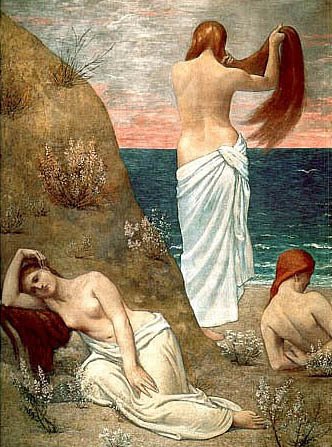
"The nudes of Puvis de Chavannes never get dressed . . ." -- Odilon Redon.

An engineer who took up painting after a trip to Italy, Pierre Puvis de Chavannes (born on this day in 1824 in Lyons, France) painted symbolic, eerily quiet and somewhat naive pastoral scenes, often decorated with ethereal female nude figures. One of his favorite models (and, for a time, his mistress) was painter Suzanne Valadon.

Stylistically, he is somewhat beholden to Academics such as Ingres, with their stiff compositions, but perhaps because of his flat lighting and coloration, he was associated in the public mind with the avant-garde, and was on friendly terms with such Impressionists as Edgar Degas and Berthe Morisot. He was a contributor to the fund set up by Monet to purchase Manet's Olympia for the French government.

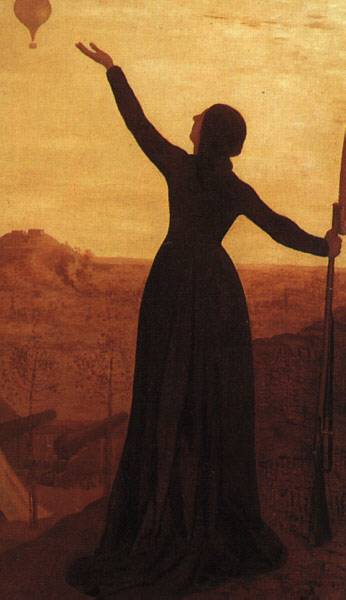
His influence can be felt in the idealistic, stylized renderings of Georges Seurat, and in the use of color by Paul Gauguin and Odilon Redon, among others. Among his better known works are The Balloon (1870, at left) and its companion piece The Pigeon (1871), Hope (1872; later copied by Gauguin) and the St. Genevieve panels at the Pantheon in Paris (1876-98).

Puvis de Chavannes died on October 24, 1898 in Paris.

Labels: ,