Wednesday, May 14, 2008

Moving Staircase


Charles D. Seeberger, the "inventor" (sort of) of the escalator, was born on this day in 1857 in Oscaloosa, Iowa.

Seeberger was a Yale-trained engineer who obsessed over the prospect of a moving staircase while working in the family hardware store in Chicago. In 1895 he left the family firm and filed a patent for an "escalator," a name he coined; the Patent Office was a little mixed up by the time it granted Seeberger's patent under the title "elevator."

Seeberger wasn't satisfied with his own design, however, preferring George Wheeler's "flat-step" design. He acquired Wheeler's patent in 1898, meshed it together with bits and pieces of what he had designed himself and engaged the Otis Elevator Company (founded by Elisha Otis in the 1850s) to build the prototype. The Otis Company and Seeberger unveiled the escalator at the 1900 Paris Universal Exposition, where it competed for attention with Jesse Reno's "inclined elevator," a conveyor belt with step-like rows of iron cleats to support the feet of the passengers as they leaned forward precariously. Although Reno's design was a lot less comfortable than Seeberger's, it did have a comb of fingers at the landing which passed between the cleats and kept stray shoelaces and skirts from getting caught in the machine.

The Otis-Seeberger and the Reno moving-staircases competed against each other until 1910, when Otis purchased Reno's company. Even as late as 1911, however, the Otis Company had to go to extreme lengths to reassure customers of the safety of the escalator; when the first Seeberger escalator was installed in the London Underground, the Otis Company hired a man with a wooden leg, "Bumper" Harris, to ride the escalator all day to demonstrate its harmlessness.

Seeberger left Otis in 1915; and in 1920, the Otis Company combined Seeberger's modified flat-step escalator with Reno's combed landing, producing what was to become the most popular model of moving-staircase, selling more units in the 2 years that followed than it had ever sold of the either the Seeberger or Reno designs alone. None of them perfected a way of keeping people walking instead of standing in my way on escalators, however.

Seeberger passed away in September 1931 in Oak Bluffs, Massachusetts.

Categories: ,

Labels: ,

Monday, December 17, 2007

Of Martinis, "Bradfords" and "Teslas"


My apologies to regular readers who may have been showing up at this space every morning hoping for a new "parlour trick." It is has been a busy season, full of deals, machinations and pre-holiday chores -- but I hope to see my way clear to writing more when 2008 begins.

One thing, however, has inspired me to put pen to paper once again ... I was out with my wife the other day, trailing behind her as she rummaged through the holiday sales at a local Sur la Table, when I stumbled upon a most disconcerting item: the Waring Pro WM007 Professional Electric Martini Maker.

First of all, we all know about Waring and his blender, and also about his Pennsylvanians. More power to the fellow, I guess, for the laser-like focus of his life and imagination upon things that rotate (phonograph turntables, blending blades, etc.). I know that, after soda fountains, taverns and bars were among Waring's first customers, but Waring was no doubt hawking his blender to poor fellows who were forced, by the preferences of their clientele, to make frozen cocktails of one type or another, such as a Frozen Daquiri or a Margarita. The venerable David Embury says as much. "Frozen cocktails require the use of a Waring Blendor or similar electric mixer of the type used at soda fountains," Embury writes in deadpan manner in his book The Fine Art of Mixing Drinks. "The egg-beater type of electric mixer cannot be used." Implicit in his observation that a "Waring Blendor" is something that is normally seen at a soda fountain is the opinion, no doubt, that frozen cocktails are for grown-ups who still have adolescent tastes. In his chapter on "Glassware, Gimmicks, and Gadgets," Embury remains pointedly silent on the necessity of keeping a "Waring Blendor" around a well-equipped bar.

Now the people who own Waring's name have unleashed this strange little device on the American consumer market, the Electric Martini Maker -- an appliance whose essential mechanism is not simply rotation (as in the machine's "Stir" mode), but also vigorous shaking (as in its "Shake" mode). Yes, that's right, the Waring 007 can give you a Martini that's either "shaken" or "stirred" at your command.

Notwithstanding James Bond's request for a "shaken, not stirred" Martini, first uttered by Sean Connery in Goldfinger and used ad infinitum ever since, David Embury is very clear on the matter. Martinis are, strictly speaking, always stirred. "If you shake the Martini," Embury maintains, "it becomes a Bradford."

Embury continues: "The real distinction between the two methods is simple. Shaking produces a colder cocktail quicker than stirring. Therefore, since frigidity is highly desirable in all cocktails, shaking is normally the preferable method. However, with some cocktails another consideration enters into the picture, and that is 'eye appeal.' A substantial part of the charm of certain cocktails such as the Martini and the Manhattan is their clear, almost scintillating translucence. A stirred cocktail will remain clear; a shaken cocktail will be cloudy or even muddy in appearance. This result is particularly noticeable where vermouth or any other wine is an ingredient. Therefore, you should never shake a cocktail containing wine unless you want a muddy looking drink. This cloudiness will clear somewhat as the drink stands, but it will never have quite the limpid appeal of the drink that is stirred. ... Incidentally, there are very few cocktails that can be made with the beautiful translucence of the Martini and the Manhattan. This is because more cocktails are made with citrus juices than with vermouths, and the citrus juices themselves are not translucent."

(Why a Bradford? I have no idea, although it does call to mind one hopelessly foggy, early morning airplane flight I took from the airfield at Bradford, Pennsylvania that forced me to admit to myself, then and there, that I was taking the worst calculated risk of my life. I'd be willing to bet, though, that Embury himself never experienced such a thing.)

Embury's distinctions seem quaint and almost archaic now, in a world of filled with muddy Mocha Fudge Latte Martinis and Apple Cinnamon Vanilla Martinis. It does, however, prompt me to wonder what the appropriate name should be for a Martini that is neither shaken nor stirred by human hands, but rather, jerked around by a Waring Pro WM007 Professional Electric Martini Maker. One is tempted to call it a "Waring," but I refuse to cast aspersions on Fred Waring without more evidence of his posthumous complicity. Perhaps we can call it a "Tesla," in honor of the unfairly maligned inventor of the AC current transmission system. Then again, I wouldn't want to further sully his memory, either.

Call it what you like -- the Waring Electric Martini Maker will not be under my Christmas tree this year or any other. I'm not a Luddite, even if I do prefer to chop my own vegetables, when making Salsa, instead of using an electric food processor. It's all about aesthetics. Give me the manually crafted beauty of a dry, translucent Martini (made with Gin, as all Martini aficionados agree), and keep the electricity out of my aperitif.

And if that isn't reason enough not to be experimenting with electricity and cocktails, try this review of the Waring Electric Martini Maker by Dave Wells:

Let's recap. You pay $99.95 (plus tax/shipping) for the machine. You measure the ingredients. You pour the ingredients. You add the ice. The machine wiggles the shaker - either up and down ('shaken') or in a circular motion ('stirred') probably for much longer than necessary. You pour the martini. You wash the jigger and the shaker. You find a place to store the bulky unitasking device. Wow, aren't modern conveniences wonderful?Indeed.


Labels: , ,

Thursday, August 30, 2007

Faster Calculating


Computer pioneer John W. Mauchly was born on this day in 1907 in Cleveland, Ohio.

John Mauchly was an obscure professor of physics --in fact, he was the whole physics department at Ursinus College in Collegeville, Pennsylvania -- who was best known locally for his entertaining "Christmas lectures" on basic physical principles, illustrating Newton's laws with skateboards and bringing spectroscopic principles to bear on finding out the contents of Christmas gifts wrapped in colored cellophane.

His avocation, however, was weather prediction, and when he wasn't teaching Physics 101 to pre-med students he was writing papers on the effect of solar activity on rainfall patterns. His sticking point, however, was that the mathematical analysis required to support his theories required a better, faster calculating machine than he had ever encountered.

Believing electronics to be the answer after a visit to Iowa to see the pioneering work of John Atanasoff, in 1941 Mauchly enrolled in a U.S. War Department- sponsored "defense training in electronics" course at Penn, where he met Pres Eckert, a recent graduate from the Penn electronics department. Together they discussed the possibility of designing an electronic calculating machine, which culminated in Mauchly's proposal for defense funding, "The Use of High-Speed Vacuum Tube Devices for Calculation." The government bit on the concept, needing faster calculators to calculate ballistic missile trajectories, and in 1943 Mauchly and Eckert began work on the ENIAC -- the Electronic Numerical Integrator and Computer.

As they built the 30-ton behemoth, they had to figure out not only how to coordinate the activities of 18,000 vacuum tubes, but they had to find wire that rats would not eat. Ultimately ENIAC was used for 8 years on hydrogen bomb problems and calculation of Russian weather patterns.

Next, Mauchly and Eckert began to work on the EDVAC (Electronic Discrete Variable Computer), a stored-program machine, but mathematician John von Neumann grabbed the reins of the project and Mauchly and Eckert got into a dispute with Penn over the ownership of their designs; so in 1948 Mauchly and Eckert formed their own company, the Eckert-Mauchly Computer Corporation, to commercialize computers. They built the UNIVAC I, which they sold to such firms as Prudential and A.C. Nielsen (as well as the U.S. Census Bureau) for a price of $150,000 each, but they were cash poor and sold out to Remington Rand, the typewriting company, in 1950, which in turn sold out to Sperry in 1955.

Having demonstrated that there was a market for large-frame computers, their much better financed competitor, IBM, began to pour its resources into the opportunity, eclipsing the success of Mauchly and Eckert's UNIVAC. Mauchly and Eckert, however, had shown the world that electricity could be used to solve mathematical problems and produced the first commercial electronic digital computer.

Mauchly died on January 8, 1980.


Labels: , ,

Saturday, June 23, 2007

Cerfing the Net


As every schoolchild knows, the Internet began, oddly enough, as a U.S. national security imperative: RAND Corporation staffers, faced with the hypothetical problem of a communications paralysis in the U.S. following a nuclear attack, developed a proposal for a completely decentralized communications network, connected by "nodes"of equal status that could toss a "packet" of information from one node to another until the information could reach its intended destination.

A few years of noodling and testing followed, until the Pentagon asked the computer science department at UCLA to assist in building a computer network that encompassed the RAND concept of "packet switching."

While the Pentagon had national security in mind, Vinton Cerf, a grad student in computer science at UCLA in 1968, had a personal stake in this alternative method of communication. Cerf (who was born prematurely on this date in 1943) was hearing-impaired and could not differentiate between telephone voices; "electronic mail" would eventually prove to be a more friendly form of communication. Cerf worked on the first relatively crude system of computer protocols that would allow different computers speaking different languages to communicate with each other over telephone lines in service of "packet switching."

By 1971, UCLA had built a 15-host system, known as the ARPANET, which was used by Pentagon scientists and their counterparts in the university sector to communicate with each other and post information of mutual interest. In 1972, Cerf joined the faculty at Stanford, and with the help of Robert Kahn and several others, conceptualized and refined the more sophisticated TCP/IP protocols for computer communication. The Transmission Control Protocols, or TCP, convert messages into streams of packets at the source and reassemble them back into messages at the destination; the Internet Protocols, or IP, handle the addressing of packets being routed across multiple nodes.

In the mid-1970s, Cerf joined the Pentagon to implement TCP/IP as the prevailing standard for computer communication. By the mid-1980s, the Internet had become one of the most influential scientific instruments of the century, enabling the free exchange of research and even the sharing of computing facilities on a global basis at low cost and high speed; but even Galileo's refracting telescope, another influential scientific instrument, could be used for other things than its intended scientific purpose -- as a window to the beauty of the firmament, as a club to beat people over the head with, or, one supposes, if you take the lenses out of a hand-held one, an imperfect funnel.

As the Internet expanded past the original ARPANET sites to 30 million hosts by the beginning of 1998 (due in part to the creation of the World Wide Web by Tim Berners-Lee, among others, which began to give the Internet its user-friendly media and navigation characteristics), users found a myriad of decidedly non-scientific uses for the Internet, the most significant being perhaps the transaction of consumer commerce (see funnel, above) for everything from mechanical parts to flowers to real estate to pornography. Cerf later served as a vice president at MCI Communications, where he continued to develop Internet-based services and tools, and now holds the title of "vice president and chief internet evangelist" at Google.


Labels: , ,

Sunday, March 11, 2007

As We May Think


"Almost forgotten today, he essentially invented the world as we know it: not so much the things in it, of course, but the way we think about innovation, what it means, and why it happens." -- G.P. Zachary.

Vannevar Bush was born on this day in 1890 in Everett, Massachusetts. He was that rare combination of entrepreneur, visionary and mechanic -- a person whose handiwork has left profound marks on the scientific, governmental and economic features of the 20th century landscape, and whose bold technological paradigms continue to have an impact on the information age.

After receiving his Ph.D in engineering from Harvard-MIT, Bush spent World War I developing a magnetic submarine locator for the U.S. Navy, but became frustrated with the red-tape which not only interfered with Bush's design process but resulted in only 3 devices being installed in Navy ships before the Armistice. It was then that he realized that an engineer who did not understand politics and economics and the effect of new scientific advancements on existing political and economic institutions would never amount to anything. He returned to MIT after the War and, applying his appreciation of politics and economics, plunged into both research and administration, helping to make MIT a major center for electrical engineering in the process.

While at MIT in 1935, Bush designed and built a machine for calculating complex differential equations, perhaps the first practical forerunner of all modern computers. Called the Differential Analyzer, the machine looked something like a printing press, weighing 100 tons, and to program it one had to employ screwdrivers and hammers -- but it was most effective in ballistics research, permitting the rapid calculation of artillery firing tables accounting for variables such as temperature and wind.

Also while at MIT, Bush was the driving force behind the commercialization of a great deal of technology, virtually pioneering the concept of the "university spin-off company," co-founding Raytheon Manufacturing to build radio tubes as well as a half dozen other companies which eventually not only made him a wealthy man but gave him years of first-hand entrepreneurial experience.

In 1939, Bush moved to Washington to head the independent Carnegie Institution, and the following year became the chief of Franklin Roosevelt's National Defense Research Committee. Judging that the lack of coordination between science and government was a national security risk, he used his influence to obtain government funding for science research (unheard of at the time), particularly in the area of nuclear physics. Advocating the replacement of the outmoded tradition of having the government run factories, he was the architect of the system of awarding federal contracts to business and actively promoted cooperation among government, business and academia to encourage scientific advancement.

By 1941, Bush was administering all Allied defense research with his red-tape-cutting, slash-and-burn style, playing a supervisory role in the development of everything from radar to sulfa drugs to the atom bomb. Einstein may have convinced Roosevelt that it was important, Oppenheimer may have directed the Manhattan Project, but it seems that, for better and for worse, Bush was the only man willing to herd all the cats necessary to permit the Manhattan Project to be born.

By continuing to press for governmental cooperation and the judicious use of federal funds for science after World War II, Bush kept the scientific infrastructure in place which led to the development of such programs as the Internet (through the Advanced Research Projects Agency, which he conceived) and NASA.

Bush retired from scientific administration in 1955, but by that time he had begun yet another career as a theorist. In his 1945 Atlantic Monthly article, "As We May Think," Bush described a hypothetical device called a "memex," a means for harnessing the information explosion through a universal library which could be designed to allow its owner to link in some automated fashion associated pieces of information, creating "trails" of thought which could then perhaps be shared by others. Bush's exploration of the possibilities of linking information is not only a forerunner to Ted Nelson's idea of "hypertext," but would appear to have been the germ of the idea behind the organization of Tim Berners-Lee's World Wide Web; in addition, in the same article he proposed such concepts as a machine which could type one's words as they were spoken, and a cyclops camera, to be worn on one's head for recording what one sees.

Vannevar Bush died on June 28, 1974 in Belmont, Massachusetts.

Labels: , ,

Sunday, December 10, 2006

Ada


Ada Byron -- born on this day in 1815 in Piccadilly Terrace, Middlesex -- was the daughter of poet Lord Byron and his wife Annabella. Shortly after Ada was born, however, Annabella had had enough of the poet's excesses and threw him out. Byron, who left England for the rest of his relatively short life, never knew his daughter, but pined after her -- at least mimetically -- in his lines from Child Harolde: "'Is thy face like thy mother's, my fair child!/ Ada! sole daughter of my house and of my heart?/ When I last saw thy young blue eyes they smiled/ And then we parted -- not as now we part, but with a hope.'"

Ada's mother, knowing all too well Byron's capacity for b.s. and thus a little skeptical of her daughter's bloodlines, recommended an intensive course in mathematics for her daughter, unusual for a woman then sadly as now, to ward against the "heedlessness, imprudence, vanity, prevarication and conceit"she might otherwise inherit from the old man. When she was still a teen, while attending a women's literary meeting at the home of Mary Somerville, Ada first heard of Charles Babbage and his design for a calculating machine, the Difference Engine, which could be used to determine the polynomial equation for a table of data, and she was inspired by his notion that a machine might be made, not only to foresee, but to conduct some activity based on that foresight.

She put her inspiration on hold temporarily, marrying Lord William King in 1835 and having 3 children, but she maintained her acquaintance with Babbage, and became fascinated by the possibilities of Babbage's new proposal for a more sophisticated calculating machine that could perform any kind of calculation, the Analytic Engine, understanding much more quickly than many of Babbage's male contemporaries how it could work and what it could do.

After Babbage delivered a talk on the Analytic Engine in Italy in 1841, Luigi Menabrea published a paper about the machine. Attempting to channel her passionate interest in Babbage's work into something meaningful, Ada translated Menabrea's paper from French into English, and at Babbage's suggestion, added her own extensive commentary. Published in 1843, Ada's translation was in fact almost a completely new book on Babbage's proposed machine, 3 times the length of Menabrea's article, in which she outlined the fundamental concepts by which the machine could be "programmed" to complete certain tasks (observing that a working Engine could "weave[ ]. . . algebraic patterns, just as the Jacquard-loom weaves flowers and leaves"), the main elements required in any mechanical "language" used to program the machine (including a discussion of the machine might be programmed to compute Bernoulli numbers, a discussion which some have cited as perhaps the ealiest articulation of a computer program), and her predicitions that such a machine might be used to compose music, produce drawings and handle other practical and scientific tasks.

The article was not simply the best description of the Analytic Engine and its capabilties to date, but a work of some vision, as unappreciated until the 20th century as Babbage's plans ultimately were by his contemporaries. After the article was published, the charming, vivacious countess of Lovelace (who also numbered David Brewster, Charles Dickens and Michael Faraday among her parlor guests) fell ill with uteran cancer, and treated herself with alcohol, opium and morphine, leading no doubt to the instability which inspired her to become, in her final days, a compulsive gambler (albeit a mathematically talented one) and going into debt before her death at age 36.

A Pascal-based software language developed by the U.S. Department of Defense in 1979 was named "ADA" in her honor, and Tilda Swinton played her in an unusual fantasy film, Conceiving Ada (1997).

Labels: , ,

Friday, June 23, 2006

Codebreaker


"One day ladies will take their computers for walks in the park and tell each other, 'My little computer said such a funny thing this morning.'" -- Alan Turing.

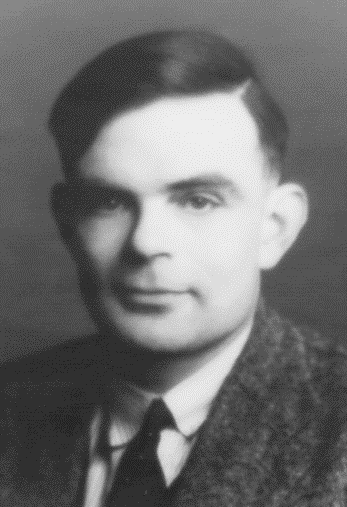
Mathematician and code-breaker Alan Turing was born on this day in 1912 in London. A brilliant youth who was neglected by his parents, Alan Turing was shy and socially-awkward, despite being a gifted athlete as well as a math whiz. At boarding school he developed a deep friendship with a schoolmate, Christopher Morcom, whose death when Turing was 18 left Turing devastated. Both before and after Morcom's death, it appears that Turing was confused about his own sexuality, although in later years, while he made occasional comments about having children and settling down, he was thought to have been exclusively homosexual.

In 1931, Turing entered King's College, Cambridge and found it rocked by a debate over the limits of mathematical analysis in reaction to the concept of "undecidables" put forward by Kurt Godel, who proved that there were some mathematical problems that were beyond the reach of logic. At 25, Turing imposed his indelible stamp on the debate -- and the history of computer science -- with a paper entitled "On Computable Numbers," in which he described an imaginary machine that would be capable of answering any mathematical question which could be logically answered through algorithms. Turing observed that such a machine (which he dubbed the "Universal Turing Machine"), though universal in its ability to apply mathematical logic to a problem, would be incapable of deciding whether a question was "undecidable," thus supporting Godel's view.

More interesting to computer historians, however, was that Turing's conceptualization of the Universal Turing Machine was a theoretical blueprint for the modern programmable computer. Before anything could be made of the idea, World War II had begun and Turing was invited to join the secret group of British cryptanalysts at Bletchley Park, where he led the British government's attempts to break German codes scrambled by Arthur Scherbius' Enigma scrambling machine by conceptualizing the descrambling approach and stringing together multiple descramblers. In conducting the war, Winston Churchill came to rely heavily on Turing's work, and even increased funding to the project based on a direct request from Turing himself.

After the war, Turing worked with the British National Physical Laboratory and at the University of Manchester to attempt to build a prototype of the Universal Turing Machine. A proponent of artificial intelligence, Turing unveiled his now famous "Turing test" in 1950, whereby a subject would be locked in a room to pose questions to 2 unseen answer providers, one human, one computer; if the subject was not able to tell which was the human and which was the computer by the content of the answers, then according to Turing the machine would be said to be "thinking" as well as the human.

In 1952 he admitted to police that he was having a homosexual affair, and was convicted of "gross indecency." Subjected to female hormones as "therapy" for curbing homosexual lust, Turing grew depressed and committed suicide on June 7, 1954 in Wilmslow, Cheshire, England by eating a cyanide-poisoned apple (he had been an avid fan of Disney's Snow White and the Seven Dwarfs) at the age of 41. His role in cracking the Enigma code would not be revealed until the 1970s.

Also an accomplished marathon runner, during the 1940s, Turing was unofficially one of Britain's finest, achieving a personal-best time of 2:46:3, only about 11 minutes behind Delfo Cabrera's 1948 Olympic gold-medal winning time of 2:34:51.6.

Labels: , , ,

Saturday, June 17, 2006

Nelson's Xanadu


"The story of Ted Nelson's Xanadu is the story of the dawn of the information age. Like the mental patient in Thomas Pynchon's Gravity's Rainbow who believes he is the Second World War . . . Nelson, with his unfocused energy, his tiny attention span, his omnivorous fascination with trivia, and his commitment to recording incidents whose meaning he will never analyze, is the human embodiment of the information explosion." - G. Wolf.

Information theorist Ted Nelson was born on this day in 1937 in Chicago, the son of film director Ralph Nelson and actress Celeste Holm.

After studying philosophy at Swarthmore, Nelson was pursuing a master's degree in sociology at Harvard when he enrolled in a computer course and began to have visions about the future of information. There he made an attempt, before the invention of word processing systems, to create a "writing system" which would allow writers to store and edit their work; unfortunately, he took an "incomplete" in the course. In the 1960s, he became known as a computer theorist, without actually producing software, and coined the words "hypertext" and "hypermedia" to refer to the linking of related texts or media -- a concept which had been explored as early as 1945 by Vannevar Bush.

With a growing reputation as a visionary, Nelson worked in and out of business and academia attempting to advance his ideas about the nonsequential, interlinked presentation of information and his predictions of millions of simultaneous users of this information, but his chronic lack of focus (he suffers from attention deficit disorder) and rebelliousness (among his favorite maxims are "most people are fools, most authority is malignant, God does not exist and everything is wrong") got him bounced from job to job.

From the late 1960s, however, Nelson has been actively supervising the design of Xanadu (named after the "pleasure dome" referred to in the unfinished poem by Samuel Coleridge, Kublai Khan), a proposed hypertext system in which all links between text are two-way and which would provide for the publication of comments on existing works to appear as anntotations; parallel retrieval and editing; version management; and an efficient system of copyright management. In effect, he had envisioned a universally accessible, self-updating electronic library/town meeting.

In its early days, the proposed system anticipated Tim Berners-Lee's World Wide Web; since the emergence of the Web in 1990, Nelson has offered his proposed system as a less autocratic, more multi-dimensional and interactive alternative to the Web, which he disparages as a mere "child's wagon" in terms of its power and complexity. Like Charles Foster Kane's Xanadu construction project in Orson Welles' Citizen Kane, Project Xanadu is "still unfinished," although it has had the backing of no less than Autodesk (for a time) and despite the fact that Nelson had predicted its release as long ago as 1976, 1988 and 1991. According to the official Xanadu website, Nelson's investors forced his work to be made available in an "open source" environment in 1999, although Nelson is seeming to insist that Project Xanadu is ongoing as an independent project.

Nelson's critics tend to portray him, at worst, as a woolly charlatan, leaving behind him a pile of unfinished projects, disgruntled investors, and a collection of clever new buzzwords (including "docuverse," "cybercrud" and "softcopy"); at best, they see him as a brilliant, compulsive mad-monk, squandering his genius by toiling away at the mystically unattainable -- like Isaac Newton in his later years, searching for the keys to alchemy.

Labels: , ,

Wednesday, May 03, 2006

Ned Ludd and His Luddites


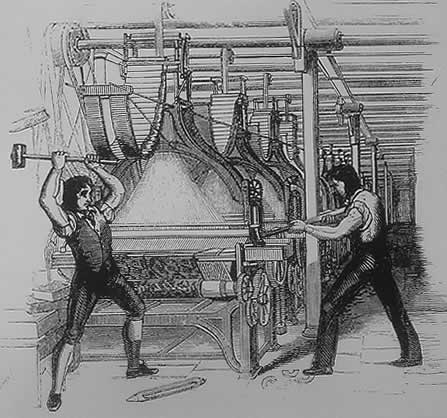
The term "Luddite" refers to a person who advocates the destruction of labor-saving technology and a return to a primitive pre-technological society which perhaps never existed, but in England during the Industrial Revolution, the term had a much more specific meaning, referring to workers who protested wage reductions and unemployment by breaking machinery.

One of the main focal points of these activities was in the stocking industry. For 200 years, stocking-makers used a simple stocking frame in their work, but around 1750, a new stocking frame was introduced in factories which permitted manufacturers to make more stockings with less labor. As the implications of technological progress became clear to the stocking-makers, a radical vanguard of them sporadically took to smashing a number of new frames in protest throughout the latter half of the 18th century.

A child's legend arose in the milieu of the protests about a young Anstey stocking-maker's apprentice named Edward Ludlam who, having received a whipping from his father for mischief unknown, retaliated by breaking a couple of stocking frames; thus, whenever stocking-makers found a broken frame, they would joke that "Ned Ludd" must have been there. The protesters found a hero in Ned Ludd, and used the image of a fiery Anstey lad grown-up to drive home their fury. In 1811, as a kick-off to the most strident of Luddite crusades, manufacturers in Nottingham started to receive threatening letters from "General Ned Ludd and the Army of Redressers," followed swiftly by nighttime raids on factories during which 200 new stocking frames were broken.

The protests spread with popular support against the evils of newfangled technology -- despite rewards offered by the Prince Regent for the arrest and capture of the Luddites and the imposition of the death penalty for frame-smashing. (On hearing about the new penalty, Lord Byron made an impassioned plea for clemency for starving stocking-makers in his maiden speech in the House of Lords.) The Luddite protests reached their peak in June 1816, when an army of Luddites marched to Loughborough, destroyed 55 frames, and burned lots of socks. In the days following the Loughborough riot there were numerous arrests, followed by 7 well-attended hangings.

Nowadays, Luddites are more likely to hang out in used bookstores and make popcorn with oil on a stove and rarely smash things or burn socks. They escape hanging but not ridicule.

Labels: ,

Saturday, November 26, 2005

Willis H. Carrier


Willis H. Carrier (born on this day in 1876 near Angola, Indiana) has a lot to answer for, apparently.

Sociologists regard the introduction of air conditioning in the U.S. as a major turning point in the evolution of the American lifestyle, transforming this once gregarious, outdoorsy, collaborative, porch-sitting population into an isolative, flabby, suspicious, couch-potato race of snarling lone wolves. Then, of course, there was the revelation in 1984 that chlorofluorocarbons used in refrigeration systems were largely responsible for the receding of the Earth's ozone layer, leading to an increase in global warming (ironically), skin cancer, cataracts and suppressed immune systems. On the other hand, as Molly Ivins puts it:

"As anyone who has ever suffered through a brutal summer can tell you, if it weren't for Carrier's having made human beings more comfortable, the rates of drunkneness, divorce, brutality and murder would be Lord knows how much higher. Productivity rates would plunge 40% over the world; the deep-sea fishing industry would be deep-sixed; Michelangelo's frescoes in the Sistine chapel would deteriorate; rare books and manuscripts would fall apart; deep mining for gold, silver and other metals would be impossible; the world's largest telescope wouldn't work; many of our children wouldn't be able to learn; and in Silicon Valley, the computer industry would crash."


Whew -- even if some of that is disputable, it's hard to dispute the positive impact Carrier's ideas have had on our culture.

A Cornell engineer, Carrier went to work for Buffalo Forge Company, where within a year he had designed a pumped ammonia system for controlling temperatures and humidity in a Brooklyn printing company, where fluctuations in heat and humidity were causing the misalignment of colored inks.

Next Carrier turned his thinking to cooling the spindles of a Carolina cotton mill, and in 1911, after a flash of genius while waiting for a train on a foggy night, Carrier developed the "rational psychometric formulae" -- equations for determining the relationship between temperature, humidity and dewpoint -- which became the basis for all fundamental calculations in the air conditioning industry. Short-sighted Buffalo Forge dismissed its entire engineering department in 1915, leaving Carrier and 6 engineer friends to form Carrier Engineering Corporation, dedicated to achieving whatever temperature and humidity levels were required by its industrial customers.

In 1922, Carrier invented the centrifugal refrigeration machine, the first practical method of conditioning air in a large space, using non-toxic, non-flammable chlorofluorcarbon refrigerants. As he had early on predicted, Carrier's designs would soon be used for human comfort, not just for industrial purposes. In 1924 Carrier installed centrifugal chillers in the J.L. Hudson Department Store in Detroit, and soon thereafter put them in the Palace, Texan and Iris movie theaters in Houston, causing the box office receipts in those theaters to jump off the charts during a heatwave; some even suggest that Carrier indirectly fostered the rise of the entertainment industry, which had always been hobbled by slacking attendance during hot summers.

Weathering the Depression with the assistance of enormously patient bankers, Carrier unveiled the "Weathermaker" air conditioner for private home use in 1926, and in 1939 he introduced a system for air-conditioning skyscrapers. Although World War II interrupted the advance of air conditioning, by 1995, Carrier Corp. sales topped $5 billion, even as the company began to produce the first chlorine-free, non-ozone-depleting residential air conditioners. Carrier himself passed away in 1950, just as the great lurch forward in the propagation of air conditioning was occurring.

Labels: , ,