Wednesday, May 14, 2008

Moving Staircase


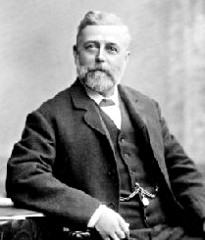
Charles D. Seeberger, the "inventor" (sort of) of the escalator, was born on this day in 1857 in Oscaloosa, Iowa.

Seeberger was a Yale-trained engineer who obsessed over the prospect of a moving staircase while working in the family hardware store in Chicago. In 1895 he left the family firm and filed a patent for an "escalator," a name he coined; the Patent Office was a little mixed up by the time it granted Seeberger's patent under the title "elevator."

Seeberger wasn't satisfied with his own design, however, preferring George Wheeler's "flat-step" design. He acquired Wheeler's patent in 1898, meshed it together with bits and pieces of what he had designed himself and engaged the Otis Elevator Company (founded by Elisha Otis in the 1850s) to build the prototype. The Otis Company and Seeberger unveiled the escalator at the 1900 Paris Universal Exposition, where it competed for attention with Jesse Reno's "inclined elevator," a conveyor belt with step-like rows of iron cleats to support the feet of the passengers as they leaned forward precariously. Although Reno's design was a lot less comfortable than Seeberger's, it did have a comb of fingers at the landing which passed between the cleats and kept stray shoelaces and skirts from getting caught in the machine.

The Otis-Seeberger and the Reno moving-staircases competed against each other until 1910, when Otis purchased Reno's company. Even as late as 1911, however, the Otis Company had to go to extreme lengths to reassure customers of the safety of the escalator; when the first Seeberger escalator was installed in the London Underground, the Otis Company hired a man with a wooden leg, "Bumper" Harris, to ride the escalator all day to demonstrate its harmlessness.

Seeberger left Otis in 1915; and in 1920, the Otis Company combined Seeberger's modified flat-step escalator with Reno's combed landing, producing what was to become the most popular model of moving-staircase, selling more units in the 2 years that followed than it had ever sold of the either the Seeberger or Reno designs alone. None of them perfected a way of keeping people walking instead of standing in my way on escalators, however.

Seeberger passed away in September 1931 in Oak Bluffs, Massachusetts.

Categories: ,

Labels: ,

Thursday, August 30, 2007

Faster Calculating


Computer pioneer John W. Mauchly was born on this day in 1907 in Cleveland, Ohio.

John Mauchly was an obscure professor of physics --in fact, he was the whole physics department at Ursinus College in Collegeville, Pennsylvania -- who was best known locally for his entertaining "Christmas lectures" on basic physical principles, illustrating Newton's laws with skateboards and bringing spectroscopic principles to bear on finding out the contents of Christmas gifts wrapped in colored cellophane.

His avocation, however, was weather prediction, and when he wasn't teaching Physics 101 to pre-med students he was writing papers on the effect of solar activity on rainfall patterns. His sticking point, however, was that the mathematical analysis required to support his theories required a better, faster calculating machine than he had ever encountered.

Believing electronics to be the answer after a visit to Iowa to see the pioneering work of John Atanasoff, in 1941 Mauchly enrolled in a U.S. War Department- sponsored "defense training in electronics" course at Penn, where he met Pres Eckert, a recent graduate from the Penn electronics department. Together they discussed the possibility of designing an electronic calculating machine, which culminated in Mauchly's proposal for defense funding, "The Use of High-Speed Vacuum Tube Devices for Calculation." The government bit on the concept, needing faster calculators to calculate ballistic missile trajectories, and in 1943 Mauchly and Eckert began work on the ENIAC -- the Electronic Numerical Integrator and Computer.

As they built the 30-ton behemoth, they had to figure out not only how to coordinate the activities of 18,000 vacuum tubes, but they had to find wire that rats would not eat. Ultimately ENIAC was used for 8 years on hydrogen bomb problems and calculation of Russian weather patterns.

Next, Mauchly and Eckert began to work on the EDVAC (Electronic Discrete Variable Computer), a stored-program machine, but mathematician John von Neumann grabbed the reins of the project and Mauchly and Eckert got into a dispute with Penn over the ownership of their designs; so in 1948 Mauchly and Eckert formed their own company, the Eckert-Mauchly Computer Corporation, to commercialize computers. They built the UNIVAC I, which they sold to such firms as Prudential and A.C. Nielsen (as well as the U.S. Census Bureau) for a price of $150,000 each, but they were cash poor and sold out to Remington Rand, the typewriting company, in 1950, which in turn sold out to Sperry in 1955.

Having demonstrated that there was a market for large-frame computers, their much better financed competitor, IBM, began to pour its resources into the opportunity, eclipsing the success of Mauchly and Eckert's UNIVAC. Mauchly and Eckert, however, had shown the world that electricity could be used to solve mathematical problems and produced the first commercial electronic digital computer.

Mauchly died on January 8, 1980.


Labels: , ,

Saturday, June 23, 2007

Cerfing the Net


As every schoolchild knows, the Internet began, oddly enough, as a U.S. national security imperative: RAND Corporation staffers, faced with the hypothetical problem of a communications paralysis in the U.S. following a nuclear attack, developed a proposal for a completely decentralized communications network, connected by "nodes"of equal status that could toss a "packet" of information from one node to another until the information could reach its intended destination.

A few years of noodling and testing followed, until the Pentagon asked the computer science department at UCLA to assist in building a computer network that encompassed the RAND concept of "packet switching."

While the Pentagon had national security in mind, Vinton Cerf, a grad student in computer science at UCLA in 1968, had a personal stake in this alternative method of communication. Cerf (who was born prematurely on this date in 1943) was hearing-impaired and could not differentiate between telephone voices; "electronic mail" would eventually prove to be a more friendly form of communication. Cerf worked on the first relatively crude system of computer protocols that would allow different computers speaking different languages to communicate with each other over telephone lines in service of "packet switching."

By 1971, UCLA had built a 15-host system, known as the ARPANET, which was used by Pentagon scientists and their counterparts in the university sector to communicate with each other and post information of mutual interest. In 1972, Cerf joined the faculty at Stanford, and with the help of Robert Kahn and several others, conceptualized and refined the more sophisticated TCP/IP protocols for computer communication. The Transmission Control Protocols, or TCP, convert messages into streams of packets at the source and reassemble them back into messages at the destination; the Internet Protocols, or IP, handle the addressing of packets being routed across multiple nodes.

In the mid-1970s, Cerf joined the Pentagon to implement TCP/IP as the prevailing standard for computer communication. By the mid-1980s, the Internet had become one of the most influential scientific instruments of the century, enabling the free exchange of research and even the sharing of computing facilities on a global basis at low cost and high speed; but even Galileo's refracting telescope, another influential scientific instrument, could be used for other things than its intended scientific purpose -- as a window to the beauty of the firmament, as a club to beat people over the head with, or, one supposes, if you take the lenses out of a hand-held one, an imperfect funnel.

As the Internet expanded past the original ARPANET sites to 30 million hosts by the beginning of 1998 (due in part to the creation of the World Wide Web by Tim Berners-Lee, among others, which began to give the Internet its user-friendly media and navigation characteristics), users found a myriad of decidedly non-scientific uses for the Internet, the most significant being perhaps the transaction of consumer commerce (see funnel, above) for everything from mechanical parts to flowers to real estate to pornography. Cerf later served as a vice president at MCI Communications, where he continued to develop Internet-based services and tools, and now holds the title of "vice president and chief internet evangelist" at Google.


Labels: , ,

Saturday, June 09, 2007

Household Sounds


Fred Waring was born on this day in 1900 in Tyrone, Pennsylvania. He died on July 29, 1983 in State College, Pennsylvania.

Waring was a violinist and banjo player, best known as the leader of a 70-man white-bread swing band, "Fred Waring and the Pennsylvanians," from 1923 up until his death. An expert marketeer and wheeler-dealer, Waring managed to build his rickety college jazz quartet into a diversified corporate venture, operated from his headquarters on Broadway in Manhattan, spawning radio and TV shows, recordings, world tours, summer choral workshops, music publishing, real estate ventures ... and a blender.

Waring's name is indeed associated with the first popular non-commercial electric blender, known as the "Waring blender." In the 1930s, an inventor named Frederick Osius asked Waring (a one-time Penn State engineering student and an incorrigible gear-head) for financing to develop his patent for an electric blender. Waring invested $25,000, but Osius developed technical difficulties with his design, so Waring fired Osius and had the machine redesigned. The new "Miracle Mixer" was introduced at the 1937 National Restaurant Show in Chicago. The following year, Waring changed the name of the product to the "Waring blender" and marketed the machine while touring the country with the Pennsylvanians. The Waring blender became a must-have item, whirring away in every American kitchen (over a million of them were sold by 1954), and commercial versions of the blender became standard laboratory equipment -- apparently even Jonas Salk used a Waring blender while developing the polio vaccine.

Waring's other distinct claim to fame was his direct effect on the nature of music played on the radio. While during the 1920s, it was fairly common for radio stations to hire bands to perform live on the air, the effects of the Depression had forced radio stations to cut back on such gigs, resorting instead to spinning records, despite the fact that records were generally sold with a stamp that prohibited them from being played on the air. Waring and his band were popular recording artists in the 1920s on the Victor label, but by 1932, Waring decided to stop recording, fearing that his records were cutting in to his more lucrative live gigs. He was also well aware of the fact that as a performer, he did not receive a penny when one of his records was played on the radio -- despite the fact that ASCAP, the American Society of Composers and Publishers, had already begun to establish rights on behalf of songwriters to be paid each time their work was broadcast. (The rival rights organization, BMI, was actually established by the National Association of Broadcasters in 1940 to break the grip of ASCAP, but expanded protection for songwriters by signing African-American songwriters who had been barred from participating in ASCAP.)

While Waring was still under contract with Victor, a bootlegging sound engineer made a transcription of one of Waring's live radio performances and sold a copy of it to a radio station. Waring successfully sued both the bootlegger and the radio station, WDAS in Philadelphia, and then he his sights on something bigger -- securing a piece of the action for performers whenever an authorized recording was played on the radio. Waring founded a new organization, the National Association of Performing Artists, and took aim at radio stations. In a case in Pennsylvania court in 1937, Waring successfully enforced a restrictive legend placed on one of his records that stated that the record was "Not Licensed for Broadcast" -- thus, in theory, giving Waring the ability to negotiate a fee for permitting a station to play the record.

In 1940, however, in the federal Second Circuit Court of Appeals, Judge Learned Hand virtually ignored the Waring case and articulated what became settled law in the matter in a case between bandleader Paul Whiteman and RCA (on the one hand) and WBO Broadcasting (owner of radio station WNEW), stating that RCA, Whiteman's label, had no power "to impose ... pretended servitude on the records; and WBO Broadcasting Corporation is free to buy and use them in entire disregard of any attempt to do so." In reading the opinion, one senses the usually redoubtable Hand's reticence to elevate the work of performers to the same status enjoyed by writers, viewing performers' work as somehow inherently ephemeral. (Maybe yes, maybe no; but what, pray tell, would Judge Hand, if he were alive today, be listening to on his iPod?)

The upshot was that, as a result of Whiteman's defeat, radio stations were emboldened to play records without worrying about claims for compensation from the performers. The record companies were quick to see the angles following the Waring and Whiteman cases; they switched their strategy from attempting to collect licensing fees from radio stations to buddying up with radio stations, enticing them to play their records in order to promote their sale. While record companies were trying to increase the free airplay of records, musicians like Fred Waring began receiving fewer invitations to perform live on the radio. Singer-songwriters, slowly and steadily, began to assert themselves as the prime movers in the pop music medium, since at least they'd get paid through ASCAP or BMI for radio airplay.

After heaving a professional sigh, Waring went back to recording after World War II.


Labels: , ,

Thursday, September 28, 2006

Crapper


The noted plumber Thomas Crapper was baptized on this day in 1836 in Thorne, Yorkshire, England.

Many sources to this day snicker as they report that a man by the name of Thomas Crapper invented the flush toilet. The truth of the matter is that while Crapper was a competent and successful plumber, the use of flush toilets was already well established in England by the time Crapper was born (about 2/3 of the essential technology having been invented by the poet John Harington in the 16th century). Crapper was apprenticed to a plumber as a youngster, and by the age of 30 he had set up his own business in the waste-water capital of the world, London.

Over the course of almost 40 years in the business, Crapper received 9 patents -- 4 for improvements to drains, 3 for water closets, 1 for manhole covers and 1 for a pipe joint -- but never received a patent for the product which seems to have bought him immortality, the Silent Valveless Water Waste Preventer, a siphonic discharge system that permitted a toilet to flush when the cistern was only half full. That device was actually patented by Albert Giblin, and it is assumed that Crapper bought the rights from Giblin before he began selling Crapper's Valveless Water Waste Preventer as part of his line of toilet products.

In the 1880s, Crapper became the royal sanitary engineer to Queen Victoria, and he supervised the refurbishing of all plumbing at Sandringham House, including around 30 lavatories with cedarwood seats. Although the word "crap" has been around since the 13th century as slang for waste, the use of the word "crapper" for the toilet seems to be uniquely American, and is thought to have been brought to the U.S. by American soldiers during World War I who saw "T. Crapper -- Chelsea" stamped on British toilets. A number of manhole covers also stamped with the Crapper name can be found around London, including several, popular for brass-rubbings, in Westminster Abbey.

After his retirement in 1904, Crapper's plumbing business continued to operate under his name until 1966. Crapper died on January 27, 1910 in London.

Labels:

Saturday, November 26, 2005

Willis H. Carrier


Willis H. Carrier (born on this day in 1876 near Angola, Indiana) has a lot to answer for, apparently.

Sociologists regard the introduction of air conditioning in the U.S. as a major turning point in the evolution of the American lifestyle, transforming this once gregarious, outdoorsy, collaborative, porch-sitting population into an isolative, flabby, suspicious, couch-potato race of snarling lone wolves. Then, of course, there was the revelation in 1984 that chlorofluorocarbons used in refrigeration systems were largely responsible for the receding of the Earth's ozone layer, leading to an increase in global warming (ironically), skin cancer, cataracts and suppressed immune systems. On the other hand, as Molly Ivins puts it:

"As anyone who has ever suffered through a brutal summer can tell you, if it weren't for Carrier's having made human beings more comfortable, the rates of drunkneness, divorce, brutality and murder would be Lord knows how much higher. Productivity rates would plunge 40% over the world; the deep-sea fishing industry would be deep-sixed; Michelangelo's frescoes in the Sistine chapel would deteriorate; rare books and manuscripts would fall apart; deep mining for gold, silver and other metals would be impossible; the world's largest telescope wouldn't work; many of our children wouldn't be able to learn; and in Silicon Valley, the computer industry would crash."


Whew -- even if some of that is disputable, it's hard to dispute the positive impact Carrier's ideas have had on our culture.

A Cornell engineer, Carrier went to work for Buffalo Forge Company, where within a year he had designed a pumped ammonia system for controlling temperatures and humidity in a Brooklyn printing company, where fluctuations in heat and humidity were causing the misalignment of colored inks.

Next Carrier turned his thinking to cooling the spindles of a Carolina cotton mill, and in 1911, after a flash of genius while waiting for a train on a foggy night, Carrier developed the "rational psychometric formulae" -- equations for determining the relationship between temperature, humidity and dewpoint -- which became the basis for all fundamental calculations in the air conditioning industry. Short-sighted Buffalo Forge dismissed its entire engineering department in 1915, leaving Carrier and 6 engineer friends to form Carrier Engineering Corporation, dedicated to achieving whatever temperature and humidity levels were required by its industrial customers.

In 1922, Carrier invented the centrifugal refrigeration machine, the first practical method of conditioning air in a large space, using non-toxic, non-flammable chlorofluorcarbon refrigerants. As he had early on predicted, Carrier's designs would soon be used for human comfort, not just for industrial purposes. In 1924 Carrier installed centrifugal chillers in the J.L. Hudson Department Store in Detroit, and soon thereafter put them in the Palace, Texan and Iris movie theaters in Houston, causing the box office receipts in those theaters to jump off the charts during a heatwave; some even suggest that Carrier indirectly fostered the rise of the entertainment industry, which had always been hobbled by slacking attendance during hot summers.

Weathering the Depression with the assistance of enormously patient bankers, Carrier unveiled the "Weathermaker" air conditioner for private home use in 1926, and in 1939 he introduced a system for air-conditioning skyscrapers. Although World War II interrupted the advance of air conditioning, by 1995, Carrier Corp. sales topped $5 billion, even as the company began to produce the first chlorine-free, non-ozone-depleting residential air conditioners. Carrier himself passed away in 1950, just as the great lurch forward in the propagation of air conditioning was occurring.

Labels: , ,

Wednesday, November 09, 2005

Hedy Lamarr

Film actress Hedy Lamarr was born Hedwig Kiesler on this day in 1913 in Vienna, Austria.

A captivating brunette beauty even in her teens, banker's daughter Hedwig Kiesler was discovered by Max Reinhardt and started appearing in German films at 17. At age 20, she became an instant international celebrity for her notorious appearance in a Czech film, Ecstasy (1933), in which she spent 10 minutes swimming and cavorting in the woods in the nude. Shortly afterward she married a munitions maker, Fritz Mandl, who attempted to buy and destroy all the copies of his wife's nude scene, but the marriage dissolved before Mandl could achieve his aim.

Louis B. Mayer met Hedwig, now known as Hedy Lamarr, in London during the mid-1930s, and although he was fascinated with her, his concern about the nude scandal led him to avoid giving her a contract until finally, in 1938, he brought her to Hollywood.

She became a kind of Garbo replacement at MGM, the enigmatic European beauty, although she enjoyed few box office successes, notable exceptions being Algiers, 1938, in which Charles Boyer whispered "Come vis me to da Casbah" to her; White Cargo, 1942, as "Tondelayo"; and Samson and Delilah, 1949, with Victor Mature -- a film about which Groucho Marx observed, "No picture can hold my interest when the leading man’s bust is bigger than the leading lady’s."

Her career declined rapidly during the 1950s, and by 1965, when she was arrested for shoplifting, she was living in a broken-down L.A. house with an unfinished swimming pool in the backyard and driving a 10-year old Lincoln with the letters "HL" spelled out in Blue Chip stamps on the dashboard. Her liaison-filled autobiography, Ecstasy and Me: My Life as a Woman, came out the next year, with introductions by a psychologist and a doctor detailing the medical significance of her narrative.

The sexual scandals and apparent instability belied and overshadowed Lamarr's role in the history of communications technology: based on two years of work with composer George Antheil, in 1942 Lamarr received a patent on a device which controlled torpedoes by radio through "frequency hopping"-- a concept which provided the basis of anti-jamming technology used on the Milstar defense satellite system and in cellular phones.

She died on January 19, 2000 in Altamonte Springs, Florida.

"Any girl can be glamorous. All you have to do is stand still and look stupid." -- H. Lamarr.

Labels: ,