Wednesday, February 07, 2007

Frederick Douglass


"If there is no struggle, there is no progress. Those who favor freedom and yet deprecate agitation are men who want crops without plowing the ground . . . Power concedes nothing without a demand." -- Frederick Douglass.

Fifteen years before the historic Lincoln-Douglas debates on the future of slavery in the U.S., another famous public debate on slavery's future occurred in Buffalo, New York in 1843 -- this one between two former slaves, Henry Highland Garnet and Frederick Douglass, before a gathering of the National Negro Convention. The question: should African-American slaves rise up in violent rebellion against their owners to bring the heinous practice to an end? Garnet lent his support to a resolution encouraging slaves to strike, violently if necessary. Douglass, however, showed his great powers as an orator and molder of opinion by convincing the assembled leaders that any such rebellion would be decisively crushed. Garnet's resolution was narrowly defeated, and Douglass emerged as a member of the front ranks of African-American political life.

As Douglass underwent a personal conversion with respect to the question of an active struggle during the 1850s, however, so would the views of his African-American constituents, and the course of history was indelibly altered.

Born around 1817 in Tuckabee, Maryland, Douglass was the son of a slave mother and an unknown white man, and was almost immediately taken away from his mother to live at another plantation as slave property. Although he suffered treatment usually only accorded to livestock (being forced to eat from a trough and enduring cold winters without adequate clothing and shelter), at the age of 8 he was selected to be a house servant, and was taught to read by the woman of the house. Douglass quickly surmised that the withholding of education from Africans was a principal instrument of the white man's domination, so he absorbed as much as he could when he could, in essence stealing an education.

In 1838, after one unsuccessful escape attempt when he was 16, he stole himself, borrowing an affidavit of freedom from an African-American sailor and settling in Massachusetts under the name "Douglass" to avoid recapture. In 1841, he gave a speech against slavery at a meeting of white abolitionists on Nantucket Island, and was instantly recognized by anti-slavery activist William Lloyd Garrison as a potentially powerful symbol for the movement. Douglass became Garrison's willing protégé, but with his charisma and superior intellect Douglass became much more than a symbol; he rose to be a leader.

His 1845 autobiography, Narrative of the Life of Frederick Douglass, was a sensation, revealing in the first person the inhumanity of the slave system as no white man could. As the leonine Douglass gained his own spotlight apart from Garrison, his views against active resistance by (and on behalf of) African-Americans began to soften. He viewed John Brown's raid as a quixotic spasm, but he predicted that Brown's execution would lead to civil war. Although white leaders on both sides cited "states' rights vs. federalism" as the central issue of the War Between the States, Douglass' voice helped to shift the debate to the human rights conflict underlying the War, and was no doubt one of the influences behind Lincoln's decision to issue the Emancipation Proclamation in 1863.

After the Proclamation, Douglass spent much of the rest of the Civil War recruiting African-Americans to fight against the South. After the War, however, Douglass permitted himself to be used as a "token African" by the Republicans to whom he somewhat naively clung, accepting hollow federal appointments (including as consul general to Haiti) from Presidents Hayes and Garfield; yet he maintained enough independence to criticize the manipulation of newly-freed Southern African-Americans. Nevertheless, his wealth and security did eventually alienate him from the realities of the Reconstruction. He drew criticism in 1884 when, 2 years after the death of his first wife (also a former slave), he married Helen Pitts, a white woman; Douglass' reply to critics was characteristically logical and unapologetic: his first wife "was the color of my mother, and the second, the color of my father."

At the height of his powers during the 1850s, he had extraordinarily complex and consistent political views which, through his words, seasoned the consciousness of white Americans. Not only did he lend his name and support to the Seneca Falls women's suffrage convention called by Elizabeth Cady Stanton and Lucretia Mott, but he was active in the temperance movement, calling the distribution of liquor by slave owners as a means of controlling slaves "one of the grossest frauds committed upon the downtrodden slaves" -- a prophetic perspective in light of the systematic exposure of African-Americans to narcotics in the 20th century.

Douglass died on February 20, 1895 in Washington, D.C.

Labels:

Wednesday, January 17, 2007

The Greatest


"You think the world was surprised when Nixon resigned? Wait 'til I kick Foreman's behind!" -- Muhammad Ali, 1974.

Brash. Stylish. Principled. Proud. These are just some of the words which come to mind when you think of Muhammad Ali. Not just a boxing champ, he was a media sensation who brought an audience back to boxing that had slipped away during the sport’s dark years -- a period in which the Kefauver Commission had explored boxing’s connections with organized crime and rendered the whole enterprise suspect. After bringing the fans back, he stood up for his race and religious principles, suffered greatly for his courage, and fought his way back to the top as only a man of Ali’s enormous self-confidence ("I am the greatest!" was his mantra) and larger-than-life stage presence could have done.

Born Cassius Marcellus Clay, Jr. on this day in 1942 in Louisville, Kentucky, he exploded onto the boxing scene by winning the light-heavyweight gold medal at the Olympics in Rome in 1960; and in an act of defiance after returning to the U.S. and being refused service in a Southern diner, he threw his gold medal into the Ohio River. "My holiday as a White Hope was over. I felt a new, secret strength," Ali later recalled. His frustration with American race relations was a constant theme during his career, and by the force of his personality he somehow managed to rise to stardom without having to play by all the "Jim Crow" rules which other African-Americans had to follow. Jackie Robinson, Joe Louis, Sammy Davis, Jr. -- these near contemporaries would all have to play by white men’s rules to some degree, being polite and subservient by word and deed, even if their impact would be felt in their ability to beat whites at their own contests.

A group of white businessmen in Kentucky sponsored young Cassius Clay’s professional career, wisely letting him become the charismatic politician/star he was born to be as they saw to his training and conditioning. Even in the ring he was unconventional, dancing around with his arms dangling, and he wasn’t given much of a chance against the scowling champ Sonny Liston in February 1964, but he beat him in 7 rounds to become the undisputed heavyweight champion. In his rematch with Liston later that year, Clay dropped Liston in the first round, then stood over him in one of the most unforgettable tableaux of 20th century sports, shouting "Get up, you bum!" through his mouthpiece.

During that first year of his first title, Clay converted to the Nation of Islam through the influence of Malcolm X, shed his "slave name" and became known as "Muhammad Ali" -- a gesture which unnerved white fans. After the Liston fights, Ali successfully defended his title 8 times, until in 1967 he was threatened with a jail sentence for refusing to enter U.S. military service in Vietnam on religious grounds, and his title was stripped from him by the World Boxing Association. Jack Johnson, similarly, had his title yanked from him behind the scenes after being convicted under the Mann Act in an episode that also had the unmistakable stench of racism. True, Ali was succeeded by another African-American, Joe Frazier, but Frazier was not an avid purveyor of "black power"; to white America at that time, Frazier was safer.

In 1970, the U.S. Supreme Court overturned Ali’s conviction, and Ali returned to boxing, losing to Frazier in his first attempt to regain the title in 1971. By 1974, when the towering new champ George Foreman agreed to face him in Zaire, fight fans feared for Ali’s life; but with a combination of pre-bout mind games and sheer stamina in the ring (employing the now famous "rope-a-dope" defense), Ali outlasted Foreman’s brutal punches and knocked him out in the 8th round to regain the title. After 10 more defenses (including the classic "Thrilla in Manilla" against Frazier in 1975), Ali somewhat jadedly fought another Olympic gold medal winner, Leon Spinks, and lost on points in February 1978 -- only to steal the WBA title back 7 months later.

He then promptly retired, his body failing to live up to the expectations of his always ready mouth. Driven by financial difficulties, he fought once more for the title against Larry Holmes in 1980 at the age of 38, and once more again in a disastrous non-title bout the following year, before Parkinson’s Disease made it impossible for him to fight and slowed his speech to a silence out of which not even Howard Cosell could coax him. His overall record, which seems like a mere meaningless footnote: 56 wins (37 knockouts) and 5 losses.

Everyone, it seems, has a story about meeting Muhammad Ali -- which means that he's probably personally touched more lives than almost any other living human being I can think of. I've met him twice -- once at a trade convention in New Orleans, and again at a Parkinson's benefit. He instantly commands a room, and he bears his role as living icon with powerful dignity, and with an unfailingly wry sense of humor.

Labels: ,

Saturday, January 06, 2007

Charles Sumner


"Where Slavery is there Liberty cannot be; and where Liberty is there Slavery cannot be." -- C. Sumner.

Abolitionist leader Charles Sumner was born on this day in 1811 in Boston, Massachusetts.

Our 21st century view of Charles Sumner is marked by distinctly contrasting indications. Having had the pleasure of working one summer for editor Beverly Wilson Palmer on the Charles Sumner Papers, I have some additional insights about the man. Sumner was an expert on the arcanities of American jurisprudence and probably among the most brilliant men in politics in his day, but he could come off personally as a marshmallowy romantic schoolboy, remaining a shy bachelor all his life; a living martyr to the anti-slavery cause, he was an American hero, yet his bloodthirsty conduct during the impeachment trial of Andrew Johnson was anything but heroic -- although it may have been perceived that way by some of his contemporaries.

Sumner attended Harvard and studied with Justice Joseph Story, and later he served as a reporter for the U.S. Circuit Court and published 3 volumes of Story's decisions. After an extended stay in Europe, he returned to the U.S. in 1840 to edit a 20-volume set of Supreme Court reports.

His opposition to the Mexican War drew him into the public arena, where he distinguished himself as a passionate, highly literate orator. In 1851, he was selected to fill the large shoes of Daniel Webster as Webster's successor to the U.S. Senate from Massachusetts. There he quickly became the leader of the hardcore anti-slavery caucus, and during the 1856 debates over the question of permitting slavery in the new state of Kansas, Sumner delivered his classic two day-long speech, "The Crime Against Kansas," in which he spared no literary excess in denouncing the Southern advocacy of the slavery system.

Congressman Preston Brooks of South Carolina thought he detected in Sumner's marathon speech an insult against his uncle, Senator Andrew Butler, and in retaliation tracked Sumner down at his desk on the Senate floor and beat him into unconsciousness with his cane. Sumner survived the attack badly injured, and was hailed as having given his body to the abolitionist cause. The North saw in Brooks' attack symptoms of generic Southern brutality -- although Brooks himself was championed as a hero in the South.

Sumner kept his seat in the Senate, but spent much of his time in Europe and elsewhere, recuperating. Yet he was energetic in his Senate appearances, calling for the emancipation of the slaves by President Lincoln, introducing the 13th Amendment to the Constitution in 1864, and initiating the bill which became the Civil Rights Act of 1875, which outlawed racial discrimination in public places until it was nullified by Justice Bradley in the Civil Rights Cases (1883).

As President Johnson's program for a lenient Reconstruction of the South began to emerge, Sumner loudly led the charge for Johnson's impeachment and removal, and even called for Johnson's impeachment again after Johnson was acquitted at trial before the U.S. Senate in June 1868. He later attempted to show compassion for the South by proposing that Civil War battles should not be listed on the regimental colours of Union regiments. For his efforts, he was censured by the Massachusetts legislature, but the censure was later repealed.

Much of Sumner's later career in the Senate concerned foreign relations, backing the American claims against the British for providing ships to the Confederacy during the Civil War and opposing President Grant's proposed annexation of Santo Domingo. Having turned down the Liberal Republican nomination for governor of Massachusetts, Sumner died on March 11, 1872, while still serving in the Senate.

Labels: , , ,

Tuesday, December 19, 2006

Freedom Ride


"White cab drivers were hanging around the bus station, with nothing to do. They saw our Trailways bus delayed, and learned the reasons why. Here was something over which they could work out their frustration and boredom. Two ringleaders started haranguing the other drivers. About ten of them started milling around the parked bus. When I got off to put up bail for the two Negroes and two whites in our group who had been arrested, five of the drivers surrounded me. 'Coming here to stir up the n*****s,' snarled a big one with steel-cold grey eyes. With that, he slugged me on the side of the head. I stepped back, looked at him, and asked, 'What's the matter?' My failure to retaliate with violence had taken him by surprise." -- James Peck.

James Peck was born on this day in 1914 in New York City.

A civil rights activist and pacifist, known for his participation in the Journey of Reconciliation (1947, designed to provoke hostile state responses to the U.S. Supreme Court's ruling that segregation in interstate travel was unconstitutional) and in the 1961 Freedom Ride from Washington, D.C. to Mississippi, Peck was brutally beaten by segregationist thugs in Birmingham, Alabama during the Freedom Ride. The brutality he and his fellow activists suffered there ultimately inspired the Kennedy Administration to pressure the Interstate Commerce Commission to end discrimination in bus terminals. Peck died on July 12, 1993.

Labels: ,

Sunday, July 02, 2006

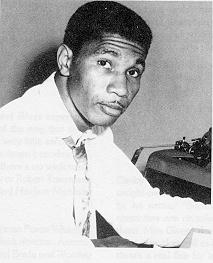
Medgar Evers


"It may sound funny, but I love the South. I don't choose to live anywhere else. There's land here, where a man can raise cattle, and I'm going to do it some day. There are lakes where a man can sink a hook and fight the bass. There is room here for my children to play and grow, and become good citizens -- if the white man will let them." -- Medgar Evers.

Civil rights leader Medgar Evers was born on this day in 1925 in Decatur, Mississippi.

A veteran of Normandy and the French campaign, Medgar Evers returned to Mississippi after World War II to find little had changed since he had left. When he was 14, he witnessed the lynching of one of his father's friends for supposedly insulting a white woman, and even if he did not necessarily personally witness the same kind of shocking violence perpetrated against African-Americans by whites, it still existed, and bigotry still defined the community's attitude toward African-Americans.

After graduating from Alcorn State with a degree in business administration in 1952, Evers joined the National Association for the Advancement of Colored People (NAACP) and tried unsuccessfully to register at the segregated University of Mississippi Law School after the Supreme Court ruled that segregation was unconstitutional in Brown vs. Board of Education (1954; argued by future Supreme Court justice Thurgood Marshall). When he asked if the NAACP would file suit on his behalf, the organization asked him to be the NAACP's field secretary (the only paid position within Mississippi), which led to his investigation of racial violence, organization of voter registration drives and other work for desegregation. Settling in Jackson, Evers protested, again without success, to the Federal Communications Commission to be allowed to have equal time on a local television to answer anti-African-American statements made by white politicians in 1957.

His protests and investigations, though conducted with Evers' natural air of quiet dignity and reasonableness, began to attract the attention of white authorities, who began a systematic program of persecution against him. In 1958, for example, he was arrested for sitting in a "white" bus seat in Meridian; in 1960 he was sentenced to 30 days in jail and fined $100 for criticizing the conviction of another African-American; and in 1962, Evers was beaten by a courtroom policeman when he applauded a defendant who was being prosecuted for his role in a sit-down demonstration. In late 1962 and 1963, while Martin Luther King was staring down Bull Connor and his police dogs in Birmingham, Alabama, Evers stepped up the pace of the civil rights movement in Jackson, publicly advocating the hiring of African-American policeman and orchestrating the first economic boycott of downtown merchants who practiced apartheid, in the process attempting to give African-Americans a reason for shrugging off the sense of inferiority which often curbed their call to action.

As Evers' profile and methods rose in pitch, threats on his life also increased. By June 1963, the Evers family had become accustomed to regular duck-and-cover drills whenever they heard a strange noise outside their home; and on the evening of June 12, 1963, the family's worst fears were fulfilled as Evers was ambushed, shot in the back as he got out of his car. Evers was rushed to a hospital, which initially would not admit him because he was black, but soon afterward tried unsuccessfully to save him once they found out who he was.

5,000 mourners marched through the streets of Jackson at his viewing, and his murder brought the attention of the world to the continuation of hate in the American South -- only a day or two after George Wallace tried to stand in the doorway of the University of Alabama to block the entry of African-American students, and a few hours after President Kennedy delivered a speech describing America's "moral crisis" over African-American civil rights.

By some accounts, Evers' assassination helped to turn the tide toward the passage of civil rights legislation through Congress; yet bigotry still defined Evers' posthumous relationship with Mississippi, as his accused murderer, Byron de la Beckwith, was set free after two hung-jury mistrials despite overwhelming evidence against him, some of it compiled by the FBI. In 1989, de la Beckwith was arrested again by Mississippi authorities based on new evidence and in a somewhat more enlightened racial climate, and on February 5, 1994, he was finally convicted of Evers' murder.

Evers' brother Charles succeeded him as NAACP field secretary in Mississippi, and in 1995 his widow, Myrlie Evers Williams, was elected chair of the national board of directors of the NAACP. Evers was buried, with full military honors, at Arlington National Cemetery, providing the nation with an immediate reminder of the equal part played by African-Americans in time of war. A statue now honors his memory in Jackson.

Labels:

Friday, May 19, 2006

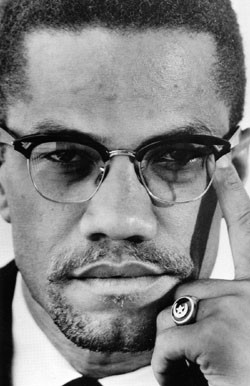
Malcolm X


Racial violence played a significant role in the make-up of the man who would be the first great proselytizer for the black-supremacist Nation of Islam movement and provide a more aggressive alternative to the gradualist, nonviolent approach of Martin Luther King, Jr. (whom Malcolm contemptuously referred to as "Reverend Dr. Chickenwing") for the aspirations of African America; but Malcolm X -- born Malcolm Little on this day in 1925 in Omaha, Nebraska -- was a more complex figure in the civil rights movement than the angry, "un-Kingly" street-hustler he is sometimes remembered as, one who ultimately saw the possibilities of black internationalism as a way of working with whites rather than opposing them.

His father was a Baptist minister who recruited for Marcus Garvey’s "Back to Africa" movement; he is thought to have been murdered in 1931 by white hooligans in Lansing, Michigan, as were 3 of Malcolm’s 4 uncles. His light-skinned mother was the product of the rape of Malcolm’s grandmother by a white man. Within 6 years after the death of his father, his mother entered a mental asylum, and Malcolm drifted into a life of juvenile delinquency. As early as 1942, under the name of "Detroit Red," he became involved in drug trafficking and bootleg whiskey in New York City, but soon the police began to catch on to him, so he fled to Boston and joined a burglary ring. In 1946 he was arrested for burglary, convicted and sentenced to 10 years in prison.

While in prison, his brother Reginald encouraged him to study the teachings of Nation of Islam leader Elijah Muhammad. By the time he was released in 1952, he was a convert, and he joined Muhammad as a recruiter, setting up new temples in Boston, Philadelphia and Harlem. Largely through his charismatic work, the sect grew from a few thousand members in 1954 to over 40,000 in 1958.

Malcolm’s activities gained national prominence in 1959 when Mike Wallace hosted a 5-part TV documentary about the Nation of Islam called "The Hate that Hate Produced," which depicted the Nation of Islam (founded by Wallace Fard in 1930) as a sinister sect which advocated white annihilation. While the documentary frightened white America, it touched a chord with black America as the Nation of Islam’s ranks swelled to 100,000.

With the Nation’s membership increasing in the 1960s, African-American leaders were obliged to take Malcolm X seriously, yet Malcolm was publicly antagonistic of the mainstream of the civil rights movement, criticizing its leaders for consorting with white liberals, referring to the NAACP as a "freak . . . with a black body and a white head" and meeting blow-by-blow the optimistic rhetoric of Martin King. "We’re not Americans," Malcolm declared, "we’re Africans who happen to be in America. We were kidnapped and brought here against our will from Africa. We didn’t land on Plymouth rock -- the rock landed on us." His black nationalist posturing was no doubt a formative influence on Bobby Seale and Huey Newton, founders of the militant Black Panther Party.

People within the Nation of Islam movement began to bristle at his popularity, however, charging him with politicizing what had been a purely religious (if admittedly separatist) movement. When Malcolm made the mistake of declaring that the assassination of John F. Kennedy was a case of "the chickens coming home to roost," Muhammad suspended Malcolm from Nation activities.

In the months of reflection and travel which followed, Malcolm began to question some of his own ideas and goals. He made a pilgrimage to Mecca and visited a number of African countries in 1964, was treated as a celebrity by people of different races and engaged in searching dialogues regarding racism. By the time he returned to the U.S., he had converted to orthodox Islam and surprised critics by declaring that he did not believe all whites were evil. In a show of what might have been, he announced the formation of the Organization of Afro-American Unity as a platform for stimulating the interest of African world leaders in assisting black Americans in joining white America in a multicultural, humanist dialogue about rights and opportunities. His more cooperative spirit succeeded in alienating many of his followers. The Nation of Islam, meanwhile, was infuriated with Malcolm for setting up a competing movement and dishonoring Muhammad’s teachings by becoming an orthodox Muslim.

While speaking at the Audubon Ballroom in Harlem on February 21, 1965, Malcolm was shot to death by members of the Nation of Islam; and although Elijah Muhammad denied any prior knowledge of the plot, Malcolm’s widow Betty Shabazz alleged that Muhammad’s successor Louis Farrakhan played a role in Malcolm’s murder until 1995, when she appeared publicly with Farrakhan to denounce the federal government for implicating her daughter Qubilah in a plot to murder Farrakhan. Interestingly enough, Farrakhan later drew upon Malcolm’s pre-OAAU rhetorical legacy in building his own following.

After Malcolm’s death, his celebrated autobiography, co-written by Alex Haley, appeared, and with the release of Spike Lee’s 1992 biopic (starring Denzel Washington), Malcolm’s memory was embraced by a new generation of young African-Americans as black baseball caps and jackets bearing a bold "X" became street fashion staples.

Labels: ,

Saturday, February 04, 2006

Rosa Parks


Today would have been the 93rd birthday of Rosa Parks. See my post "Rosa Parks, 1913-2005" for more information.

Labels: ,

Thursday, November 17, 2005

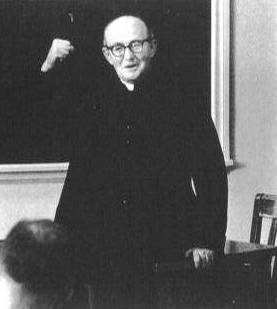
Charles Owen Rice, 1908-2005


Monsignor Charles Owen Rice, known as "Pittsburgh's Labor Priest," died Sunday in nearby McCandless Township at the age of 96, and I regret that I didn't get a chance to meet him.

From the 1930s through the 1990s, Msgr. Rice battled injustice -- not simply in the worker-vs.-bosses steel mill fights during the heyday of organized labor in Pittsburgh -- but against racism, intolerance and violence.

During the Depression, like Father Coughlin, Rice gave fiery radio sermons that mesmerized his parishoners -- but there the resemblance ended, for Rice's mission was to open his listeners' minds to grace rather than to inspire fear and distrust. Rice (whose Irish brogue was authentic, trained during his childhood in Ireland, where he lived from ages 4 to 11) not only used the radio pulpit to advance his cause, but was a front-line soldier whenever he believed the cause was just -- he marched in the picket lines; gave pep talks in the rain during strike rallies; urged the U.S. to aid England in its struggle against the Nazis; linked arms with Martin Luther King and marched with him to the United Nations in 1967; marched on the Pentagon in protest of the Vietnam War; and stood on the barricades as the steel plants were shut down in the 1980s. During much of that time, he also ran St. Joseph's House of Hopsitality, a Hill District shelter for the poor and homeless.

His columns for the Pittsburgh Catholic drew more mail than any other feature, much of it negative. One doesn't need to agree with Rice's advocacy of the union movement, however, to recognize the truth and integrity of his beliefs. His was the rare muscular moral voice of the Left, something today's Democrats still seem to struggle over finding for themselves:


'The Dynamite of the Encyclicals'


Last month some of the good Catholic people of Pittsburgh were startled to hear that a group of priests had been interested in organizing, of all things, a Catholic Radical Alliance. There was a general lifting of the eyebrows all along the line at the idea of Catholic Radicals . . . It might be reasonable to inquire, whom are we following? What prominent Catholics are radicals in this sense? Well, off hand, the first name that comes to my mind is that of Pope Pius XI, Bishop of Rome, Vicar of Christ, visible head of the Church. This program, by the way, is commemorating a radical document that he issued six years ago this very day; and it is commemorating another radical document that was issued forty years before that again: The Encyclical "On the Condition of Labor" by Leo XIII . . . The Popes issued these documents to the entire world, one of them forty-six years ago, and the other six years ago; but it is an annoying fact that the principles in them have not gotten around. Outside her fold the Church has the reputation, unfortunately, among all too many of being reactionary -- the friend of the rich rather than the poor; the friend of the bosses rather than the masses. And yet, if the plain facts of Christian principles and practice were known, it is just the opposite. The Church is the Church of the poor and must be. She is the friend of the oppressed against the oppressor . . . To be brutally frank, there are Catholics, many by no means obscure, who act not like followers of Christ, but like followers of the devil in their dealing with and attitude toward the problems of social justice . . .


Rice, PITTSBURGH CATHOLIC, May 20, 1937


'The Lord Hears the Cry of the Poor! So should we.'


. . . Actually, there is a class war raging in this country, but it is being waged not by the poor, but against them. Those who would deny government relief to the poor but demand they find jobs, when all the jobs are hard to find and decent ones impossible, are waging class war.


Rice, PITTSBURGH CATHOLIC, July 14, 1995

More about Charles Owen Rice can be found in Fighter with a Heart: Writings of Charles Owen Rice, Pittsburgh Labor Priest, edited by Charles McCollester.

Labels: , , , , ,

Tuesday, October 25, 2005

Rosa Parks, 1913-2005


On December 1, 1955 in Montgomery, Alabama, a petite, unassuming 42-year old African-American department store seamstress named Rosa Parks boarded a public bus and sat down in one of the first 10 seats -- which were reserved for white passengers regardless of whether there were any. Moments later, the bus driver asked her to give up her seat for a white male passenger. When she refused, the driver said that he would have her arrested. "You may go on and do so," she calmly replied.

Parks later said she was tired and weary after a long day's work, but that was shorthand for her greater exhaustion from the racism and segregationist policies of the American South. Her quiet protest marked the beginning of the civil rights movement that caught fire in the U.S. through the early 1970s, giving momentum to the careers of Martin Luther King, Jr., Medgar Evers, Fannie Lou Hamer and countless others; but while it was a milestone in American history, for Rosa Parks it was just another act in a long career of commitment to civil rights. She passed away yesterday.

Born in poverty on February 4, 1913 in Tuskegee, Alabama, at age 11 Rosa McCauley entered the Montgomery Industrial School for Girls, a school founded by Northern liberals which promoted self-worth among its students, and later moved on to study at the Alabama State Teachers College. In 1932, she married Raymond Parks, a barber who was active in African-American voter registration.

During the next 20 years, while working as a seamstress or clerk here and there, Rosa Parks became an active participant the local NAACP, ultimately as secretary and youth advisor for the Montgomery branch (1943-56), where she anonymously helped victims of "flogging, peonage, murder and rape."

Dissatisfaction within the Montgomery African-American community, which represented about 42% of the population of the city and about 70% of the ridership of the city bus lines, had been building for some time by April 1955, when an African-American teenager named Claudette Colvin was arrested for refusing to give up her seat on a bus. Montgomery civil rights leaders decided not to pursue Colvin's case as their test of segregation, given her age (15) and the fact that she was an unwed mother-to-be, and similarly passed on the case of 18-year old Mary Louise Smith, who was arrested in October. When Parks took her stand in December, it was a surprise to her colleagues, but she was immediately seen as the ideal protagonist for the cause: married, middle-aged, employed, sweet and demure, but nonetheless possessed of a strong will and a superior sense of the politics of her situation. "My God," exclaimed local activist E.D. Nixon, "look what segregation has put in my hands!"

The local Women's Political Council almost immediately initiated a one-day bus boycott, after which local activists formed the Montgomery Improvement Association and elected 26-year old Baptist pastor Martin King as their leader. With boycott extended, the bus lines began to lose money, and the white city commissioners and their hooligan-supporters resorted to harassment of African-American carpools and pedestrians to get the activists to drop their mission. A number of the boycotters, including Parks and her husband, lost their jobs in the fray; King's home was bombed; and a court order barred the NAACP from operating in Alabama. In February 1956, however, civil rights lawyer Fred Gray filed a federal suit challenging segregated transportation, and was successful in having it declared unconstitutional, a ruling which was upheld by the U.S. Supreme Court. Under an order served by U.S. marshals, after 382 days of the Montgomery bus boycott, the buses were finally desegregated on December 20, 1956.

Parks was thankful for the result, but noted that there was much more work to be done. Parks moved to Detroit, and despite her own sufferings and losses as a result of the episode (hospitalization for stomach ulcers, a period of joblessness, her husband's nervous breakdown), she campaigned tirelessly on behalf of the cause, raising funds for the NAACP. From 1965 until her retirement in 1988, she ran the Detroit office of Democratic congressman John Conyers and maintained her presence as a community activist for jobs and cultural issues. In August 1994, Parks was the victim of a robbery and assault in her home. In 1999, however, she showed that she still had plenty of fight left in her when (ultimately with the help of attorney Johnnie Cochran) she sued the rap act OutKast over the misappropriation of her name for the title of their Grammy-nominated song "Rosa Parks"; a federal court eventually ruled that OutKast's song title was protected by the First Amendment.

Much decorated, she became an elder statesperson of the civil rights movement, still determined to drive home her points. When the elder George Bush mistakenly referred to Birmingham as the site of the bus boycott during her appearance at a White House ceremony in 1989, she later commented, "Instead of having better ceremonies, we need better programs" for the poor and disenfranchised.

Labels: ,

Thursday, October 06, 2005

Fannie Lou Hamer


Fannie Lou Hamer -- sharecropper and voting rights activist – was born on this day in 1917 in Ruleville, Mississippi.
The youngest of 20 children born to her sharecropper parents, Hamer picked cotton from the age of 6 and received a minimal education before leaving school to cut corn stalks and help support the family. She married in 1944 and spent the next 18 years sharecropping on the Marlowe Plantation.
In August 1962, Hamer attended a civil rights meeting sponsored by the Southern Christian Leadership Conference (SCLC) and was inspired to go to the Sunflower County seat at Indianola to register to vote. "I didn't know that a Negro could register and vote," she recalled. Hamer was rebuffed at the courthouse and turned out of her home at the Plantation for trying to register.
From that time on, Hamer devoted her life to securing a political voice for African-Americans. On her third try in June 1963, Hamer was finally permitted to register, but on her return home she was arrested and severely beaten by white police in Winona, Mississippi, experiencing permanent damage to her arm and kidneys. Coincidentally, as she lay in her jail cell, swollen and blue, Mississippi NAACP leader Medgar Evers was assassinated outside his home in Jackson, Mississippi.
Even within this climate of savage violence, Hamer took her commitment to voting rights to the next level by helping to establish the Mississippi Freedom Democratic Party (MFDP). In June 1964, Hamer and three others from the MFDP appeared on the ballot for delegates to the Democratic National Convention. They were defeated, but their activism attracted the attention of Democrats in other states, and delegates in Michigan and New York voted to endorse the MFDP delegation in lieu of the all-white segregationist slate.
Meanwhile, delegations from five other Southern states threatened to walk out of the Convention if the MFDP delegates were seated. President Lyndon Johnson, nervous about the effect of this controversy on his chances in the November election, asked Senator Hubert Humphrey to arrange a compromise (despite the fact that Johnson had already privately promised Mississippi governor Paul Johnson that the MFDP would not be seated).
In the most dramatic moment of the entire 1964 presidential campaign, Fannie Lou Hamer testified before the Democratic Party Credentials Committee in a fine, mellow voice, chanting with grief over the beating she received at Winona and over the immorality of leaving her race behind.
While the MFDP did not win their seats, they won a larger victory: the compromise, worked out in negotiations between MFDP attorney Joseph Rauh and Humphrey's lieutenant, Walter Mondale, provided that two MFDP members would be seated as alternates with full right to vote, and that in 1968 and at all Conventions thereafter, no delegation would be seated where the Party process deprived citizens of the right to vote by reason of their race. (During the course of those negotiations, when Humphrey asked Rauh to provide assurances that the Mississippi group would not upset Johnson's re-election bid, Rauh defiantly replied, "Why don't you tell [the President] I'm a dirty bastard and completely uncontrollable?")
Hamer called the short-term fix "token rights" and denounced the treatment of the MFDP; but in the years following the Convention, Hamer did not give up her fight. Through her work with MFDP, she helped organize food cooperatives and day care centers; she even ran (unsuccessfully) for state senate in 1971.
She died on March 15, 1977 in Mound Bayou, Mississippi. On her tombstone is the epitaph "I am sick and tired of being sick and tired."
For those among us who think the Voting Rights Act is out of date and need not be renewed, it is worth remembering what it took to get here, and that issues still arise. See: http://moritzlaw.osu.edu/blogs/tokaji/.


Labels: ,