Wednesday, July 18, 2007

Twist Slowly, Slowly in the Wind


L. Patrick Gray, III, acting director of the U.S. Federal Bureau of Investigation (1972-3), was born on this day in 1916 in St. Louis, Missouri.

A Navy submarine captain and lawyer, Pat Gray served briefly as military assistant to the chairman of the Joint Chiefs of Staff before working on Richard Nixon's 1960 presidential campaign. In 1970, Nixon pulled Gray away from his quiet Connecticut law practice and appointed him assistant U.S. attorney general. After the death of the seemingly indestructible FBI chief J. Edgar Hoover in 1972, Nixon seized the opportunity to try and re-make the FBI as an instrument of the White House by installing his loyal friend Pat Gray as acting director pending confirmation by the Senate.

Faced with the resentment of Hoover loyalists such as Associate Director Mark Felt, Gray nonetheless relied heavily upon the old guard to help him chart his course, even during the FBI's investigation of the Watergate break-in in 1972 that would ultimately be linked to the White House. When leaks about the investigation began showing up in the Washington Post, Nixon asked Gray to fire Mark Felt or at least submit him to a lie-detector test, but Gray refused to do so, failing to believe that Felt would be capable of destroying the FBI's credibility.

At Gray's Senate confirmation hearings, which were the first opportunity the Senate had to question an administration official about Watergate, Gray was candid; he revealed that he had disclosed information about the Watergate investigation to White House counsel John Dean after consulting with the FBI's general counsel, and that in turn Dean had provided him with files from Howard Hunt's White House safe (mainly relating to Hunt's covert investigations on the activities of the Kennedy family) that, in Dean's words, "should never see the light of day," with the request that Gray take charge of destroying them. The White House had denied for months that it had been attempting to interfere with the investigation, but Gray's revelations called the denials into question, escalating the Senate's interest in Watergate; the White House was so angry about Gray's admissions that John Ehrlichman famously remarked, in a taped conversation with Nixon that would be revealed later, that Gray ought to be left to "twist slowly, slowly in the wind." Shortly thereafter, Gray withdrew his name from consideration for the FBI directorate and resigned from the FBI, returning to private practice and maintaining his silence about Nixon and Watergate for more than 30 years.

In 1980, Gray was indicted for having approved illegal break-ins while serving in the Nixon administration, but the charges were dropped and he was given a full pardon by President Reagan (only after Gray had to sell his house to pay for his legal bills); it was brief moment of renewed notoriety for a man who wanted to be left alone.

When Mark Felt revealed that he was "Deep Throat," the source of FBI leaks in the Washington Post's coverage of Watergate, in a 2005 Vanity Fair article, however, Gray decided he could not remain silent any longer. Appearing in an ABC interview with George Stephanopoulos that aired only 12 days before his death, Gray -- terminally ill with pancreatic cancer -- said he felt betrayed by Mark Felt ("I could not be more shocked and disappointed in a man whom I trusted," he said), and that he had no reason at the time to feel that the White House was trying to sandbag him. All told, he said, "the gravest mistake of my 88 years" was getting involved with Nixon at all, and that for years afterward Gray refused all contact with him. Gray said: "If you could have known what was in my heart and mind then, you would have thought I was a vigilante. I was so hurt and so angry at this man, who had not only junked his own presidency, but junked the career of so many other people, many of whom had to go to jail."

Gray died on July 6, 2005 in Miami, Florida.


Labels: ,

Wednesday, July 19, 2006

McGovern


After he lost 49 out of 50 states to incumbent Richard Nixon in the disastrous 1972 Democratic campaign, and after the exposure of the abuses of power waged by Nixon and his crew in the Watergate affair led to numerous convictions and the resignation of Nixon himself, George McGovern wrote: "I have to live with the knowledge that, not only did I lose the election, but I lost it to the most discredited man ever to occupy the White House." He occupies a unique position in recent history as the electoral martyr in a not-so-fair fight, but one for whom no great feeling of passion is summoned. Respect, yes -- but not passion.

Born on this day in 1922 in Avon, South Dakota, McGovern was a World War II combat pilot who settled in as a professor of history and government at Dakota Wesleyan University, the earnest, serene, soft-spoken McGovern served briefly in Congress before John Kennedy appointed him director of the Food for Peace Program. The prestige from that stint contributed to his election to the Senate in 1962, where he focused on poverty issues (particularly as chairman of the Select Committee on "Unmet Basic Needs"). After the assassination of his friend Robert Kennedy just before the 1968 Democratic convention, McGovern waged a three-week candidacy for the nomination as a successor to Kennedy's Vietnam peace candidacy, but disappeared in the confusion which led to the nomination of Hubert Humphrey.

He seemed like a long-shot at the beginning of the 1972 campaign, with a young, close-to-the-ground campaign staff he capitalized on the wobbliness of Edmund Muskie's campaign, placing a convincing 2nd in New Hampshire (Muskie's own backyard) and sending Muskie to the showers soon afterward. After George Wallace was sidelined by a would-be assassin, only Humphrey stood by as a potential threat to McGovern's most improbable nomination, waging convention floor fights over credentials which, while unsuccessful in conquering McGovern, hobbled his hoped-for harmonious launch. McGovern's first choice for his running mate, Sen. Tom Eagleton, stumbled into controversy when he admitted to having undergone shock therapy for depression. After first guaranteeing his support for Eagleton ("1,000 percent"), McGovern coolly shrugged to the party leadership and chose Kennedy relative Sargent Shriver as Eagleton's replacement on the ticket.

The same capacity McGovern had for riding out stormy weather without panicking made him a colorless campaigner, however; coupled with the Republicans' success in tarring him as the ultra-liberal candidate of "amnesty, acid and abortion" (a refrain begun by his Democratic primary opponents) and a loss of confidence from his core supporters over his perceived waffling on the issue of ending the Vietnam War, he suffered a decisive defeat in November.

He lost reelection to the Senate in 1980 in the midst of the anti-Jimmy Carter backlash, and went back to teaching, until he surprised everyone by announcing yet another presidential candidacy in 1984. If the 1972 campaign seemed quixotic, his 1984 bid for the Democratic nomination was downright sisyphean: tooling around New Hampshire in a rented car with one volunteer staffer, running far behind his own wunderkind campaign manager from 1972, Gary Hart, McGovern nevertheless managed to survive on vapor for a few primaries. He stole some choice moments, coming on much as the same disengaged, slightly cranky Bodhisattva he was in 1972, as the only one of the candidates who seemed to have been guided by a moral compass and a sense of duty to humanity. Yet the effort was quickly forgotten.

In 1996, he wrote a moving reminiscence on the death of his daughter Terry, who struggled with alcoholism, and in 1998 President Clinton appointed him to the ambassador-rank position of UN representative to the Food and Agriculture Organzation in Rome. Perhaps as an indication of his "elder statesman" status, George W. Bush asked him to stay on in the position in 2001. Later that year, McGovern was appointed global ambassador on world hunger by the United Nations.

Labels: , ,

Friday, June 16, 2006

Put One Foot in Front of the Other, and Step Off the Edge


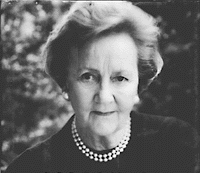
Katherine Graham, publisher of the Washington Post (1969-79) and chairman of the Washington Post Company (1973-91), was born on this day in 1917 in New York City.

After she left her job as a reporter with the Washington Post in 1945, Katherine Graham probably had no reason to believe that she would be anything other than a Washington hostess, mother and housewife. Her father, Eugene Meyer, had bought the Washington Post in 1933, and Katherine took a job there at age 20. Shortly thereafter, however, Katherine married Philip Graham, and left the Post to raise their family. Philip bought out Katherine's father and proceeded to expand the company, buying Newsweek and the Washington Times-Herald.

Philip Graham suffered from manic depression, however, and in 1963, he committed suicide, leaving Katherine in control of the Washington Post. In her memoirs, published in 1997 (for which she won a Pulitzer Prize), Graham wrote: "I had very little idea of what I was supposed to be doing, so I set out to learn. What I essentially did was to put one foot in front of the other, shut my eyes, and step off the edge."

During the 1960s and 70s, the Post became known for its tough investigative reporting under Graham's leadership, as she brought on Ben Bradlee as editor-in-chief; published the Pentagon Papers, leaked by Pentagon official Daniel Ellsberg, in 1971, against the advice of attorneys; and pressed the polices that resulted in Carl Bernstein and Bob Woodward's reports on the Watergate scandal, and ultimately in the resignation of President Nixon -- despite the fact that at the time the Nixon administration was threatening to pull the FCC licenses for her TV stations in Florida. When Carl Bernstein called to inform John Mitchell, Nixon's campaign chair and former Attorney General, that the Post would be printing an article linking him to the fund which paid for the Watergate burglary, it was perhaps a measure of Graham's personal power and charisma within the corridors of power in Washington when Mitchell testily responded "Katie Graham's gonna get her t*t caught in a big fat wringer if that's ever published." Mitchell was later convicted of conspiracy to obstruct justice and perjury, and served 19 months of a 2-1/2-to-8 year prison sentence in a minimum-security federal prison in Alabama.

Not only did Graham help to make the Washington Post an internationally respected newspaper, but by the mid-1970s she was being hailed as the most influential woman in the U.S. When she retired as CEO of the Washington Post in 1991, she was one of only 2 female CEOs of Fortune 500 companies. She died on July 17, 2001 in Boise, Idaho, from head injuries after a fall on a sidewalk while attending a conference.

Labels: , ,

Thursday, October 27, 2005

H.R. Haldeman


While we await a possible announcement regarding indictments in the Plame Leak investigation (or not), it is perhaps fitting and appropriate that we remember H.R. "Bob" Haldeman, President Nixon's chief of staff and convicted Watergate conspirator, who was born on this day in 1926 in Los Angeles.

The son of one of the California businessmen who contributed to the private political expense fund which inspired Richard Nixon's famous "Checkers" mea culpa in 1952, Haldeman was an ad executive who helped to engineer Nixon's winning image during the 1968 presidential campaign. After the election, Nixon appointed Haldeman as his White House chief of staff.

The lynchpin of Bob Haldeman's administrative approach was the cultivation of an image for himself, one of ruthlessness to front-line adversaries and constituents outside the White House as well as among the hired help. Sporting a military-style crew-cut long after it had fallen out of fashion, Haldeman was an arrogant, cold-blooded field marshal who enforced his sense of order upon White House calendars and to-do lists in the service of Nixon's objectives, and he reveled in press descriptions of Nixon's "efficient Prussians" (Haldeman and John Ehrlichman, Nixon's domestic adviser) building a "Berlin wall" around the Oval Office.

As the White House puppet-master he knew about the covert plans of the Watergate burglars and participated in the cover-up; the infamous "18-1/2-minute gap" in the White House tapes contained a conversation he had with Nixon which many believe would have shown that Nixon had known all along about the entire Watergate affair.

After the Watergate story broke and he was forced to resign in April 1973, Haldeman grew his hair to a neat and somewhat fashionable length in a last-ditch attempt to soften his public image; nevertheless he was convicted of conspiracy and obstruction of justice and served 18 months in prison.

Afterwards, Haldeman went into the real estate development business and published two memoirs, The Ends of Power (1978) and The Haldeman Diaries (1994) in which he took responsibility for the paranoiac atmosphere which prevailed in the White House. He died in 1993.

After Bob Haldeman, the position of White House chief of staff became a public one, reserved in large part for ex-officeholders -- ex-Senator Howard Baker, ex-Governor John Sununu, ex-Congressman Leon Panetta, ex-Secretary of Transportation Andrew Card, etc. In effect, it became a position demanding as much public trust as most elected positions -- while positions such as deputy chief of staff and chief of staff to the vice president have, until the recent scrutiny of the press, been faceless to the public at large.

Labels: , ,

Monday, September 12, 2005

Goodbye, Vinyl


When you’ve lived with your stuff for so long, sometimes it takes someone new to give you a sense of perspective on it. This was certainly the case when recently my beloved wife of 5 months decided I didn’t need my collection of LPs on vinyl anymore.

“You don’t listen to them. They’re just taking up space.”

“But . . . I collected those.”

I had decided a long time ago not to be a Shrevie about my record collection – you know, the guy in Barry Levinson’s Diner (1982) who goes ballistic when his wife messes around with his records, which seemed to be an unhealthy extension of his own identity. By “a long time ago,” I mean that after the first pang of recognizing myself in that character, it took several years for me to shuck off the humiliation of such recognition, stand on my own two feet, and decide that there were more important things in life than “what’s on the B-side.” Since that epiphany, I have been content to let perfect strangers rifle through my collection and make rude comments about it, or rearrange it out of alphabetical or genre order. I have learned to live with the chaos.

And while it was true that (1) I hadn’t plugged in a turntable in years, and (2) I had re-collected a good percentage of my vinyl collection on CD and that even that wasn’t getting listened to the way it used to, I still had to sit down for a moment in a quiet room and seek some clarity.

As usual, however, I was soon able to come to the conclusion that my wife was correct – I wasn’t listening to them, they were taking up space, and moreover my self-esteem had long ago managed to declare its independence from what was in my record collection. In that quiet room I also remembered a passage in Walter Kerr’s The Silent Clowns, in which he writes disparagingly of collectors of old cans of silent movies -- some of which are otherwise lost to the ages -- who horde their cache like trophies, keeping them out of circulation or letting them rot, never again to be experienced and appreciated by the public. I didn’t want to be retentive for the sake of being retentive.

After trading phone calls with a local vinyl dealer, on Saturday we loaded up 3 boxes of my decomposing records and lugged them up the dealer’s narrow, dark staircase.

“You the guy I just spoke to?,” asked Jerry, the big, hairy proprietor.

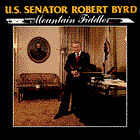
“Yeah, that was me. About 200 records here” – some 1980s jazz reissues, some Beatles and post-Beatles rarities, Monty Python, some Joy Division first-pressings, a bunch of obscure classical stuff (Alkan, Poulenc, Milhaud, Geminiani, Delius), and a smattering of other things that I can afford now to admit I’m embarrassed about – that sullen singer-songwriter that my girlfriend and I latched onto when we were in high school, that LP of Senate Majority leader Robert Byrd where he plays the fiddle, etc.

Jerry sat astride a stool and inspected my LPs in chubby handfuls, carefully sizing up each individual record before designating it for an appropriate pile. Although he didn’t say what the significance of the piles were, I quickly guessed that one was the stuff he thought was pretty interesting, one was the stuff that he had too many copies of already but might sell someday, and one was the stuff he’d rather not pay for, but would take if I threw it in.

There were some he paused over, making curious comments: a Thelonius Monk reissue (“Oh, yeah, that Italian label . . . ”), five volumes of Senate Watergate testimony (“You know there’s gotta be someone out there who wants this . . .”), a miscellany by Cajun swing fiddler Harry Choates (“Wow!”), a Clarence Williams collection (“I haven’t seen this packaging before . . . ”), George Harrison’s Wonderwall, a critical bomb but a collector’s dream (“Ha!”). The “interesting” stack was the tallest of the bunch.

All the classical LPs ended up in the “throw-in” pile. “I suppose you want me to take these, too.”

“If you can, sure.”

He named his price. I didn’t even muster up much of a grimace before he raised it. That told me he knew he was getting some good stuff. I agreed, and we took the cash. “That’s great,” he said. “You’re going to make some collectors very happy – you had a lot of unusual items there.”

There it was again, my sense of pride over this stack of cardboard-encased vinyl, rushing back with a warm embrace like an old friend. I smiled as I wandered back down the stairway. I knew he’d make some money on me, but I didn’t care. I was happy to hear that I had done a good job with that collection. It was good to know that my judgments could be validated by someone. And I really didn’t need to possess these records anymore to know it, either.

If you’re interested in picking through what I left behind, visit Jerry's Records on Murray Avenue, Squirrel Hill, Pittsburgh.

See also:

Marketplace (American Public Media): "Day in the Work Life," featuring Jerry's Records (March 12, 2005)

Labels: