Thursday, February 01, 2007

S.J. Perelman


Sidney Joseph Perelman -- better known as "S.J." -- was born on this day in 1904 in Brooklyn, New York.

A graduate of Brown University, Perelman wrote comic vignettes for magazines but was little appreciated until the publication of a collection of his articles, Dawn Ginsbergh's Revenge (1929). Despite the fact that his name was left off the title page of the first edition (unintentionally), Perelman gained a national readership for his outrageous wordplay, non sequitirs and puns. Shortly thereafter he moved to Hollywood, where he wrote for the Marx Brothers (Monkey Business, 1931; Horse Feathers, 1932) and continued writing magazine pieces, showing an increasingly angry and nihilist comic persona, while contributing to other Hollywood scripts. He won an Oscar for his work on the script for Around the World in 80 Days (1956, with David Niven).

Once asked by an earnest interviewer how many drafts he wrote of his stories, Perelman replied, in typical wise-ass fashion, "Thirty-seven. I once tried doing 33, but something was lacking, a certain -- how shall I say? -- je ne sais quoi. On another occasion, I tried 42 versions, but the final effect was too lapidary -- you know what I mean, Jack? What the hell are you trying to extort -- my trade secrets?"

Perelman died on October 17, 1979 in New York City.

Labels: , ,

Thursday, January 25, 2007

So Long As I Can Sing and Dance


"I belong to a race that sings and dances as it breathes. I don't care where I am so long as I can sing and dance." -- Florence Mills.

Florence Mills was born Florence Winfrey on this day in 1895, in either Washington, D.C. or Virginia.

The first African-American singer/dancer to headline at the New York Palace Theatre, Mills conquered Broadway before it was acceptable for African-Americans to appear in big time venues. Possessed of a high, quavery voice, she enchanted audiences with her brightness and elegant bearing as the star of Sissle and Blake's groundbreaking revue Shuffle Along in 1921. In 1926, Mills starred in Blackbirds, first in New York and subsequently in Paris (where it was Paris' first-ever all-black revue) -- a show that the Prince of Wales, for one, is said to have seen over 20 times.

She died on November 1, 1927 at the age of 32 while hospitalized for an appendectomy. As her funeral cortege marched down Seventh Avenue, a plane flew overhead, dipped its wings, and released a flock of bluebirds in tribute to her.

Labels: , ,

Wednesday, November 29, 2006

Busby


Busby Berkeley -- born William Berkeley Enos on this day in 1895 in Los Angeles -- grew up in the theater: his parents were performers in a traveling repertory company, and Berkeley was nicknamed "Busby" after stage actress Amy Busby, one of the stars of his parents' troupe. Berkeley's parents shipped him off to a military academy and by 1914 Berkeley was a management trainee at a Massachusetts shoe factory.

In 1917, he enlisted in the U.S. Army and served in France during World War I, where he had his first experiences in conducting large numbers of people through complex marching patterns as a field artillery lieutenant, working out a trick drill for 1,200 men.

Returning to the states, he entered the theater as an actor, significantly in the role of fashion designer "Madame Lucy" in a Broadway revival of Irene (1923-26). Soon, however, he was serving as dance director for Broadway productions, despite the fact that he had never taken a dancing lesson in his life, bluffing his way through choreography sessions by getting his dancers to demonstrate what he had in mind. By 1930, he was one of the most sought after dance directors on Broadway with a reputation for devising intricate dance spectacles involving staircases and multi-layered platforms.

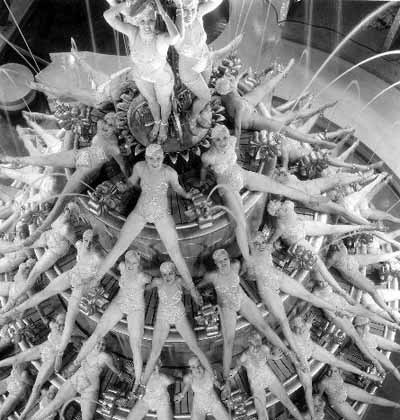
He went to Hollywood in 1930 to direct dance numbers for an Eddie Cantor vehicle, Whoopee, in which Berkeley stretched the envelope of static early sound film technique, forcing his director to enter the realm of pure cinema by lifting the camera above the soundstage to see Berkeley's dancers form geometric patterns. In 42nd Street (with Ruby Keeler and Dick Powell) and Footlight Parade (with Keeler, Powell and James Cagney) (both 1933; directed by Lloyd Bacon) and in later Warner Brothers musicals, Berkeley emerged as a true screen original, choreographing elaborate dance numbers involving hundreds of dancers moving in syncopated precision on oversized sets, through waterfalls and giant swimming pools, and on winding staircases and aerial platforms -- or as described by one film critic: "kaleidoscopic patterns of female flesh, dissolving into artichokes, exploding stars, snowflakes and the expanding leaves of water lillies."

His interest in using the camera and editing in inventive ways to highlight his production numbers led him to try directing, which he did successfully in a variety of musicals, including Babes in Arms (1939; with Mickey Rooney and Judy Garland) and The Gang's All Here (1943; with Alice Faye and Carmen Miranda).

Among the stars who got their start as Berkeley dancers were Lucille Ball, Paulette Goddard and Betty Grable. As musicals fell out of favor in the late 1950s, however, so did Berkeley, but his reputation re-emerged in the 1970s as Berkeley's work became celebrated as one of the essential liberating influences of 1930s cinema. Berkeley died on March 14, 1976.

Labels: ,

Tuesday, November 21, 2006

Voltaire


"When truth is evident, it is impossible for parties and factions to arise. There has never been a dispute as to whether there is daylight at noon." -- Voltaire.

One of the key figures of the Age of Enlightenment, Voltaire was known and admired throughout Europe by such diverse figures as Bolingbroke, Frederick the Great, Benjamin Franklin and James Boswell as France's great philosopher, satirist and wit. At the same time, he lived the life of a revolutionary for much of his career, spending years in exile and months inside the Bastille for sedition, waging a running battle with the Catholic church and settling in a French border town (Ferney, near Switzerland) so that he could escape the country easily in the event of another state crackdown. As he himself put it, "Philosophers should always have two or three underground holes in case of dogs hunting them."

As to his "philosophy," Voltaire never developed a systematic political theory, but rather he popularized, through poems, plays and essays, what he viewed as enlightened thinking -- characterized by a rational, scientific approach to political matters and technological progress, condemnation of superstition, and an uncompromising devotion to freedom of thought, speech and religion.

Born Francois-Marie Arouet on this day in 1694 in Paris, his father was a conventional bureaucrat who sent him to a Jesuit college (where he learned "Latin and nonsense" as he put it), but Voltaire's earliest intellectual guidance came from his godfather, the free-thinking Abbe de Chateauneuf, who introduced him to scientific skepticism. Voltaire, although educated to practice law, settled down to write plays and poems in a writing style that was brutally logical, trenchant and almost always bitingly humorous, and became the light of Paris society.

In 1717, however, he was falsely accused of lampooning the regent, and was thrown into the Bastille for a year. While there, he wrote his first play, Oedipe (1718) which was hugely successful, as well as an epic poem about Henry IV called the Henriade. Henry IV, as well as Louis XIV (about whose reign Voltaire later wrote in Le Siecle de Louis XIV, 1751), represented Voltaire's ideal of the enlightened despot, an absolute ruler who promoted rational discourse, kept the clergy in its place, and promoted religious tolerance; political liberty, in Voltaire's view, was not necessary if the king is enlightened.

Almost as instantly as his success took hold in France, he was forced into the Bastille again and into exile due to a quarrel with an important French family. He went to England in 1726, mixed in the intellectual society of Alexander Pope and Jonathan Swift, learned English so that he could read and study Shakespeare, John Locke and Isaac Newton in their native tongue, and developed a great admiration for the religious tolerance and freedom of speech practiced there.

He returned to France 3 years later, consolidated the fortune he had begun to amass through the success of his writings and wise investments, and wrote works popularizing the Empiricism of Locke (Lettres philosophiques, 1734) and the scientific principles of Newton (Elements de la philosophie de Newton, 1738), who became his intellectual heroes. Fleeing a warrant for his arrest for sedition in 1734, he took refuge at the country chateau of Madame du Chatelet, a well-read woman with a passion for metaphysics and science, with whom he enjoyed his longest relationship despite the fact that she was married.

During another period of exile Voltaire answered the invitation of the newly-crowned king of Prussia, Frederick II (the Great), to join him in his court at Potsdam. Frederick collected Voltaire almost as he would have collected a painting, for his sparkling wit at court and literary achievements, but their relations became strained as the Prussians treated Voltaire as a demi-god of sorts, and Voltaire soon departed. Nevertheless, they remained friends after Voltaire left.

In the 1750s, Voltaire began to write stories, including Micromegas (1752), arguably the first story in which the Earth is visited by alien beings from another planet. In 1758, Voltaire wrote his masterpiece, Candide (about a Romantic philosopher who experiences a conversion to science and rationalism after suffering misfortune), in response to the "anti-rational," Romantic positions of his intellectual enemy Jean-Jacques Rousseau. Voltaire assumed the role of activist during the infamous Calais Affair in 1762, in which a Protestant shopkeeper was brutally tortured and executed for murder following the suicide of his son, who was despondent over not being allowed to practice his trade due to his religion. The incident was fertile ground for Voltaire's critique of Catholicism, but he also became personally involved in the matter, conducting his own investigation into the matter, paying expenses for a new inquest and providing financial support to the widow.

When Voltaire died on May 30, 1778, crowds gathered in mourning outside his Paris apartment; and although the Catholic church attempted to deprive him of a Christian burial, some local church officials defied the church and provided him with one anyway at the Abbey of Seillieres. After the French Revolution, Voltaire was again declared a hero and his remains were moved to a position of honor in the Pantheon in Paris.

Labels: , ,

Monday, November 06, 2006

Mike Nichols


Mike Nichols was born on this day in 1931 in Berlin.

The grandsons of Jewish socialist/anarchist Gustav Landauer and opera librettist Hedwig Lachmann, Michael Peschkowsky and his brother Robert were sent by their family from Nazi Germany to live with an English family in America in 1938; their parents followed shortly thereafter, and they adopted the surname "Nichols" after his father's Russian patronymic "Nicholaiyevitch." Although the family was impoverished, Mike Nichols attended private schools on scholarship (with a reported IQ of 180); but he was a loner, the sour-tongued bald kid (having lost all of his hair at age 4 due to a reaction to a whooping cough vaccination) with the German accent.

At the University of Chicago, he got a job as a staff announcer on a classical music station (shedding the German accent for a crisply sophisticated American one), but he found his real outlet in the theater. Paul Sills, the founder of The Compass improv group (later called Second City), brought his friend Elaine May to see Nichols on stage, telling her "I want you to meet the only person at the University of Chicago who is as hostile as you." Nichols and May got into each other's respective craws immediately, and in 1957 they began performing deadpan comic dialogues on stage at The Compass that were so close to being straight that you could cut the gender-tension with a knife. Their comedy emerged directly from the ambiguous negotiations of this man and this woman -- whether it was a "romantic spat between dentist and hygienist during oral surgery" or a pair of hopeful pseudo-intellectual singles discussing Bartok and Nietzsche. They released a popular record of their material (Improvisations to Music, 1958), appeared on radio and TV, and from Chicago they played their act to critical acclaim on Broadway in 1960. The record of their Broadway show, An Evening with Mike Nichols and Elaine May, won a Grammy in 1961, but in that year they abruptly announced their break-up; according to Nichols, he gave it up because satire got too trendy.

Nichols turned to directing (avoiding writing almost altogether), winning his first 2 of 7 Tony Awards for his productions of Neil Simon's Barefoot in the Park (1964) and The Odd Couple (1965). He made his debut as a film director with a well-received version of Edward Albee's Who's Afraid of Virginia Woolf? (1966, with Elizabeth Taylor and Richard Burton), but Nichols was hailed as the great new director of his generation with The Graduate (1967; best director Oscar), a film that focused on 20-somethings before it was trendy to do so, used a contemporary score (by Simon and Garfunkel), and featured the lemony Dustin Hoffman as a rather unconventional leading man.

With Hollywood at his feet, Nichols' natural orneriness, perhaps, led him to take on a series of offbeat challenges as follow-up projects, including a disappointing version of Joseph Heller's Catch-22 (1970) and the sexually candid Carnal Knowledge (1971). After The Fortune (1975, with Jack Nicholson and Warren Beatty), he returned to the theater for a time, but reemerged in Hollywood with Silkwood (1983). During the 1980s and 90s, he turned out a series of more conventional, immaculately realized comedies with stellar casts, such as Working Girl (1988), Postcards from the Edge (1990), Wolf (1994), The Birdcage (1996) and Primary Colors (1998). In 2001 he won an Emmy for his HBO production of Wit (with Emma Thompson) and scored another triumph with the HBO mini-series based on Tony Kushner's Angels in America (2003).

Labels: ,

Monday, September 04, 2006

Artaud


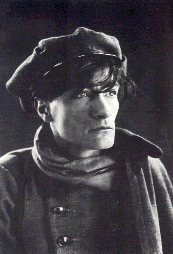
Iconoclastic actor, playwright, poet and stage theorist Antonin Artaud was born on this day in 1896 in Marseilles, France.

After suffering from bouts of mental disease in his teens and early 20s, Artaud began acting on the stage in the 1920s (at the Theatre de l'Ouerve, the Atelier, and for Pitoëff) and publishing his poems in literary magazines. Before long, he caught on with Andre Breton and the Surrealists, but by 1926 he was expelled over his disagreement with Breton's conversion to Communism.

While living with his mother and supplementing his income by performing in movies (in Abel Gance's Napoleon, 1927, as Marat; Dreyer's Passion of Joan of Arc, 1928), he opened the Theatre Alfred-Jarry, but it quickly failed. In 1931, he found inspiration from performances of Balinese plays at the Colonial Exposition, in which Artaud perceived that the text was merely incantatory, wrapped around a conglomeration of gestures, postures and sounds. Shortly thereafter, he wrote the first and second manifestos of the "Theater of Cruelty" (1932, 1938), an approach to writing, acting and stagecraft which incorporated the Balinese style, with an emphasis on shock-lighting, violent gestures and noise (the theatrical equivalent of Hieronymus Bosch's paintings, Artaud explained), designed by Artaud's account to liberate the subconscious mind through a kind of magical exorcism, and return the audience to its most primitive responses.

Although his theories were influential on such artists as Beckett, Genet and Ionesco, his stage experiments (such as Heliogabale, or the Crowned Anarchist, 1934; Les Cenci, 1935; Mexico, 1936) largely failed. Following a breakdown, he lived in an insane asylum from 1937 to 1946, undergoing starvation and electroshock treatments. Upon his release, he wrote a couple of combative, scatological rants -- an essay, "Van Gogh, the Suicide of Society," and a radio broadcast, To Have Done with the Judgment of God (1947) -- before succumbing to cancer on March 4, 1948 in Paris.

Labels: ,

Thursday, July 20, 2006

Mrs. Peel


Actress and icon of cool Diana Rigg was born on this day in 1938 in Doncaster, England.

After a childhood spent in India, in 1957 Diana Rigg landed on the York Festival stage as "Natasha Abashwilli" in the Royal Academy of Dramatic Art production of Bertolt Brecht's Caucasian Chalk Circle. Soon afterward, she became a fixture of the Royal Shakespeare Company (e.g. as "Cordelia" in Peter Brook's production of King Lear), seemingly destined for a career of prestigious literary revivals.

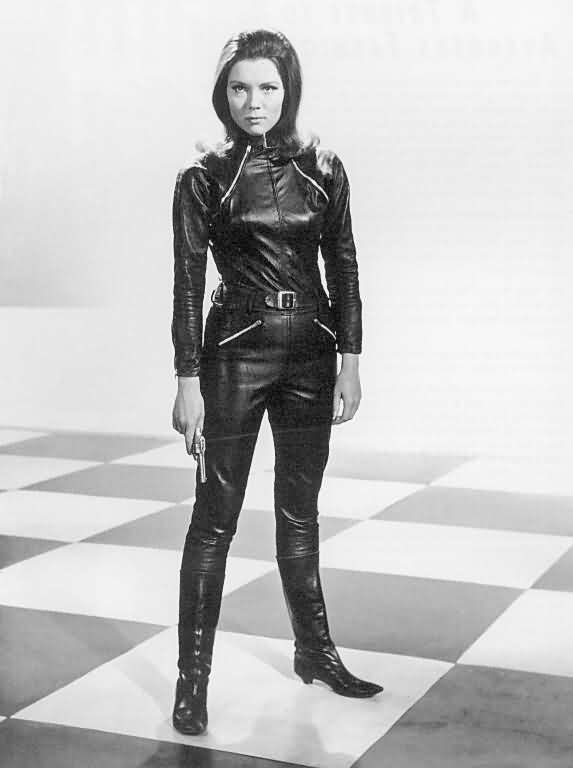
When she left RSC in 1964 for a job on a jokey TV crime-fighter adventure series (replacing future Bond girl Honor Blackman), eyebrows raised. Critics sniffed, but with Rigg on board The Avengers (co-starring Patrick Macnee as "John Steed") became one of the most popular British entertainment exports of the 1960s. As "Mrs. Emma Peel," Rigg had "a disarming sexiness, the best leather wardrobe in the history of television and a mean karate chop" (R. Dougherty, Salon). She was a TV revolutionary, too, in the sense that she was a charming woman with a piercing intelligence, acting in a man's world and frequently bettering men at their own games, a woman whose judo moves and physical prowess enabled her to make an impact with her body without merely being a slinky sex kitten. Steed and Mrs. Peel also captured the essence of 1960s London as stylish, eminently civilized, sophisticated crime-fighters who traded clever bon mots and toasted their successes with champagne.

After The Avengers, Rigg made other passes at pop culture (as James Bond's only bride in On Her Majesty's Secret Service, 1967, with George Lazenby, and in her own NBC sitcom, Diana, 1973-4), but also cycled easily back from pop icon to the stage, always with that cool, rich voice and indelibly acute intellect -- starring, for example on London and/or on Broadway in Abelard and Heloise (1971, Tony nomination), Phaedra Britannica (London Theatre Critics best actress, 1975) and Medea (1994, best actress Tony). She returned to series television as the host of Mystery!, the PBS anthology series (replacing Vincent Price), in 1989, and did star turns in the miniseries Mother Love (1990) and Rebecca (1996, best supporting actress Emmy).

Labels: , ,

Wednesday, June 28, 2006

Pirandello

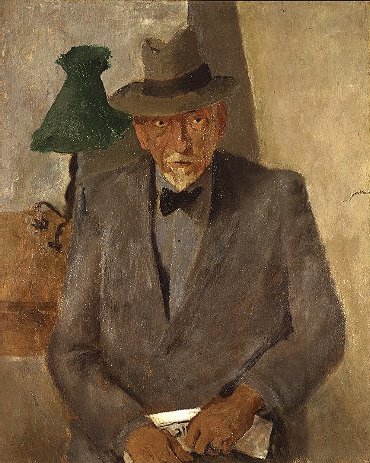
"Each one must arrange his mask as best he can -- his outer mask. For inside of it there is then the inner mask, which often fails to square with the outer. And nothing is true!" -- Luigi Pirandello.

Playwright Luigi Pirandello was born on this date in 1867 in Agrigento, Sicily.

A teacher at a girl's school, Pirandello experimented with verse and narrative prose (especially the latter, under the tutelage of Luigi Capuana) and criticized the drama as a second-rate art form -- perhaps in part due to some bad experiences in attempting to bring certain of his early works to the stage. His career path as a playwright, however, was sealed when in 1916 an old friend was cleaning Pirandello's apartment, found one of his old plays and sent it to the director of a Sicilian theatrical company. Once enticed, Pirandello unleashed an avalanche of new plays.

His masterpiece, Six Characters in Search of an Author, premiered in Rome in 1921 -- and after the first performance, a near riot broke out on the stage as actors, critics and members of the audience fought about what they had just experienced. The play ended up being one of the most influential stage works of the 20th century, containing a heavy dose of theatrical self-consciousness, a play within a play and sudden shifts of mood from the comic to the tragic and from the naturalistic to the grotesque, with stock dramatic effects heaped one upon the next with the result that they finally destroy contemporary theatrical conventions altogether.

Underlying his works was a feeling of isolation associated with the impossibility of communication in an absurdly organized world, and a proposed antidote for such impossibility, namely the wearing of another, perhaps more convenient personality. He joined the Italian fascists in 1924 -- perhaps forgiveable only to the extent one understands Pirandello's deep-seated fear of chaos and his own willingness to wear a convenient mask -- and was rewarded by Mussolini for a time with a state-funded theater company.

Pirandello won the Nobel Prize for Literature in 1934 (although some say the fascist-hating Italian writer Benedetto Croce would have been the winner that year were it not for the political intrigues of Mussolini's ambassador in Sweden).

Pirandello died on December 10, 1936.

Labels: , ,

Sunday, June 11, 2006

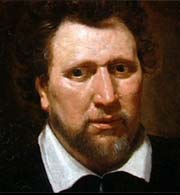
O Rare Ben Jonson


As between his beloved pal Shakespeare and himself, Ben Jonson was in his day heralded as the finer artist of his generation -- perhaps because it was known that he was self-consciously involved in the creation of Art with a capital "A" unlike his rough-and-tumble friend. Jonson's assessment of Shakespeare's work ("Would he had blotted out a thousand [lines]") is instructive: although Jonson's life was certainly wild and woolly, his interest was in infusing his writing with classical virtues -- balance, formality, restraint -- in an effort to civilize and tame the "humours" of his age.

Born on this day in 1572 in London, his father (a Protestant minister) died before he was born, and he was raised by his mother and his bricklaying step-father. After a pretty good classical education at the Westminster School (thanks to an anonymous sponsor), he briefly entered his step-father's trade and then served in the military before becoming an actor and hack-writer.

A hard-drinking, hard-playing fellow, Jonson was briefly imprisoned for writing a "lewd" and "seditious" play (The Isle of Dogs, 1597, with Thomas Nashe) and shortly afterwards was again arrested, this time for killing actor Gabriel Spenser in a duel. He narrowly escaped execution for the crime, and while in prison converted to Catholicism (a fad which stuck with him for 12 years). He hit his stride as a playwright with his first solo effort, Every Man in his Humour (1598), which premiered with Shakespeare in the cast, and its sequel, Every Man out of his Humour (1599). The latter play was the first of several in which Jonson included satirical portraits of playwrights John Marston and Thomas Dekker, after Marston had attacked Jonson in his play Histriomastix. The "War of the Theatres" continued for a few plays until Jonson turned his attention to tragedy, based on models from antiquity, notably in Sejanus (1603).

With James I's accession to the throne, Jonson started writing lighthearted masques (with occasionally dark undertones) for the court, working with architect Inigo Jones on sets. He patched up his quarrels with Marston and Dekker and even collaborated with them; when James I found Eastward Ho (1605, co-written with Marston and George Chapman) offensive to the Scots, he imprisoned Marston and Chapman, and Jonson voluntarily joined them out of solidarity. Jonson's 5 comedies from this period -- Volpone, or the Fox (1605), Epicene, or the Silent Woman (1609), The Alchemist (1610), Bartholomew Fair (1614) and The Devil is an Ass (1616) -- are considered to be his masterpieces; full of the mischief and color and vitality of his time, Jonson gives his topical circuses an angle of moral instruction and civilizing reason.

Throughout this period until the end of his life, particularly as James' poet laureate, poetry provided an ideal canvas for his classical palette; Jonson's verse is graceful, masculine and controlled, especially by contrast to the excesses of contemporary love poets, as exemplified in his famous poem "To Celia" (which begins "Drink to me, only, with thine eyes"). In 1619, he walked from London to Scotland (buying a new pair of shoes in Darlington) and stayed for a time with poet William Drummond. Although he continued to write in later years, he exercised more influence as elder statesman of English letters, presiding over meetings of his "sons" in authorship at the Mermaid Tavern and giving weight by his presence to the notion of literature as a profession.

At the end, he was bed-ridden from a stroke, living at Westminster with a drunken servant and a pet fox. He died in 1637, and he was buried standing up in Westminster Abbey, with the inscription "O Rare Ben Jonson" added to his comically small, square tomb-slab almost as an after-thought at the behest of a passing admirer.

Labels: , ,

Saturday, May 06, 2006

'I Started at the Top and Worked Down'


"I started at the top and worked down." -- Orson Welles.

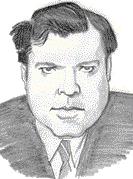
It is possible that Orson Welles' childhood gave him the tools to insinuate his way into the life of a raging mendicant moine terrible. Born on this day in 1915 in Kenosha, Wisconsin to affluent parents who encouraged his artistic interests, Welles was pegged as a prodigy early -- reading Shakespeare on his own at three; writing, designing and performing his own plays at four; playing violin and piano, drawing and performing magic at 8. While still a teenager at school, he co-authored and published a popular textbook, Everybody's Shakespeare.

By the time he was 14, Welles' parents were both dead and he was adopted by a family friend. At 16 he was supposed to enter Harvard, but instead he followed his heart to Ireland to paint, and he soon joined Micheal MacLiammoir's Gate Theater in Dublin. After a hiatus (bullfighting in Spain, sketching in Morocco) he returned to the U.S. and was hired by Katherine Cornell (on the recommendation of Thornton Wilder) and performed in her national tours of Romeo and Juliet and Candida.

Next he turned to directing, mounting dazzlingly original productions of Macbeth (1935, for the Federal WPA; set in the Caribbean with an all-African cast) and Julius Caesar (1937; in modern dress, drawing explicit parallels with contemporary European fascism), as well as the controversial, renegade premiere of Marc Blitzstein's socialist opera The Cradle Will Rock (1937).

With John Houseman he established the Mercury Theater, producing not only stage works but radio shows. While he earned his bread using his rich, deep voice as "Lamont Cranston" on radio's The Shadow, with the Mercury group he wrote, produced and acted in inventive radio dramas, including the notorious adaptation of H.G. Wells' War of the Worlds (October 30, 1938) -- a Halloween prank about Martian invaders which was so realistic that thousands of radio listeners became panic-stricken.

At the end of the 1930s, Welles brought the Mercury group (including Houseman, composer Bernard Herrmann and actor Joseph Cotten) to Hollywood, where eventually he began work on Citizen Kane (1941) for RKO. Considered by many critics to be the greatest American sound film ever made, Kane (which was co-written by Herman Mankiewicz) was full of surprising cinematic wizardry atypical of Hollywood productions, including deep-focus photography by Gregg Toland, shocking jump-cuts and an unprecedentedly complex soundtrack. The film was loosely modeled on the life of newspaper tycoon William Randolph Hearst, and made Hearst look, by implication, like a brute and a pathetic old fool; Hearst threw his weight against it, and the film did not do well at the box office.

Welles' second film for RKO, The Magnificent Ambersons (1942, based on Booth Tarkington's novel) was re-cut by the studio and flopped, and soon Welles was out on his own. After a brief marriage to Rita Hayworth (his second), he spent much of his time in Europe, acting in occasional films (notably as "Harry Lime" in Carol Reed's The Third Man, 1949) and occasionally finding backing to direct his own films. His Othello (1952) won the Grand Prix at the Cannes Film Festival; Touch of Evil (1958) and Chimes at Midnight (1966) were also critically-acclaimed.

Late in life he settled gracefully into the role of the avuncular talk show guest and TV pitchman while he waited for another chance to make a film of his own. He was a boldly self-confident, larger-than-life character, bursting with promise unfulfilled, yet never idle -- just misunderstood by those who should have provided him with his tools.

Labels: , ,

Wednesday, April 26, 2006

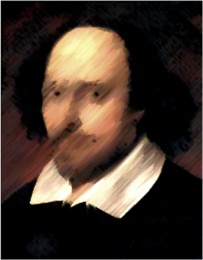
Ladies and Gentlemen, William Shakespeare


A minor but persistent strain of Shakespearean criticism refuses to believe that a man of Shakespeare's biographical shortcomings should be responsible for his works, proposing instead that such persons as Christopher Marlowe (admittedly a great playwright), Francis Bacon or the Earl of Oxford were the actual authors; these theories are wholly unimportant to the Shakespearean legacy, except as comic relief in the critical canon.

Who was Shakespeare? In his own words: "You know me well. I am he." (Much Ado About Nothing, Act 2, Scene I). Baptized on this day in 1564 at Stratford-on-Avon, he has been nearly unanimously canonized as the greatest writer in the English tongue for almost 400 years, except perhaps during his lifetime and shortly thereafter, when his friend Ben Jonson was more highly praised.

His father was a prominent if chronically unsuccessful leathermaker and local politico, and consistent with his family's modest status, Shakespeare received only a little formal schooling in English, Latin and Greek. At 18 he married Anne Hathaway, a woman eight years his senior, who was then pregnant with his first child, Susanna; less than two years later there followed the twins, Hamnet and Judith. It is perhaps hardly surprising that a young man with the restless intellect and creative energy evidenced by his writings should have found himself feeling stifled in this atmosphere; and some time in the late 1580s he left his wife and family behind and sought his fortune in London as an actor in the theater. He acted and wrote for the Lord Chamberlain's Men, a London professional troupe, shared in the profits from the performance of his plays at the Globe and at Blackfriars Theatre, and through his practical business sense was able to retire comfortably to Stratford, where at his death on April 23, 1616 (at 52, after a night's drunken revel with Jonson and Michael Drayton) he left his wife his "2nd best bed."

His earliest published works were poems (Venus and Adonis, 1593, and The Rape of Lucrece, 1594), but his lasting fame comes from his works for the stage. Thirty-eight plays bear his name, written between 1590 and 1613: a series of historical plays dealing with the War of the Roses showing a wry and world-weary sense of the arc of fate, as well as occasional flashes of crowd-rousing patriotism, such as in the jingoistic Henry V; earthy yet morally chaste comedies, both light (as in A Midsummer Night's Dream) and dark (Measure for Measure); and brilliant tragedies, from the early Romeo and Juliet to the four masterpieces, Othello, King Lear, Macbeth and Hamlet.

According to Jonson he worked as a quick and careless scribbler (in much the same way that 21st century popular culture imagines Mozart to have worked), yet his superior powers of material observation, sure ear and a rough-and-ready capacity for walking right into the three-dimensional consciousness of real or imagined human beings (something like Art Clokey's Gumby), apparently gave Shakespeare the ability to draw compelling scenes from all walks of Elizabethan and Jacobean life, from the curb up. Nevertheless, his plays have a transcendent quality which has enabled succeeding generations to adopt Shakespeare as their own, in countless productions of his plays, in other literary adaptations, music, visual arts and in films.

He also had the effect of enriching and stabilizing the English language itself: he loved to invent new words and reinvent old ones, and the longevity of his work assured that many of his usages would become common parlance (including "puke," faint-hearted," "monumental," "lackluster," "assassin," "useless," etc.).

For a few hundred years, the publication of a new critical edition of Shakespeare's works, or some other critical interpretation, was an essential task to be undertaken by the best and the brightest of subsequent generations: John Dryden, Alexander Pope and Samuel Johnson, to name but a few, all took their turn at dressing and undressing the Bard's corpus. It has been observed that you have to be nuts to produce a Shakespeare play today, with all the critical baggage which has collected around his old literary bones; yet the rewards for wading through it remain rich.

Labels: , ,

Thursday, April 13, 2006

Beckett


Samuel Beckett did not see his breakthrough as a writer until he was 47; but with the performance of his play Waiting for Godot in 1953, Beckett placed his indelible stamp on the shape of 20th century drama.

He was born on this day 100 years ago, in 1906 in Foxrock, Ireland. A shy young man, Beckett was an accomplished cricket player and boxer who thought he was destined for a career in chartered accountancy until he found he had a facility with modern languages while at Trinity College in Dublin. From Trinity he went to the Ecole Normale Superieure in Paris, where he met James Joyce and became one of his assistants. Joyce exemplified for Beckett an extraordinary dedication to one’s craft and encouraged Beckett with his own writing. Their friendship ended, however, over Joyce’s daughter, Lucia, a schizophrenic who fell obsessively in love with the disinterested Beckett; to avoid the uncomfortable situation, Joyce simply refused to see Beckett any more about the time Beckett was supposed to return to Dublin to finish his Trinity College thesis in 1930.

In Dublin, Beckett became seriously depressed, and was sent to live with his aunt’s family in Kassel, Germany for a change of scenery. From there Beckett returned to Paris to make a living at writing, but was turned away following the assassination of French president Paul Doumer in a police crackdown on foreigners, and eventually ended up in London to write and seek psychoanalysis.

In 1934 he published his first collection of short stories, More Pricks Than Kicks, which received critical praise but did not sell well. Continuing to suffer from clinical depression, he nonetheless worked away at a novel, Murphy, which was published in 1937. Shortly thereafter, he had a brief affair with Peggy Guggenheim before being brutally stabbed in the chest in a random attack in Paris; while recovering he met Suzanne Deschevaux-Dumesnil, a pianist who became his life-companion (they married in 1961). Murphy did not bring Beckett his exepected recognition, but he continued to write as World War II approached, and in 1940 he became a member of one of the first French resistance groups. When the Nazis infiltrated his group, Beckett and Deschevaux-Dumesnil escaped to non-occupied southern France. After the War he received the Croix de Guerre and the Medaille de la Resistance for his resistance efforts, and wrote two more novels while shuttling back and forth between Dublin and Paris.

Beckett turned to writing drama to relieve himself from writer’s blocks while trying to write prose. He wrote Waiting for Godot (in French) in a little over three months at the end of 1948, a spare piece about two down-and-out nonentities, Vladimir and Estragon, who are waiting for someone named Godot with whom they apparently have an appointment; as Godot continually fails to show, they consider suicide, but then acknowledge that they have done their best in waiting, and end the play in resignation, silently facing the audience. The original "show about nothing" (a la Seinfeld), Beckett’s play departed from the exalted language of French theater of the time, instead using an ordinary conversational tone, and it combines accents of broad music hall comedy (showcasing the comic skills of vaudevillian and Wizard of Oz "Cowardly Lion" Bert Lahr in the American premiere) with a moral bleakness to define a new genre of absurdist tragi-comedy.

Encouraged by the success of Godot, Beckett became a more confident and prolific playwright, and all but gave up novels. In his plays Endgame (1958) and Krapp’s Last Tape (1960), Beckett continued to explore the desolate spirit of humankind -- mournful yet at the same time beautiful, wryly commenting on the brutalities of time, memory, longing and familiarity. Happy Days (1961), the story of a woman buried in sand up to her waist, amusing herself with various objects while her husband reads the newspaper behind the sandpile, carried through similar themes in an even more broadly absurd setting. In the late 1960s, his work became known for its almost outlandish brevity, stretching the boundaries of theatrical expression with Breath (1970), a play of 120 words that lasts 35 seconds, and Not I (1973), a 16-minute play. He flirted with cinema on his only trip to the U.S., making Film (1965) with Buster Keaton.

He received the Nobel Prize for Literature in 1969 for "a body of work that, in new forms of fiction and the theatre, has transmuted the destitution of modern man into his exaltation." Beckett died on December 22, 1989 in France.

Labels: , ,

Tuesday, February 28, 2006

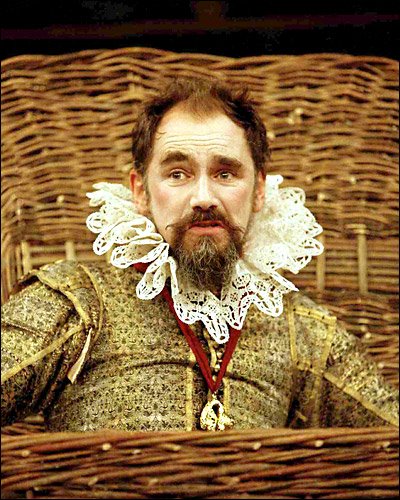
Mark Rylance and Shakespeare's 'Measure for Measure'


Among Shakespeare’s plays, Measure for Measure (first performed in 1604) has never been one of my favorites. Apparently, I’ve not been alone in my assessment. As the venerable G.B. Harrison observed:


Measure for Measure is one of Shakespeare’s unpleasant plays, and has, on the whole, been roughly treated by the earlier critics . . . It is not surprising that critics should disagree, for the play presents a stark problem of human conduct: When a woman is offered the choice of saving a condemned man – her brother, as it happens – at the cost of her own chastity, what should she do? As Shakespeare states the problem there is no simple answer . . .

Few of Shakespeare’s comedies could possibly have happened in real life, but usually no one takes the stories too seriously, because they never touch the deeper levels of emotion. This play in its earlier and middle scenes has been too powerful. Emotions have been so painfully stirred by the central problem that the critical instincts demand an answer. A profound moral issue has been stated, and we are not to be satisfied by a series of plots and stratagems, no matter how ingenious . . . He treated his puppets seriously, and he made them human, with the result that the soul of the play became too great for its body.
Harrison is certainly correct that Measure for Measure is a “plots-and-stratagems” play. Vincentio, the Duke of Vienna, tells his confidantes that he is traveling to Poland, and he appoints his conscientious follower, Angelo, as his deputy, with the full power to condemn the guilty to death. A young gentleman named Claudio, who has secretly become betrothed to Juliet, is arrested on the accusation of having sired Juliet’s unborn child out of wedlock; and Angelo, with a great show of self-righteousness, condemns Claudio to death. Claudio’s sister, the equally self-righteous Isabella (who is studying to become a nun) pleads with Angelo for mercy, but, as Harrison says, “suddenly the old restraint snaps,” and Angelo offers Isabella a non-negotiable proposition for her brother’s release – that Isabella must give Angelo her chastity in exchange for Claudio’s life. Meanwhile, the Duke has taken on the guise of a lowly friar, who advises Isabella to consent to the bargain, only to pull a switch and substitute Mariana, a woman to whom Angelo was once betrothed but whose dowry was lost at sea, as his bed-mate. Angelo satisfies his lust without the trick being revealed (somehow), but when pushed to honor his end of the bargain, he refuses to release Claudio, calling for his head. The Duke tries to fool Angelo with the head of a substitute condemnee; luckily for the Duke, another prisoner’s head becomes available unexpectedly, and in the ensuing “reveals,” Angelo is ordered to marry Mariana, Claudio is reunited with his Juliet, and the Duke asks Isabella to marry him – an ending, says Harrison, that is “more symmetrical than convincing.”

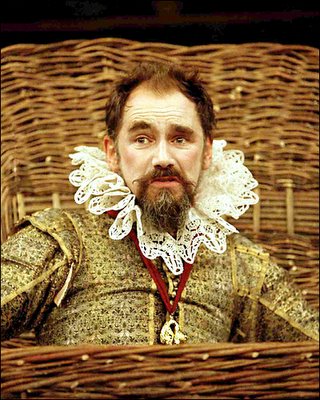
It probably says something about me that, on the evening of Pittsburgh’s worst blizzard of December 2005, I decided I needed to see Mark Rylance and his traveling Shakespeare’s Globe troupe perform Measure for Measure at the O’Reilly Theatre on December 7. On the way in, Pittsburgh’s streets were still clear of snow and I still agreed with Harrison that Measure for Measure was one of Shakespeare’s unpleasant plays; but after seeing Rylance’s production, whistling as I gingerly passed to the right of fish-tailing 18-wheelers on snow-clogged Route 22 East, I had a different view.

In his farewell tour as artistic director of Shakespeare’s Globe Theatre in London, Rylance took a gamble, at least from the box office point of view, that he’s been known to take in the past by presenting Measure for Measure in accordance with “original practices.” For today’s attention-deficit-disordered consumers of entertainment, saying that something is being presented in accordance with “original practices” is akin to telling us that this week’s episode of Desperate Housewives will be broadcast in black-and-white, with no dialogue track, accompanied only by Gaylord Carter on the organ – we expect a maddeningly primitive and stilted presentation.

“Original practices,” when it comes to playing Shakespeare, actually means that a play is presented on a bare stage, with handmade period costumes and period music, and most significantly, with an all-male cast – yes, that’s right, men playing women’s roles.

Instead of yielding a maddeningly primitive and stilted production of Measure for Measure, Rylance’s “original practices” actually has the effect of enlivening a moribund play – giving a neglected manuscript the chance to be understood through the lens of contemporary social relations.

For starters, Rylance encourages a certain level of interaction between his cast and the audience, fostering the kind of winking intimacy that one imagines must have been present when Shakespeare originally staged his productions, in a smaller London, amid the camaraderie of local playgivers and local playgoers. Lucio is allowed to ask a question of the audience and wait for it to answer him; the Duke is permitted to acknowledge the audience’s laughter over a bit of business; and an audience member may be pulled onto the stage at the conclusion of the piece, to help perform the closing dance number. Rylance apparently loves this stuff: legend has it that while playing Hamlet, after a woman in the audience spontaneously answered Rylance’s “to be or not to be” with a “that is the question” rejoinder, Rylance turned and pointed to the woman and declared, “Indeed, madam – that is the question.”

The darker passages of Measure for Measure are largely unspoiled by this freewheeling interaction. In fact, Harrison’s concern about the juxtaposition of comedic contrivances and deeper emotions is mitigated here in the post-M*A*S*H era, in which we have grown accustomed to the “dramedy” template, and in which our favorite “puppets” are allowed to experience deep turmoil.

More to the point, however, is the way in which Rylance’s deployment of “original practices” has the effect of emphasizing the things about Measure for Measure that connect with modern audiences. G.B. Harrison says, writing in 1948, that the play raises a question about the value of chastity. We’d put it another way today – we’d say that the play concerns itself with the sexual harassment of women, raising uncomfortable questions about power structures that pit women petitioners against those would prey on them. This aspect of the play is actually heightened by the fact that men are playing women in Rylance’s production. Imagine if, in your next human resources workshop, male mid-managers are asked to play female assistants in a role-playing exercise, and perhaps you can begin to understand what I mean by this. In having men play out scenes of sexual harassment, the play presents itself almost as a kind of ritualized catharsis, a mimetic acceptance of personal responsibility that in itself is quite powerful to behold.

The all-male cast also has the effect of universalizing the central concern of the play: the ways in which the administration of justice, arbitrary and often cruel, rubs up against the inviolability of human individuality and choice – the sovereign government against the sovereign me. In context, Shakespeare can perhaps be forgiven if he fails to answer questions in Measure for Measure – its first performance, after all, was before the Court of King James I, and to answer the questions would have been to call attention to uncomfortable issues of governance in the presence of He who Governed. Shakespeare here prefers to allow a benevolent observer (the Duke) and chance resolve the dramatic conflicts, and (if you'll please forgive the post-modern gloss) to leave the unanswered questions to be pondered in the silence before and after the play. That, in itself, is astonishingly subversive.

Rylance, at the helm and on the boards, swerves into Shakespeare's realm of controlled chaos. As the Duke, Rylance is “like a flustered God who's set the universe in motion and is surprised by the imperfect results,”as Timothy Gray wrote in Variety – he dithers and he hevers, with the fear of being out of control implacably written across his brow.

A friend of mine, a member of the board of the Pittsburgh Public Theater, seized upon the humility in Rylance’s performance and took the opportunity to tell Rylance that it reminded him of Peter Falk doing Columbo. Rylance thanked him and said he’d always appreciated Peter Falk’s work. Rylance offered another presumably iconic performance as his model, but unfortunately my friend doesn’t remember what the model was. (If my friend’s amnesia ever clears, I will let you know.)

As it has often been said, you have to be nuts to attempt to produce Shakespeare today, with all its layers of critical outerwear, and Rylance indeed may be certifiably nuts – he apparently is one of that dunderheaded school who believes that Bacon or one of his cronies actually authored Shakespeare’s works. Nevertheless, I hope that Mark Rylance’s swan song with Shakespeare’s Globe does not signal an end to his relationship with Shakespeare. I hope and suspect he’ll be back soon, undressing another neglected Shakespearean text to find the subversive spots and the post-modern stripes underneath.

Labels: , ,

Sunday, February 26, 2006

'The name is Marlowe . . . Kit Marlowe'


The playwright and spy Christopher Marlowe was baptized on this day in 1564 in Canterbury, Kent, England.

The son of a shoemaker, Marlowe's intellectual gifts were recognized early by a local philanthropist, who sent him to the prestigious Kings School. He went on to Corpus Christi College, Cambridge, from which his benefactors expected he would pursue a career in the clergy, but literature and theater were more to the impetuous young man's taste, and he showed his talent in them by translating Lucan's De Bello Civili into blank verse and Ovid's Amores into rhyming couplets, and writing his first full-length play, now lost, The True History of George Scanderbeg (1582), about a heroic yet chaste Albanian prince who is kidnapped and renamed by the Turks, but returns to lead his people to victory.

Contemporaries of Marlowe seemed to think he particularly identified with Scanderbeg, which may explain his willingness, shortly after receiving his B.A. in 1584, to enter Queen Elizabeth's service as a spy. At that time, many European heads of state were either assassinated or suffered assassination plots as part of the shifting of power between Catholics and Protestants. William the Silent of Orange, Henry III of France and Henry IV of France all fell victim to assassins, but the English secret service (under Sir Francis Walsingham) kept Elizabeth safe with the era's most successful network of espionage, and there is evidence that Marlowe played a role in foiling the Catholic "Babbington Plot" of 1587 as an agent of the Queen. His role as a "double agent" in the Catholic-Protestant conflict may also explain the charges of "atheism" (still punishable by burning at the stake) leveled against him by rival playwright Thomas Kyd, which were pending against him at the time of his death.

While acting in the Queen's service, Marlowe also began to write for the London theater company of the Admiral's Men. His first performed work, the ambitious Tamburlaine the Great (1586-7) burst onto the London scene as the first play written in English blank verse. Other successes, including The Tragical History of Doctor Faustus (1588) and The Famous Tragedy of the Rich Jew of Malta (1589), follow the theme he essayed in Tamburlaine of a larger-than-life protagonist who is driven by a passion that ultimately destroys him. In these plays and in Edward II (1594), Marlowe shows his ability to endow the blank verse line with intense dramatic power, in effect paving the way for the finest work of William Shakespeare, his London contemporary, and John Milton.

A notoriously reckless character, Marlowe's death remains suspicious, especially in light of the fact that he was in the company of three government spies. He met his colleagues at a roominghouse, and soon a brawl erupted over who would pay the bill. Marlowe drew his dagger and hit Ingram Frizer on the head with the flat of it; whereupon Frizer wrestled the dagger away from Marlowe and stabbed him over the eye. Marlowe died, swearing (presumably on May 30, 1593 in Deptford, England), and Frizer was let off with a claim of self-defense.

A small number of mush-headed scholars have claimed that, due to his political intrigues, Marlowe actually faked his own death and went into hiding, using his superior knowledge of classical antiquity, geography, astronomy and the like as the ghost-writer of Shakespeare's greatest plays. This bit of wishful thinking obviously underestimates the value of his known achievements, of the impact that a 29-year old smart alecky rapscallion could have on generations of readers to come. His super-suave portrayal by Rupert Everett in Tom Stoppard's film Shakespeare in Love (1998) is entertaining, but of course Marlowe's real story might have made a great movie on its own.

Labels: , ,

Tuesday, February 14, 2006

A Slip of the Cup 'Twixt the Actress and the Ballplayer


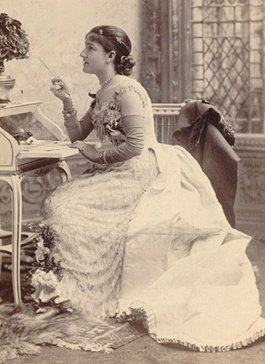
Helen Dauvray -- born Helen Gibson on this day in 1859 in San Francisco -- made her name as an ingénue on the stage, having appeared as "Eva" traveling stage productions of Harriet Beecher Stowe's Uncle Tom's Cabin, and as "Little Nell, the California Diamond." In her 20s, she moved to Paris, studied at the Paris Conservatory and under the name "Dauvray," became one of the great stars of the New York stage with her role in One of Our Girls (debuted 1885). Although she played other roles (contemporary critics lament, for example, her unfortunate tendency to take on singing roles from time to time), her triumph in Our Girls became the staple of her touring repertoire, and made her a wealthy woman.

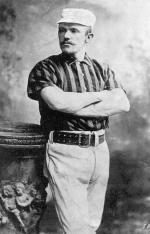
A bona fide darling of the press of New York, Dauvray rather astonishingly became involved with the rough-and-tumble world of baseball, sponsoring in 1887 the Dauvray Cup, a $500 silver trophy to be bestowed upon the winner of the "World Series" between the National League and American Association pennant winners. Shortly thereafter, she married Monte Ward (pictured at left), a dashing but mercurial ballplayer for the New York Giants and a Columbia-educated lawyer.

Perhaps consonant with her effort to reform Ward, she did her best to reform baseball during a time when fans would typically witness, during the course of a game, copious amounts of swearing, spitting and spiking. Dauvray wrote to National League president Nick Young concerning the raucous base-coaching of the St. Louis ball club: "There is no reason why base ball should not become to America what cricket is to England, but in order to accomplish that the players should do everything they can to refine and improve the game."
Her marriage to Ward, like her infatuation with baseball, was doomed to failure. They were divorced in 1890. But there were happy "Valentine" endings for both Dauvray and Ward. In later years Dauvray retired from the stage and became the wife of U.S. Navy Admiral Albert Winterhalter, and as his widow was given an honorable burial at Arlington National Cemetery upon her death on December 3, 1923. Monte Ward married golfer Katherine Wass in 1903, and lived happily and comfortably with her until his death on March 4, 1925 in Augusta, Georgia. He was posthumously elected to the Baseball Hall of Fame in 1964.

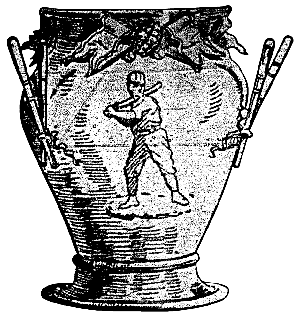
The Dauvray Cup, last awarded in 1890, has unfortunately been mislaid. If you see anything resembling the cup pictured below, please contact the Baseball Hall of Fame. I'd imagine there might be some reward involved.


Labels: , ,

Friday, February 10, 2006

John Webster


George Bernard Shaw dismissed him as a "Tussaud laureate"; but at the other end of the spectrum, T.S. Eliot saw him as a sensitive artist who "was much possessed by death/ And saw the skull beneath the skin," knowing that "thought clings round dead limbs/ Tightening its lusts and luxuries."

Little is known about the playwright John Webster (we don't even know the exact dates of his birth or death), but Tom Stoppard added considerably to his legend by portraying him as a blood-lusting child hanger-on in Shakespeare in Love. He was the son of a coachmaker, is likely to have studied law at the Middle Temple around 1597, and may have served as a clerk at St. Andrew's, Holborn. Although it is not believed that he toiled as a full-time writer, by 1602 he was contributing scenes to multi-authored plays such as Christmas Comes But Once a Year and Lady Jane.

After co-writing Westward Ho and Northward Ho with Thomas Dekker (1605), he churned out a few tragedies of his own before disappearing from the boards and from history: The White Devil (1612), his masterpiece The Duchess of Malfi (1613), The Devil's Law Case (1617) and Appius and Virginia (1622).

While some critics have found them to be implausible, gratuitously violent, cheap melodramas, Webster's works are classic examples of bloody, grim Jacobean drama. They're not really "revenge" dramas as much as they are pageants of swirling human evil and Hobbesian bleakness, put across by Webster in sure-handed verse, often with famously stark language. One of his more renowned lines from Malfi -- "Cover her face: mine eyes dazzle: she died young" -- has been described as a "three-act tragedy in miniature."

As for realism, Webster had no pretentions to it; his scenes are, like Renaissance street literature, woodcut tableaux inscribed with darkly moralistic couplets and decorated with grinning corpses.

Labels: , ,