Monday, June 11, 2007

Ever Try to Win an Earthquake?


"You can no more win a war than you can win an earthquake." -- Jeannette Rankin.

Jeannette Rankin, the first woman in Congress, was born on this day in 1880 near Missoula, Montana.

A graduate of the University of Montana with a B.S. in biology, Rankin taught briefly in Montana before settling in New York and attending the School of Philanthropy studying social work. She worked briefly at a children's home in Spokane, Washington, studied at the University of Washington and joined the women's suffrage movement, returning to Montana in 1910 to lobby for the passage of the suffrage bill introduced there as the first woman to speak before the all-male Montana legislature.

Rankin drew a forceful connection between conditions of poverty and the inability of women to affect the democratic process, as well as arguing that women were being taxed without representation. While she was unsuccessful in Montana, she attracted the attention of the National American Woman Suffrage Association (NAWSA), which appointed her as a field secretary. She successfully directed the effort for suffrage in North Dakota, then quit NAWSA and returned to Montana to continue the suffrage fight.

In November 1914, Montana granted women the right to vote. Running as a Republican for one of Montana's 2 at-large congressional seats, Rankin became the first woman elected to Congress in 1916. Young and attractive, she became an object of media curiosity, but she also bore the responsibility, somewhat unfairly, of being the voice of American women in Congress. Thus, her position on the most important issue before the 65th Congress, American entry into World War I, became a hotly debated topic among leaders of the suffrage movement. NAWSA president Carrie Chapman Catt cautioned that a vote against the war would make women seem unpatriotic (and many had not yet received the right to vote which would be guaranteed by the passage of the 20th Amendment in 1920); meanwhile, the more radical Alice Paul thought that women should stand together for peace.

With the first vote on the issue of war ever cast by a female parliamentarian in the history of the Western world, Rankin voted with 49 other congressmen against Wilson's declaration of war in 1917 -- a position that cost Rankin her seat in the following congressional election. In one term, however, Rankin served as the ranking minority member of the special committee which drafted the women's suffrage amendment; sponsored a women's health education bill which later passed as the Sheppard-Towner Act (1921); presented the demands of the Industrial Workers of the World to the federal government during the Anaconda Copper Company strike in Butte, Montana; and enjoyed immense popularity throughout the country.

After leaving Congress, Rankin joined the pacifist cause with all her energies, helping to found the Women's International League for Peace and Freedom in 1919, repeatedly testifying before Congress against military budget increases, and lobbying for women's and children's legislation around the U.S.

As World War II loomed on the horizon, Rankin ran for Congress again in 1940, and with the help of well-known pacifists such as Bruce Barton, she won. Although Speaker Sam Rayburn would not permit her to speak against the War, she nonetheless voted against it -- this time as the only representative to do so -- and was jeered on the House floor. Failing to win reelection, in later years Rankin traveled to India to study nonviolent resistance with Mahatma Gandhi and organized an anti-Vietnam War march on Washington at the age of 88.


Labels: , ,

Tuesday, December 19, 2006

Freedom Ride


"White cab drivers were hanging around the bus station, with nothing to do. They saw our Trailways bus delayed, and learned the reasons why. Here was something over which they could work out their frustration and boredom. Two ringleaders started haranguing the other drivers. About ten of them started milling around the parked bus. When I got off to put up bail for the two Negroes and two whites in our group who had been arrested, five of the drivers surrounded me. 'Coming here to stir up the n*****s,' snarled a big one with steel-cold grey eyes. With that, he slugged me on the side of the head. I stepped back, looked at him, and asked, 'What's the matter?' My failure to retaliate with violence had taken him by surprise." -- James Peck.

James Peck was born on this day in 1914 in New York City.

A civil rights activist and pacifist, known for his participation in the Journey of Reconciliation (1947, designed to provoke hostile state responses to the U.S. Supreme Court's ruling that segregation in interstate travel was unconstitutional) and in the 1961 Freedom Ride from Washington, D.C. to Mississippi, Peck was brutally beaten by segregationist thugs in Birmingham, Alabama during the Freedom Ride. The brutality he and his fellow activists suffered there ultimately inspired the Kennedy Administration to pressure the Interstate Commerce Commission to end discrimination in bus terminals. Peck died on July 12, 1993.

Labels: ,

Monday, October 02, 2006

Mahatma


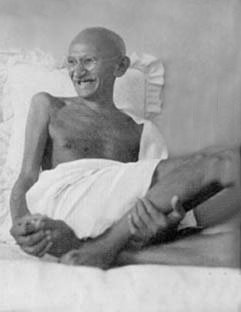
Mohandas Karamchand Gandhi (whose full name was translated by G.V. Desani as "Action-Slave Fascination-Moon Grocer") is often credited with securing independence for India from the British. While it is true that no other individual could claim more credit for turning the infant crusade for Indian independence into a national movement, representing all classes of Indian society, critics have since pointed out that Gandhi achieved neither a unified independent India nor peace. Nevertheless, revolutionaries around the world have galvanized around the memory of the Mahatma, seeing him almost as a miraculous living confluence of human kindness and political change, of faith-based theory and effective practice.

Born on this day in 1869 in Probandar, India, the son of a prime minister of the tiny principality of Porbandar, Gandhi was married at 13. Three years later he suffered self-loathing disgrace which would never leave him and which would predispose his philosophy and public persona: he was making love to his wife when a servant brought him the news that his father had died. "The shame to which I have referred . . . was this shame of my carnal desire even at the critical hour of my father's death, which demanded wakeful service." This incident, along with his mother's teaching of devotion to rituals of self-suffering, led him inch-by-inch to live as an ascetic, forsaking sexual relations (after fathering 4 children) and scaling down to a simple agrarian life.

When he was 19, however, his family expected him to be a professional, and he was sent to England to qualify as a barrister, where in addition he studied the New Testament, Buddha's sutras and the Bhagavad Gita while avoiding Western temptations. When he returned to India in 1891, he was not considered to be the brightest of lights, seeming too shy for litigation, and after 2 years he moved to South Africa, then also a possession of the British Empire. To his surprise, he discovered that as an Indian he had no rights in South Africa, and soon he found his voice and vocation as an activist.

Drawing from his religious studies and from works by Tolstoy and Ruskin, among others, Gandhi developed the three principles by which he would conduct his life and causes: satyagraha ("truth-force," denoting "the method of securing rights by personal suffering; it is the reverse of resistance by arms," bringing injustice to an end by changing the hearts of the oppressors though love and self-suffering), ahimsa (non-violence) and brachmacharya (sexual abstinence).

He put satyagraha to the test in civil protests over racial discrimination in South Africa, leading thousands of ethnic Indians in publicly refusing to submit to the ignominy of registration and fingerprinting in 1907, resulting in Gandhi's arrest and conviction the following year; and leading a massive general strike to oppose a court ruling that non-Christian marriages were not considered legal in South Africa. He was again arrested, along with thousands of others, and released after reaching a watered-down compromise with South African general Jan Christian Smuts over the future treatment of ethnic Indians. During this period, he also experimented with communal living, setting up the Phoenix Community near Durban and the Tolstoy Farm near Johannesburg; but after the compromise with Smuts, he returned to India in 1915.

Within 5 years, he became the leader of the Indian nationalist movement, spearheading nonviolent protests in Champara to improve the conditions of indigo farmers (1917) and in Ahmedabad on behalf of textile workers (1918), building support for his views among the working class; and, as leader of a reformed Indian National Congress, a noncooperation movement against British rule in response to the slaughter of hundreds of Indians demonstrating for independence at Amritsar (1919-22) which attracted the support of the Muslim community. Gandhi suspended the latter program, however, when a violent protest broke out in Chauri Chauri, resulting in the death of 22 policemen inside a building burned down by independence protesters.

Suspending the movement did not endear him to militants who sought independence at any cost, and there was no outpouring of rage when Gandhi was sentenced to 6 years in prison for inciting the movement. Gandhi was freed after serving only 2 years, and emerged to find Hindu and Muslim factions of the Indian National Congress arguing over methods and strategies. His reaction was to undertake a much-publicized fast in protest of the in-fighting, a satyagraha technique which became his hallmark in the years which followed. By this time, Gandhi had shed the Western suit and tie he wore as a barrister in favor of dhotis (white traditionally-Indian wrap-around garments), shaved his head and immersed himself in collective farming -- consciously adopting a luddite persona and luddite practices as a way of separating himself (and ultimately his followers) from England, its European fashions, and what he viewed as its soul-killing and politically oppressive industry and technology.

In 1930, when he reemerged as the architect of Indian protests against the Salt Act (which required Indians to buy salt from the British government) by leading thousands of Indians in a 200-mile nonviolent march to the sea to make salt by hand from ocean water, Gandhi was internationally recognized as the personification of colonial peoples desiring self-determination. The march sparked another round of mass noncooperation, and fostered international sympathy for the Indian cause for which the British government was entirely unprepared. (Evidence of his impact can be seen in his being named Time's "Man of the Year" in 1930).

Both sides called a truce as Gandhi was invited to England to negotiate a compromise. Reveling in the consciousness-raising publicity, he took tea with George V wearing nothing but a "loincloth" ("the King was wearing enough for both of us"); and while the talks resulted in no great progress, British rule was becoming less tenable as Gandhi renewed the civil disobedience movement upon his return to India. He was arrested again, but his presence was felt nonetheless when he undertook 2 lengthy fasts in response to proposed constitutional provisions for a separate, marginalizing electorate for the harijans (the "untouchables," the lowest caste of Hindus), exerting moral pressure on the British to propose an alternative structure.

In 1934, Gandhi resigned from the Indian National Congress, by this time headed by his friend Jawaharlal Nehru, but continued to be a mentor to Nehru. As World War II began in Europe in 1939, the Indian National Congress proposed to press the cause for independence in exchange for India's support of the British war effort, while Gandhi was concerned about England's ability to use the independence issue to issue to drive a wedge between Hindus and Muslims to delay the inevitable.

While the Muslim League, led by Mohammed Ali Jinnah, curried favor with the British by pledging support for the war, Gandhi went public with a more radical stance, calling for the immediate withdrawal of the British from India during a crucial moment in the war during the summer of 1942 (the "Quit India" declaration) and declaring that all Indians should engage in one final struggle to achieve independence or die trying. He was quickly imprisoned by the British for what amounted to treason. A violent uprising followed throughout India, much of it directed at railway stations, telegraph offices and other British-built communications and transportation posts. To Gandhi's great grief, 1.5 million Indians died in the resulting chaos and famine, and he mourned by fasting for 21 days while under house arrest at the Aga Khan's palace in Poona.

When he was released in 1944, he attempted to engage Jinnah in a dialogue about unified independence, but his vision of a decentralized multi-creed agrarian state was viewed as an anachronism by Jinnah and (with all due respect) by Nehru, and Gandhi was effectively shut out of the negotiations which resulted in the Mountbatten Plan and the declaration of independence of India and Pakistan as separate dominions in August 1947. As Gandhi had predicted, however, violent Hindu-Muslim riots broke out all over India and once again, in an attempt to bring peace, the 78-year old Gandhi fasted. He stopped only when community leaders agreed to do everything they could to stop the violence. Lord Mountbatten later observed that as Gandhi walked from village to village, nursing and consoling the victims of the strife, he came to be "a one-man boundary force" between the Muslims and the Hindus. Radical Hindus, however, became increasingly angry with what they perceived to be Gandhi's constant appeasements; and on January 30, 1948, as Gandhi was on his way to an evening prayer meeting, he was shot at point blank and killed by Nathuram Godse, the editor of an extremist Hindu newspaper.

India, then as now, is nothing like Gandhi hoped it would be, and it is fair to question the extent of his lasting impact there as anything other than a semi-mythical "father of the nation," as Nehru called him. As a philosopher of nonviolence and an endlessly adaptable, abstract global symbol, however, he had an enduring effect on the history that followed, inspiring leaders from distant corners of the world, from Martin Luther King, Jr. to Desmond Tutu to Natan Scharansky to Greenpeace to factions of the Northern Irish, to name but a few.

Labels: ,

Wednesday, September 06, 2006

Jane Addams


Jane Addams was born on this day in 1860 in Cedarville, Illinois.

Growing up in frail health and uncertain of her future after studies at Rockford College and the Women's Medical College in Philadelphia, Addams became attracted to social reform after visiting Toynbee Hall, the London charity house. Arriving in Chicago in 1889, Addams sought out the city's most needy neighborhood, rented a portion of the old Hull mansion on South Halstead Street and founded Hull House, one of the first settlement houses in America attempting to address the needs of the poor immigrant families in the neighborhood.

Largely through the force of her own personality -- her tact, personal charm and leadership abilities -- Hull House became a center of social reform in the U.S., attracting like-minded talents from a variety of disciplines such as Florence Kelley, Julia Lathrop, Alice Hamilton and Grace Abbott, as well as exerting a powerful influence over Chicago political battles regarding child labor laws, protection of immigrants, industrial safety and organized labor. With respect to labor, she was an enthusiastic supporter of worker organization and helped to negotiate a number of labor disputes. She lobbied for municipal suffrage in Chicago and served as vice president of the National American Woman Suffrage Assocation from 1911 to 1914.

When World War I broke out, Addams turned her attention to pacifist causes, observing that war consistently destroys social reform and that reform and peace were inseparable. As president of the International Congress of Women, Addams visited the heads of state of warring and neutral antions urging round-the-clock peace negotiations, and attempted to convince President Wilson to initiate an international mediation. Although Wilson would not heed her advice, he later adapted some of Addams' 11 peace planks, drafted in 1915 for the Women's Peace Party, to his famous "Fourteen Points." During the war, she led food drives to help the starving women and children of the warring nations -- including those of the enemy. While American Relief Committee chair Herbert Hoover and others supported her efforts, Addams was branded unpatriotic or worse by newspapers and was expelled from the Daughters of the American Revolution.

In addition to her peace efforts, she assisted in the establishment of the National Assocation for the Advancement of Colored People and the American Civil Liberties Union. After suffering an angina attack and reducing her workload, she received the Nobel Peace Prize (with Nicholas Murray Butler) in 1931, and donated the $16,000 in prize money to peace organizations.

Her writings, principally about the philosphical underpinnings of reform and peace (including Democracy and Social Ethics, 1902; Newer Ideals of Peace, 1907; Twenty Years at Hull House, 1910; and The Second Twenty Years at Hull House, 1930), combined analysis with anecdote to raise American consciousness about the poor and the disenfranchised. She died on May 21, 1935.

Labels: , ,

Thursday, December 01, 2005

'Prove it!'


Dorothy Detzer was born on this day in 1893 in Ft. Wayne, Indiana.

Detzer, a deceptively demure human battering-ram, served as National Secretary of the Women's International League for Peace and Freedom (1924-47) -- in effect, the chief lobbyist of the organization. She almost singlehandedly sparked a Senate investigation of the munitions industry in 1934, which showed links between the activities of arms manufacturers and bankers, and outbreaks of war. It was, of course, a more innocent time, when a congressman could get away with saying that "the record of facts makes it altogether fair to say that these bankers were in the heart and center of a system that made our going to war inevitable." Detzer's lobbying also resulted in getting a woman (Mt. Holyoke president Mary Woolley) appointed to the U.S. delegation to the Geneva Disarmament Conference (1932).

At a rally in Concord, Massachusetts in 1926, Detzer was accused by a member of the crowd of being a Communist. After denying the charge, she pointedly asked the heckler if he was a nudist. He replied that he was not.

"Prove it!," she demanded, getting the final word.

Detzer died on January 7, 1981 in Monterey, California.

Labels:

Thursday, November 17, 2005

Charles Owen Rice, 1908-2005


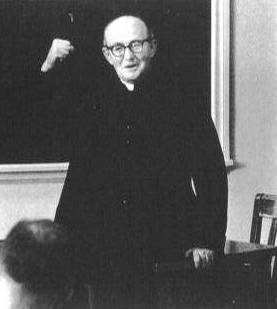
Monsignor Charles Owen Rice, known as "Pittsburgh's Labor Priest," died Sunday in nearby McCandless Township at the age of 96, and I regret that I didn't get a chance to meet him.

From the 1930s through the 1990s, Msgr. Rice battled injustice -- not simply in the worker-vs.-bosses steel mill fights during the heyday of organized labor in Pittsburgh -- but against racism, intolerance and violence.

During the Depression, like Father Coughlin, Rice gave fiery radio sermons that mesmerized his parishoners -- but there the resemblance ended, for Rice's mission was to open his listeners' minds to grace rather than to inspire fear and distrust. Rice (whose Irish brogue was authentic, trained during his childhood in Ireland, where he lived from ages 4 to 11) not only used the radio pulpit to advance his cause, but was a front-line soldier whenever he believed the cause was just -- he marched in the picket lines; gave pep talks in the rain during strike rallies; urged the U.S. to aid England in its struggle against the Nazis; linked arms with Martin Luther King and marched with him to the United Nations in 1967; marched on the Pentagon in protest of the Vietnam War; and stood on the barricades as the steel plants were shut down in the 1980s. During much of that time, he also ran St. Joseph's House of Hopsitality, a Hill District shelter for the poor and homeless.

His columns for the Pittsburgh Catholic drew more mail than any other feature, much of it negative. One doesn't need to agree with Rice's advocacy of the union movement, however, to recognize the truth and integrity of his beliefs. His was the rare muscular moral voice of the Left, something today's Democrats still seem to struggle over finding for themselves:


'The Dynamite of the Encyclicals'


Last month some of the good Catholic people of Pittsburgh were startled to hear that a group of priests had been interested in organizing, of all things, a Catholic Radical Alliance. There was a general lifting of the eyebrows all along the line at the idea of Catholic Radicals . . . It might be reasonable to inquire, whom are we following? What prominent Catholics are radicals in this sense? Well, off hand, the first name that comes to my mind is that of Pope Pius XI, Bishop of Rome, Vicar of Christ, visible head of the Church. This program, by the way, is commemorating a radical document that he issued six years ago this very day; and it is commemorating another radical document that was issued forty years before that again: The Encyclical "On the Condition of Labor" by Leo XIII . . . The Popes issued these documents to the entire world, one of them forty-six years ago, and the other six years ago; but it is an annoying fact that the principles in them have not gotten around. Outside her fold the Church has the reputation, unfortunately, among all too many of being reactionary -- the friend of the rich rather than the poor; the friend of the bosses rather than the masses. And yet, if the plain facts of Christian principles and practice were known, it is just the opposite. The Church is the Church of the poor and must be. She is the friend of the oppressed against the oppressor . . . To be brutally frank, there are Catholics, many by no means obscure, who act not like followers of Christ, but like followers of the devil in their dealing with and attitude toward the problems of social justice . . .


Rice, PITTSBURGH CATHOLIC, May 20, 1937


'The Lord Hears the Cry of the Poor! So should we.'


. . . Actually, there is a class war raging in this country, but it is being waged not by the poor, but against them. Those who would deny government relief to the poor but demand they find jobs, when all the jobs are hard to find and decent ones impossible, are waging class war.


Rice, PITTSBURGH CATHOLIC, July 14, 1995

More about Charles Owen Rice can be found in Fighter with a Heart: Writings of Charles Owen Rice, Pittsburgh Labor Priest, edited by Charles McCollester.

Labels: , , , , ,