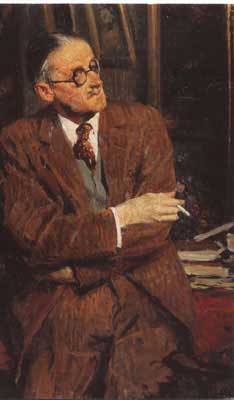
 "A cruel playful mind like a great soft tiger cat."
 -- W.B. Yeats.
At the close of the 20th century, Joyce was measured as the century's greatest novelist, one critic going so far as to say that Joyce "published nothing but masterpieces." Some casual students of literature registered some alarm at the choice of Joyce's
Ulysses as the greatest 20th century book in English by a Modern Library panel in 1998, since
Ulysses is also considered one the most "challenging" (unreadable) modern classics. The book, however, does have a scarlet past, being the subject of a famous U.S. obscenity case -- and surely no one can resist a rebel's charm, whether the rebel be
Ulysses or James Joyce himself.
The eldest surviving child of a large Irish family, born on this day in 1882 in Rathgar, Dublin, Joyce's father was a beguiling, rhetorically-gifted and usually unemployed drunkard. Joyce followed in his father's footsteps in a number of respects. He was educated by Jesuits at Clongowes Wood College and University College, spending a good deal of his time learning languages (Gaelic, Dano-Norwegian, French, Italian, German), bristling over the English rule of Ireland (Charles Parnell was a hero) and devouring "dangerous" modern literature.
Joyce developed a local reputation as a rebellious lad with a literary streak, making public shows of defending plays by such modern writers as W.B. Yeats and Henrik Ibsen against attacks by the Catholic Church and its apologists. Near the end of his educational career, while Joyce still a held a strong desire for Irish Home Rule, he avoided the paramilitary groups which trained for revolutionary conflict, regarding them a backward-looking and Church-dominated; as would be the attitude of his semi-autobiographical hero Stephen Dedalus, Joyce did not want to commit to a political movement which seemed to be in search of martyrs. Instead, Joyce's ideal revolutionary was the artist-hero, the man who breaks out of the social and political conventions of his time through personal creation.
After college, he left Dublin for Paris with an introduction from Yeats in his pocket, struggled along writing book reviews for a time and eventually returned home briefly. He met and wooed a local chambermaid, Nora Barnacle, and, fleeing what he believed to be the stifling cultural environment of Ireland under siege, he took Nora with him to Trieste in 1904, leaving Ireland more or less permanently.
Alternating between teaching, drinking and publishing miscellaneous tales which later comprised the classic short story collection
Dubliners (published in 1914), Joyce began work on a semi-autobiographical "essay" called
Stephen Hero. The poet Ezra Pound discovered Joyce toiling in near obscurity, encouraged his reworking of the
Stephen Hero material, and arranged for the serialization of the book in
The Egoist magazine. The new editor of the magazine, Harriet Shaw Weaver, was captivated by the technical and stylistic innovations of Joyce's book, and settled a trust for Joyce which gave him a measure of economic security for the rest of his life.
After several unsuccessful attempts to publish
Stephen Hero (now known as
Portrait of the Artist as a Young Man) as a full novel due to publishers' fears over obscenity laws, the novel was finally published in 1916. Just after its publication Joyce suffered a severe attack of glaucoma, and by the end of his life, he was virtually blind. In 1918, however, Joyce's sequel to
Portrait of the Artist,
Ulysses, began to be serialized in the
Little Review. The book's 700 pages take place in a single day, following the interior monologues of Stephen Dedalus, a Jewish ad-canvasser named Ulysses whose wife is contemplating an affair with another man that afternoon, Ulysses' wife Molly, and so on -- with commonplace meetings turning into dramatic climaxes. When
Ulysses was finally published as a novel in Paris in 1922, a number of countries immediately moved to ban it as "obscene" -- including the U.S., where the ban was finally lifted in 1933.
Joyce's last major work,
Finnegan's Wake (1939), which essentially concerns a pubkeep named Humphrey Chimpden Earwicker, stripped away much of the constraints imposed by language (the book contains some puns and innuendo which can only be fully understood if the reader knows three or four languages), space and time (the story leaps from the pub, to nursery rhymes, to Parnell's trials, to
Tristan and Isolde with impunity) and individuality (the main character metamorphoses several times and finally changes into "Tim Finnegan," the hero of an Irish song who arises at his own wake to share a drink) -- all wrapped within a plot structured to complement 18th century philosopher Giambattista Vico's theory of historical development. (And you thought
Ulysses was tough!) Joyce directed his assistants,
Samuel Beckett among them, to assist the public's understanding of
Finnegan's Wake by producing a treatise on his work in progress in 1929. It appears that Joyce understood his own joke all too well, but critics continue to argue about whether his unbridled virtuosity with language led him to create an incomprehensible white elephant of a book, or whether his final work fundamentally expanded the horizons of literary activity.
Joyce was branded as paranoid for staying away from Ireland for most of his later years, although it has been observed that many of his revolutionary friends died early deaths there. Much of Joyce's work remains unfilmed and probably unfilmable (ironically enough, as Joyce started Ireland's first movie house in 1909) but John Huston directed a splendid version of his short story masterpiece,
The Dead (1987).
Labels: Ireland, Literature
 Malachy O'Morgair, also known as St. Malachy, died on this date in 1148.