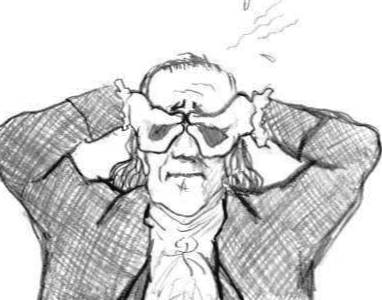
Forgive me if I don't join in the nation's year-long celebration of the 300th anniversary of Benjamin Franklin's birth. My lack of enthusiasm actually runs in my family. One of my great-great-etc grandfathers, a noted Germantown printer and a contemporary of Franklin's named
Christoph Sauer, was pretty sure that Franklin was a greedy and selfish man, and he was a victim of some of Franklin's most uncouth prejudices.
To most of posterity, Franklin and his friend
Thomas Jefferson were the twin poles of the American Enlightenment, titans of ingenuity and revolutionary thinking. While it is true that Franklin's tinkering led to some interesting scientific advancements (not as many, it would seem, as he receives credit for), and that he was an industrious fellow with a good business head and a charming raconteur, Franklin's outlook was sometimes quite provincial, and his goals were middle-class goals. Much of his activity must be viewed through the prism of personal commercial gain to be properly understood. His greatest contribution to the American revolution was that he found effective ways of clothing middle-class economic grievances as matters of fundamental liberty.
The 15th child of a soap maker, born on this day in 1706 in Boston, Franklin worked in his father's shop until he was 12, when he became an apprentice (under a 9-year indenture) to his brother James, a printer. He read voraciously and, unbeknownst to James, secretly began to contribute a regular satirical column to his brother's newspaper, the
New England Courant, under the pseudonym "Silence Dogood." Franklin briefly took over the paper in 1723 when his brother was banned for his supposedly seditious publications, but James was habitually ungrateful and abusive, so Benjamin skipped out on the indenture to Philadelphia later that year and joined another print shop.
At the advice of the governor of Pennsylvania who had agreed to help him start his own shop, Franklin went to London in 1724, but found that the governor had duped him and that he was stuck there without money or leads. He found work with a London printer and set the type for William Wollaston's
Religion of Nature Delineated; having had occasion to read it carefully, he prepared an ironic, humorous (and anonymous) reply,
A Dissertation on Liberty and Necessity, Pleasure and Pain. Its popularity led to his entry into freethinking circles in London before he returned to Philadelphia in 1726.
Continuing to work as a printer while writing columns, Franklin had an affair with Mrs. Deborah Rogers (Franklin later took her as his common law wife, the whereabouts of her husband being unknown). He took over the
Pennsylvania Gazette in 1730, founded a subscription library the following year, and began to extend his media empire by the unusual act of starting a partnership with one of his apprentices to open a shop in Charleston, South Carolina; most print shops were local, owned by families, but Franklin sought to expand his "franchise" with invested capital and regional reps.
In fact, Franklin was North America's first vertically-integrated media mogul. He even controlled the colonial paper supply in Pennsylvania, which caused my great-grandfather no small amount of discomfort. "No credit to the Dutch," was Franklin's haughty note to my ancestor. Despite murmuring that Germans were smelly and ignorant, Franklin also tried to set up a few German-speaking newspapers in an effort to compete with Christoph Sauer's popular offerings in the large German market around Philadelphia, but Franklin never figured out how to make them succeed.
For Franklin, the Germans represented not only a ripe market, but a populace in need of secular instruction. Germans would become a thorn in his side for some time to come, however, as a demographic group he couldn't conquer commercially, and as an ethnic group whose separateness and Anabaptist pacifism frustrated his civic goals. Expressing the belief that Germans had swarthy complexions and that Anglo-Saxons were the only "White People" in the world, Franklin wrote:
"Why should Pennsylvania, founded by the English, become a Colony of Aliens, who will shortly be so numerous as to Germanicize us instead of our Anglifying them, and will never adopt our Language or Customs any more than they can acquire our Complexion?"
The less he was able to control people like my great-grandfather, the more he felt compelled to villify them.
In 1733, Franklin started to publish
Poor Richard's Almanac, for which he created the persona of "Poor Richard" as a disarmingly naive send-up of astrologers, whose pragmatic proverbs and advice outdid the rival almanacs Franklin had intended to spoof in common wisdom. The apparent influence of the popular "Poor Richard" gave Franklin a soapbox, and emboldened his confidence in his own advice, although he saw himself as somewhat undisciplined, privately recording his violations of "thirteen virtues" which he set for himself to improve his conduct. His jocularity was at times a matter for private shame, but it didn't still his pen; some of his literary hoaxes included "Reasons for Preferring an Old Mistress to a Young One," 1745; "The Speech of Miss Polly Baker," in which a woman who is prosecuted for the fifth time for having an illegitimate child convinces a judge to throw out the charges and marry her; and numerous mock biblical parables.
His reputation as a sensible merchant got him elected clerk of the Pennsylvania Assembly in 1736, marking his first furtive entry into electoral politics. Meanwhile, it was science which held most of his attention -- particularly the study of electricity. In 1747, he proved, with the use of a Leyden jar as a capacitor, that there were not 2 types of electricity but one, to which he applied the terms "positive" and "negative," and in 1749, experimenting with charged metal bowls, he invented a "lightning rod" for redirecting lightning during electrical storms. In his most famous (and reckless) experiment, he confirmed for the public that lightning was merely electricity when in 1752 he flew a kite into an electrical storm while standing on an insulated surface, drawing sparks from a key tied to the kite string; another scientist, Georg Richmann, died the following year when he was struck by lightning trying to recreate the experiment. The experiment, and Franklin's book
Experiments and Observations on Electricity made him an international celebrity, however; even
Immanuel Kant called him the "Prometheus of modern time."
In 1747, Franklin faced down the Quaker-dominated Assembly by raising a militia to fight against French and Indians who were raiding Pennsylvania frontier towns and mucking up trade; in 1751, as the dominant cultural figure in Philadelphia, he was elected to the Assembly. As a legislator, he spent of his time trying to diminish the influence of the descendants of William Penn for the benefit of the merchant class. As the war against the French intensified on the borders, Franklin proposed a union of English colonies for purposes of raising a continental militia, but the proposal was shut down (despite his now-famous engraving of a snake cut into pieces with the words "Join or Die!" underneath); otherwise, he concerned himself with converting Pennsylvania from Penn's colony into a royal colony as agent of Pennsylvania in England.
When Franklin returned to London in 1764 after a 2 year absence, the colonies were in the midst of protesting the proposed stamp tax to be imposed on them by the British Parliament. Franklin offered alternatives to the British which were ignored, but when the tax was passed Franklin initially decided that it could be tolerated and offered the name of a friend for the post of stamp distributor in Pennsylvania. Meanwhile, on rumors that he had supported the tax, protesters threatened Franklin's home in Philadelphia.
Finding himself on the wrong side of the issue back home, he became a one-man anti-stamp tax propaganda machine in London with letters and pamphlets, and spoke against the tax before a session of the House of Commons. Increasingly, Franklin began to take the position that Great Britain's use of the American economy was repressive, and that America would ultimately need to become an independent nation. In 1773, a letter of Franklin's, in which he urged non-cooperation with British war activities around the world until the British guaranteed the colonists the rights of British citizens, was stolen and presented to the British colonial secretary, who judged it treasonous. He was brought before the King's Privy Council, where he was denounced in a 1-hour diatribe and stripped of his position as deputy postmaster of North America.
Now clearly identified with the independence movement which had been growing steadily in Massachusetts, Franklin returned to Pennsylvania and was chosen as a delegate to the 2nd Continental Congress. In February 1776, he was part of an unsuccessful mission to Canada to convince the Canadian colonies to join in the American resistance, and upon his return in June served on the committee to draft the Declaration of Independence (with Jefferson, John Adams, Roger Sherman and Robert R. Livingston). When the Declaration was passed by the Congress on July 4, Franklin was the oldest of its signatories. Almost immediately afterward, Franklin was elected president of the Pennsylvania state convention and before the end of the year was chosen as an American commissioner in France.
In Paris, he enjoyed a return to his role as a great man of letters, charming the French intelligentsia (Voltaire among them) with his quaintly homespun manner and dress, his flirtatiousness and his wit. He helped direct the American negotiation of commercial and political alliances with the French republican government, and in 1783, at the age of 76, he served with Adams and John Jay as the American team at the Paris peace talks which successfully concluded the American revolution. Upon his return to Pennsylvania 2 years later, he was elected president of Pennsylvania's executive council for 2 years.
He later lent his prestige to the federal Constitution which was adopted by the states in 1787, and worked on his beguiling, self-congratulatory
Autobiography (considered one of the finest works of early American literature), although his final public act was to sign a memorial to Congress calling for an end to African slavery in the United States. He died on April 17, 1790 in Philadelphia.
John Adams, who was no great admirer of what he took to be Franklin's lax morality, correctly predicted that Franklin would be given inflated credit for his role in the American revolution.
Meanwhile, today I'll refrain from attending any parades or cake-cuttings in Franklin's honor. Instead I'll hold my own private celebration in honor of my swarthy, stinky great-grandfather Christoph Sauer. Franklin does get the last laugh on us, however, for out of necessity, I'll have to conduct my private ceremony in English, just as Franklin wanted.
Labels: American Politicians, Colonial History, Family History