Kapurats
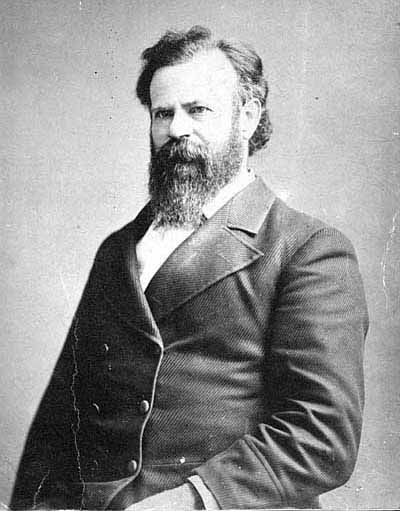
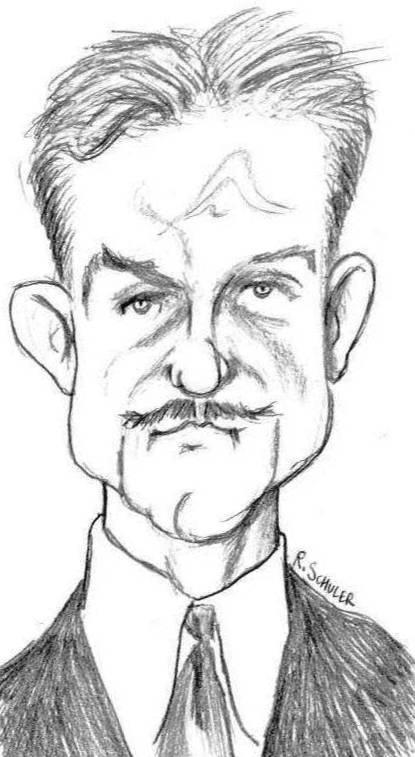
John Wesley Powell -- geologist, ethnologist and explorer -- was born on this day in 1834 in Mount Morris, New York.
With little formal education and a lot of spare-time exploring, young John Wesley Powell developed an interest in natural history and archaeology, collecting Indian artifacts, rocks and fossils around his home in Illinois. Prior to the Civil War, he farmed and occasionally taught school; but with the War's onset, at age 27 he joined the 20th Illinois Volunteer Infantry for the North as a private, and within a year he was captain of an artillery unit. At Shiloh, under U.S. Grant, he lost his right arm below his elbow to a musket ball, but returned to fight at the siege of Vicksburg and the battle of Nashville, receiving his discharge in 1865 with the rank of major.
On the basis of his reputation as an amateur naturalist, after the War Powell became a lecturer in natural history at Illinois Wesleyan College and Illinois Normal University -- but he still had an eye for adventure. With some of his students, he began staging reconnaissance expeditions in the Colorado Rockies, and in the winter of 1868, he explored the upper tributaries of the Colorado River, studying the culture of the Utes and seeking grants from his universities, the Smithsonian and the U.S. Army for a full-fledged journey down the Colorado.
On May 24, 1869, the intrepid one-armed Powell and his crew of 9 other men embarked on what would become one of the last epic explorations of the continental U.S., a treacherous boat trip down the Colorado, through the monolithic gorges of the Southwest that had scared off prior expeditions. By the time he emerged from the Grand Canyon (so named by Powell himself) on August 29, 1869, Powell had succeeded in laying the groundwork for a good map of the Colorado, at the cost of 3 men who were killed along the way; developed an influential theory of how the Colorado preserved its level; established relations with the Utes and Shivwits of northern Arizona and southern Utah (who recalled Powell as "Kapurats," or "right-arm-off"); and was hailed as a hero in the East.
Congress responded by funding Powell to map and study large areas of the West. In 1872, Powell was appointed special commissioner of Indian Affairs, but in addition to providing advice to the government as one of the nation's foremost experts on Native American culture in the West, he began to concern himself with the natural limits of the American settlement of the West.
In his prophetic Report on the Lands of the Arid Regions of the United States (1878), he observed that the region to the west of the 100th meridian (roughly running through present-day Erick, Oklahoma, among other places) lacked the abundant water that had supported the growing populations in the East and Midwest. Therefore, he argued, for the West to grow within the bounds of its resources, the U.S. government would be required to carefully control homesteading, limiting it to self-reliant (not federally subsidized) communal authorities gathered around water and natural watershed areas where irrigation ditches might easily transport water to crops. Powell argued that this kind of control was required to encourage conservation, minimize conflicts over water rights, and reduce inefficiencies inherent in transporting water over long distances.
Powell's Report fell on deaf ears, however: while newspapers and speculators, aided by crackpot scientists, promised that water would somehow appear wherever civilization chose to install itself, politicians in Washington bristled at the notion of imposing so much control over the settlement of the West, arguing that it would interfere with free enterprise.
Between 1880 and 1930, the population of the Western states would increase by almost 10 times without a federal water conservation policy; within the same period, a city like Los Angeles would swell from a sleepy pueblo to a metropolis of 2 million people on the back of William Mulholland's nefarious Owens Valley aqueduct scheme, supplemented every decade or so by greedy grabs of additional water sources further and further Eastward and by billions of dollars of federal dams and reservoir projects; and by 2000, a city like Las Vegas, which would not have even existed under Powell's plans, would become the fastest growing city in the country -- with the highest per capita (and most conspicuous) water use in the West, an overdrawn aquifer, and fewer and fewer options other than to drill for water on federally-protected lands. So much for conservation and self-reliance.
With Powell's visionary plans doused, however, he was consigned to the federal bureaucracy; but as head of both the Bureau of Ethnology (from 1879) and the U.S. Geological Survey (from 1881), he turned his agencies into model government science organizations, fostering the publication of numerous classics of Native American anthropology, as well as topographical maps and land studies. His continual attempts to get in the way of unfettered development in the West ultimately got him fired in 1894, and he retired, somewhat bitterly, to write epistemological works that have been described by one writer as "abstruse." He died on September 23, 1902 in Haven, Maine.
Labels: Conservation, Exploration, Geology, Native American History, Old West, Southern California, USGS, Water
posted by Ron Schuler at
5:41 AM
0 Comments


 (1994), Shaw applied non-linear dynamical systems analysis to the study of meteorites and attempted to identify a relationship between the interior dynamics of the Earth and the entire record of each meteorite hitting the Earth since pre-Cambrian times. In the process, Shaw proposed the possibility of synchronicity between physical occurrences as diverse as volcanic eruptions, meteoroids, biochemical genetic changes, mass extinctions and intergalactic dynamics, positing that instead of viewing such phenomena as randomly disassociated from each other, that they are instead a pattern of interactions occurring within what Shaw described as the "Celestial Reference Frame," a "limitless chain of 'resonances' linking terrestrial microcosms to galactic macrocosms," in the words of writer Mike Davis.