Sunday, July 01, 2007

The Archdruid


"David Brower was the greatest environmentalist and conservationist of the 20th century." -- Ralph Nader.

David Brower was born on this day in 1912 in Berkeley, California.

Dubbed the "Archdruid" by environmental writer John McPhee, Brower was an iconoclast who started out as a shy kid who liked hiking and was transformed by his experiences into an evangelistic, single-minded campaigner on behalf of Earth conservation, the kind of fellow who could get kicked out of organizations he himself had activated for his sometimes maddening inflexibility.

During the 1930s, Brower made a number of first ascents of Western mountains, including Shiprock in New Mexico (1939), leading Camel Cigarettes to consider signing him as a handsome young athlete endorser. He drifted, however, into volunteering for a small organization of outdoor enthusiasts and day-trippers called the Sierra Club, guiding knapsack tours of the Sierra Nevadas. In 1941, he secured a job as an editor with the University of California Press as well as a seat on the board of directors of the Sierra Club.

The Club would never be the same. Using the Club as his pulpit, Brower launched an all-out assault against roads, bridges, tourist development, power lines and dams which threatened precious wilderness land. Funding the organization by producing and selling expensive coffee table books with his friend Ansel Adams' photos of Yosemite, as executive director of the Sierra Club (from 1952) Brower turned the Club into an environmental activism organization with a membership swelling from 2,000 to 77,000, fighting successfully against the damming of the Colorado at Dinosaur National Monument and at the Grand Canyon; getting the Wilderness Act of 1964 passed; and saving Point Reyes National Seashore.

In 1963, he bargained for the cancellation of dam projects at Echo Park and Split Mountain in Utah in exchange for agreeing not to oppose a project at Glen Canyon, but it was a loss for which he never forgave himself; "Glen Canyon died in 1963," he wrote in The Place No One Knew, his subsequent guilty documentation of the disappearing habitat there, "and I was partly responsible for its needless death. So were you." Meanwhile, the Sierra Club was stripped of its tax-exempt status for its political activities, and with financial losses mounting, Brower was fired by the Club in 1969.

He immediately formed Friends of the Earth (FOE) and broadened his efforts, taking on nuclear weapons and advocating solar energy and population control within a more media-directed format. Here, as before, Brower shined as a speaker: with his incantatory phrasing, lyrical evocations and sometimes biting humor, he appeared to college students and before fundraisers as a wild-eyed visionary-poet of the vanishing wilderness.

Although FOE raised lots of money and eventually took root in 68 countries, Brower's plans were always larger than his budgets, and in 1986, at the age of 74, he was fired by the FOE board. Within months, he was busy getting the Earth Island Institute off the ground, an umbrella organization for smaller self-funded projects concerning peace, environmental and social justice. He returned to the board of directors of the Sierra Club during the 1980s and 90s (by then possessed of a membership of 600,000), carping at hypocrisies and distractions as a relentless outsider. He was still busy at his work when he died at 88, on November 5, 2000.

Labels: ,

Saturday, May 27, 2006

Silent Spring


"Carson -- a believer in Atlantis, by the way -- writes as a mystic as well as a scientist; her style is Thoreavian in this way. She links our existence to the cosmos, and makes the sea's great mysteries explicable. She plumbs the depths." -- R. Sullivan, on Carson's "Sea" books.

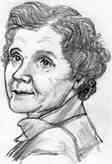
Rachel Carson, born on this day in 1907 in Springdale, Pennsylvania, was the catalyst for the environmental movement which erupted in the 1960s in the U.S. with her book Silent Spring (1962), an exposé on pesticides and their effects on wildlife.

A graduate of the Pennsylvania College for Women and Johns Hopkins, Carson studied aquatic life, becoming one of the first 2 women staff biologists at the U.S. Bureau of Fisheries in 1935. She proved to be an excellent writer, her 1937 article in Atlantic Monthly, "Undersea," becoming the basis of her first book, Under the Sea-Wind (1941). By 1949, she was chief editor of the publishing programs of the U.S. Fish and Wildlife Service. Her second book, The Sea Around Us (1951) was a bestseller and won the National Book Award. The attention that book brought to her led to her receiving a Guggenheim fellowship, which permitted her to take a leave of absence and write another book, The Edge of the Sea (1955). Her niece’s 5-year old son, Roger Christie, became the inspiration for a 1956 magazine article, "Help Your Child to Wonder" which was later turned into a children's book; the following year her niece died and Carson adopted Christie.

For all these accomplishments, Carson would be little remembered today were it not for an inquiry from her friend Olga Huckins, who had witnessed the destruction of wildlife in her bird sanctuary after spraying with pesticides, about the potential dangers of the pesticide DDT. Using data from prior studies, Carson wrote a moving indictment about the lack of responsible oversight in the pesticide industry. DDT had been created by Paul Muller, who won a Nobel Prize in 1948, as a result of biological warfare experiments. When it began to be used on insects in farming during the 1940s and 50s, crop yields increased dramatically; DDT was, as a result, considered to be a miracle of modern science.

As Carson wrote in Silent Spring, "Over increasingly large areas of the United States, spring now comes unheralded by the return of the birds, and the early mornings are strangely silent where once they were filled with the beauty of bird song"; and the evidence suggested, she said, that pesticides such as DDT were slowly killing bird flocks. For Carson, however, the issue was not DDT, but the false notion of "control of nature" which chemical manufacturers were trying to exploit, a "phrase conceived in arrogance, born of the Neanderthal age of biology and philosophy, when it was supposed that nature exists for the convenience of man . . . It is our alarming misfortune that so primitive a science had armed itself with the most modern and terrible weapons, and that in turning them against the insects it has also turned them against the earth."

Pesticide companies, aided by such organs as Time magazine, called Carson a hysterical alarmist, but her poetic conjecture awakened the nature consciousness of American readers, leading President Kennedy to form a special panel to study the effects of pesticides on the environment. This led to the eventual creation of the Environmental Protection Agency, and to the ban of DDT in 1972 and its derivatives by 1975. Far from being an alarmist, scientists now believe that her descriptions of the potential dangers of pesticides were understatements. Carson died of bone cancer on April 14, 1964 in Silver Spring, Maryland, eight years before the DDT ban.

Labels:

Sunday, April 30, 2006

GDP

"I was recently in Pennsylvania at the site of a zinc factory whose airborne wastes were formerly so laden with pollutants that they denuded an entire mountainside . . . From a GDP perspective, however, this was wonderful. First there was the gain to the economy from all the zinc the factory had refined and sold over the years. Then there was the gain from the tens of millions of dollars the government must spend to clean up the site and restore the mountain. Finally, there will be a continuing gain from medical treatments for workers and townspeople made chronically ill by living amid all those contaminants. In terms of conventional economic measurement, all of this is gain, not loss . . . In short, the more recklessly we use up natural resources, the more the GDP glows." Bill Bryson, Notes from a Big Country.

Economist Simon S. Kuznets was born on this day in 1901 in Kharkov, Ukraine.

With funding from the U.S. National Bureau of Economic Research, Kuznets was the first economist to compute national income (gross national product, now boiled down as gross domestic product, or GDP) in a systematic fashion, breaking it down by industry, finished product and use, and assisting the U.S. Department of Commerce in standardizing the measurement of GDP. He won the 1971 Nobel Prize in Economics for his empirical work on economic growth, which showed, among other things, that in poor countries economic growth increased the disparity between rich and poor, while in wealthier countries economic growth seemed to decrease that disparity. He died on July 9, 1985.

Labels: ,

Friday, March 24, 2006

Kapurats


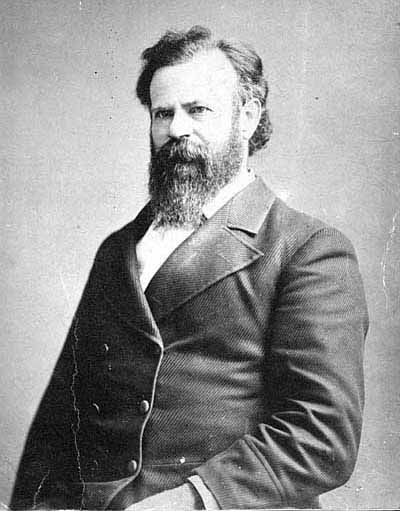
John Wesley Powell -- geologist, ethnologist and explorer -- was born on this day in 1834 in Mount Morris, New York.

With little formal education and a lot of spare-time exploring, young John Wesley Powell developed an interest in natural history and archaeology, collecting Indian artifacts, rocks and fossils around his home in Illinois. Prior to the Civil War, he farmed and occasionally taught school; but with the War's onset, at age 27 he joined the 20th Illinois Volunteer Infantry for the North as a private, and within a year he was captain of an artillery unit. At Shiloh, under U.S. Grant, he lost his right arm below his elbow to a musket ball, but returned to fight at the siege of Vicksburg and the battle of Nashville, receiving his discharge in 1865 with the rank of major.

On the basis of his reputation as an amateur naturalist, after the War Powell became a lecturer in natural history at Illinois Wesleyan College and Illinois Normal University -- but he still had an eye for adventure. With some of his students, he began staging reconnaissance expeditions in the Colorado Rockies, and in the winter of 1868, he explored the upper tributaries of the Colorado River, studying the culture of the Utes and seeking grants from his universities, the Smithsonian and the U.S. Army for a full-fledged journey down the Colorado.

On May 24, 1869, the intrepid one-armed Powell and his crew of 9 other men embarked on what would become one of the last epic explorations of the continental U.S., a treacherous boat trip down the Colorado, through the monolithic gorges of the Southwest that had scared off prior expeditions. By the time he emerged from the Grand Canyon (so named by Powell himself) on August 29, 1869, Powell had succeeded in laying the groundwork for a good map of the Colorado, at the cost of 3 men who were killed along the way; developed an influential theory of how the Colorado preserved its level; established relations with the Utes and Shivwits of northern Arizona and southern Utah (who recalled Powell as "Kapurats," or "right-arm-off"); and was hailed as a hero in the East.

Congress responded by funding Powell to map and study large areas of the West. In 1872, Powell was appointed special commissioner of Indian Affairs, but in addition to providing advice to the government as one of the nation's foremost experts on Native American culture in the West, he began to concern himself with the natural limits of the American settlement of the West.

In his prophetic Report on the Lands of the Arid Regions of the United States (1878), he observed that the region to the west of the 100th meridian (roughly running through present-day Erick, Oklahoma, among other places) lacked the abundant water that had supported the growing populations in the East and Midwest. Therefore, he argued, for the West to grow within the bounds of its resources, the U.S. government would be required to carefully control homesteading, limiting it to self-reliant (not federally subsidized) communal authorities gathered around water and natural watershed areas where irrigation ditches might easily transport water to crops. Powell argued that this kind of control was required to encourage conservation, minimize conflicts over water rights, and reduce inefficiencies inherent in transporting water over long distances.

Powell's Report fell on deaf ears, however: while newspapers and speculators, aided by crackpot scientists, promised that water would somehow appear wherever civilization chose to install itself, politicians in Washington bristled at the notion of imposing so much control over the settlement of the West, arguing that it would interfere with free enterprise.

Between 1880 and 1930, the population of the Western states would increase by almost 10 times without a federal water conservation policy; within the same period, a city like Los Angeles would swell from a sleepy pueblo to a metropolis of 2 million people on the back of William Mulholland's nefarious Owens Valley aqueduct scheme, supplemented every decade or so by greedy grabs of additional water sources further and further Eastward and by billions of dollars of federal dams and reservoir projects; and by 2000, a city like Las Vegas, which would not have even existed under Powell's plans, would become the fastest growing city in the country -- with the highest per capita (and most conspicuous) water use in the West, an overdrawn aquifer, and fewer and fewer options other than to drill for water on federally-protected lands. So much for conservation and self-reliance.

With Powell's visionary plans doused, however, he was consigned to the federal bureaucracy; but as head of both the Bureau of Ethnology (from 1879) and the U.S. Geological Survey (from 1881), he turned his agencies into model government science organizations, fostering the publication of numerous classics of Native American anthropology, as well as topographical maps and land studies. His continual attempts to get in the way of unfettered development in the West ultimately got him fired in 1894, and he retired, somewhat bitterly, to write epistemological works that have been described by one writer as "abstruse." He died on September 23, 1902 in Haven, Maine.

Labels: , , , , , , ,

Wednesday, January 11, 2006

Land Ethic


"Twenty centuries of 'progress' have brought the average citizen a vote, a national anthem, a Ford, a bank account, and a high opinion of himself, but not the capacity to live in high density without befouling or denuding his environment, nor a conviction that such capacity, rather than such density, is the true test of whether he is civilized." -- Aldo Leopold.

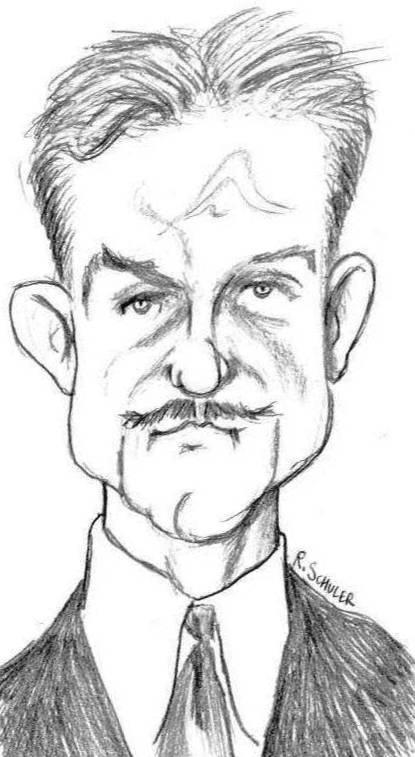
Naturalist and philosopher Rand Aldo Leopold was born on this day in 1887 in Burlington, Iowa.

Leopold’s reputation as the founder of Land Ethic conservation philosophy is a posthumous product, growing as a consequence of the publication of his beautifully written contemplation on man and his relation with nature, A Sand County Almanac and Sketches Here and There (1949), which the Oxford University Press informed Leopold it would publish only a week before his death. During his lifetime, Leopold was known principally as a forester and a game manager.
His family was comprised of outdoor enthusiasts, and most of his early training came from his father, who instilled in him a strict code of sportsmanship. He attended prep school in New Jersey and entered the Sheffield Scientific School at Yale to study in America’s first school of forestry. He received his M.A. in 1909, just in time to get a job with Theodore Roosevelt’s newly-created U.S. Forestry Service. In Arizona and New Mexico, Leopold worked on timber gangs along the route that would become U.S. Route 666 (the Coronado Trail) and administered grazing and forest work in the Carson National Forest while promoting game conservation and the establishment of wilderness preserves.

In those days, however, his orientation was still predominantly economic: a forester’s job was to produce cuttable timber, and a game manager’s job was to produce shootable game. A bout with nephritis caused him to retire from the field in 1924, and in 1928 he joined the Sporting Arms and Ammunition Manufacturer’s Institute as a game surveyor. In 1933 he wrote Game Management, the seminal textbook for the profession, and settled in as the University of Wisconsin’s chair of game management, the first such chair in the country.

In 1935 he bought a piece of spent farm land along the Wisconsin River which became his family’s natural sanctuary. There he watched the land heal itself, reflected and began to write about the slow transformation of his own attitudes about the land. One formative experience he had was a mountain hunting episode along the Arizona-New Mexico border, where he and a group of sportsmen happened across a wolf and her 6 pups. After the party massacred the predators, a reflection of the prevailing attitude that eradicating wolves made for more shootable game, Leopold watched the mother wolf die and had an epiphany -- he suddenly understood the meaning of his labors from the point of view of the mountain itself, rather than simply from the sportsman. As he later concluded, a deer herd without wolves and lions "is more dangerous to wilderness areas than the most piratical senator or the go-gettingest chamber of commerce."

His interest subtly changed from game management to wilderness management, an effort to preserve the natural, ever-regenerating cycles of an ecology, leading to his formulation of a "land ethic" to stand alongside inter-personal human ethics, stated simply by Leopold as "a thing is right when it tends to preserve the integrity, stability and beauty of the biotic community" as a whole, and that "it is wrong when it tends otherwise."

He would not turn against hunting, however, only bad hunting policies and irresponsible overhunting; hunting was, for Leopold, an active participation by man as a citizen of the wilderness in the drama of ecology. Still, he could turn his wit and literary abilities against stupid hunting and stupid hunters. When the president of the National Rifle Association called the killing of eagles "the purest of all rifle sports," Leopold countered that would rather that the NRA president "shoot the vases off my mantelpiece than the eagles out of Alaska." Sand County Almanac became one of the primary philosophical touchstones of the conservation movement which would grow during the 1960s and 70s.

Leopold died of a heart attack while fighting a grass fire which was threatening his farm in Sauk County, Wisconsin on April 21, 1948.

[Meanwhile, today's NPR commentary by Frank Deford focuses on hunting's current status as a sport in America, with a conclusion that Leopold could not have predicted.]

Labels:

Thursday, December 15, 2005

Chico Mendes


"My dream is to see this entire forest conserved because we know that it can guarantee the future of all the people who live in it . . . If a messenger from the sky came down and guaranteed me that my death would help to strengthen our struggle it would even be worth it. Experience teaches us the contrary. I want to live." -- Chico Mendes, 1988.

The man whose life stands almost as a symbol of the fight to preserve the Amazon rainforest actually began his struggle as a way of preserving the economy in which he grew up. The Amazon rainforest is the world’s largest and most ecologically diverse forest on the planet, a mystical sanctuary for ecologists around the world. When Chico Mendes (born on this day in 1944 near Xapuri, Acre, Brazil) was a child, however, the forest had been his family’s livelihood for generations -- not for lumber to be harvested there, but for the latex to be tapped from its living Hevea trees.

Mendes was a rubber tapper from the age of 9 and never had a formal education, but he learned to read from a local left-wing revolutionary and absorbed world political news from the Voice of America, Radio Moscow and BBC World Service. During the 1960s, public homesteading laws in Brazil made it possible for wealthy ranchers to move into the far reaches of the isolated state of Acre where Mendes plied his trade and indiscriminately clear out trees for cattle grazing; while by the 1980s only 130 ranchers controlled lands in Acre, their activities (both their poaching and their violent strong-arming) has led to the displacement of over 100,000 rubber tappers and their families.

In the 1970s Mendes became a member of the Catholic church-supported Confederation of Agricultural Workers, through which he and his mentor Wilson Pinheiro began to set up human blockades, long lines of rubber tappers and their families, to literally place their bodies between the loggers’ chainsaws and the trees. These nonviolent protests had limited success but did serve to attract attention to the plight of the rubber tappers. The ranchers responded violently, however, using local police to threaten, torture and kill many rubber tappers, and eventually murdering Pinheiro in 1980.

After the murder of Pinheiro, Mendes assumed the leadership of the rubber tappers’ movement, and through the First National Rubber Tappers’ Congress, Mendes was able to get enough support to convince the Brazilian government to establish "extractive reserves" in which only renewable resources, such as latex and Brazil nuts, could be harvested. This attracted the attention of the international environmental community, which assisted him in successful lobbying efforts in Miami and Washington, D.C. to stop the Inter-American Development Bank from funding a major road into the forest which had been promoted by cattle ranchers. Mendes had not initially thought of his struggle as an environmental struggle, but a political and economic one; nevertheless, he loved his homeland and recognized the power of the ecological arguments for the preservation of his ancestral land, and embraced the international movement with heart and mind.

In 1987, Mendes was awarded the UN Global 500 Prize and a medal from Ted Turner’s Society for a Better World, but the local ranchers and corrupt police in Acre did not care about Mendes’ international accolades. To them, he was a pariah, and on May 24, 1988, Mendes received his official, anonymous notice that he would be killed, a ritual among the strongmen in western Brazil. Despite warnings to the local federal police, who turned a deaf ear, Mendes was murdered 7 days after his 44th birthday with a shotgun blast to the chest while on his way to take a shower in his backyard bathhouse.

Mendes’ death made the front page of the New York Times, and within 48 hours the international press had descended on tiny Xapuri, leading an embarrassed Brazilian government to move in with a small army and arrest Darci Alves Pereira for the murder. Although there had only been 8 convictions in connection with the over 1,500 rubber tapper murders between 1964 and 1989, Pereira and Pereira’s father Darly, a notorious ranch strongman, were convicted of Mendes' assassination, although Darly’s conviction was overturned for lack of evidence in 1992. It is surmised that forces connected with the ranchers' newspaper, O Rio Branco, participated in the conspiracy behind Mendes’ death.

While at least 21 "extractive reserves" comprising 8.2 million acres have been set aside in Brazil as a result of Mendes’ efforts, they only represent about 1.5% of the Brazilian Amazon, and deforestation continues at staggering rates into the 21st century.

[A cinema note: John Frankenheimer made a film about Mendes, The Burning Season (1994), starring Raul Julia.]

Labels:

Wednesday, October 05, 2005

M. King Hubbert


Geophysicist and mathematician M. King Hubbert was born on this day in 1903 in San Saba, Texas.

In 1956, M. King Hubbert, the head of Shell Oil's research lab and a brilliant but cantankerous University of Chicago scientist, made a bold prediction that raised the ire of his powerful employer. Starting from the assumption that there is only so much oil in the ground, Hubbert designed a mathematical formula that could be used to chart the rate of consumption against the remaining reserves of any finite resource. The resulting curve, known as "Hubbert's peak," would roughly show the point in time at which the production of oil in the U.S. would peak and thereafter decline.

Hubbert's prediction? That the production of crude oil in the U.S. would peak some time between 1966 and 1971, then fall off rapidly to nearly zero. Shell Oil was aghast; Hubbert's estimate of future reserves in the U.S. was far below what Shell and its competitors had predicted, and Hubbert was failing to take into account the uncovering of new reserves and the improvement of exploration technology.

Hubbert stuck to his guns, however. In 1958, Hubbert published a report recommending that the U.S. increase its importation and storage of foreign oil -- in response to which, ignoring Hubbert's estimates, the U.S. government tapped Francis Turner to expand the interstate highway system. In 1962, he wrote the energy section for a National Academy of Sciences report commissioned by President Kennedy, but his conclusions about peak oil production were toned down for the executive summary. Hubbert reached the mandatory retirement age at Shell at age 60 and assumed joint appointments with the U.S. Geological Survey and Stanford University in 1964.

In February 1975, when the U.S. was experiencing a "surprise" oil crisis, the National Academy of Sciences finally accepted Hubbert's calculations, admitting that the U.S. peak had occurred in 1970 -- leaving Hubbert to conduct "I-told-you-so" interviews with the press. "A child born in the middle [19]30s will have seen the consumption of 80% of all American oil and gas in his lifetime," he declared, and "a child born about 1970 will see most of the world's [reserves] consumed."

With better statistical information, Hubbert's successors have concluded that worldwide peak oil production will occur no later than 2020, although industry diehards continue to dispute Hubbert's methodology, awaiting the new technology panacea. With consumption rates in China and India growing by leaps and bounds at the beginning of the 21st century, the Hubbertists claim that the peak could occur even sooner.

Some experts now believe that Hubbert's 1956 prediction should have been a Bill W. moment of self-awareness in America concerning its addiction to petroleum -- if you suddenly became aware of the fact that you would have to have your gin shipped to you from half-way across the world in specially-built tankers just to keep up with your glorious future thirst, wouldn't that be an opportune time to try to kick the habit? Although the macroeconomic significance of "Hubbert's peak" should have led public policy to favor the development of alternative energy sources in 1956, its macroeconomic significance 50 years hence is simply that buyers and sellers, in a world gravely dependent on oil, are now aware that the end is in sight, and prices will continue to rise accordingly.

While "Hubbert's peak" propelled Hubbert to visionary status, his earlier work in geophysics was also highly influential. In 1937, while teaching at Columbia, Hubbert employed a mathematical analysis to explain how the hardest of rocks forming the crust of the Earth could show signs of plastic flow under extreme geophysical pressures. By the 1950s, his work regarding the flow and entrapment of underground fluids caused the oil industry to rethink its basic exploration methods; and much later, Hubbert authored a compelling argument that overcrust faults, whose origins had long puzzled geologists, originated as a consequence of underground fluid pressures. Hubbert was also influential, at Stanford and at Berkeley (1973-6), in advocating that earth and environmental science programs place a greater emphasis on mathematics and physics. He passed away in 1989.

"Growth, growth, growth -- that's all we've known . . . World automobile production is doubling every 10 years; human population growth is like nothing that has happened in all of geologic history. The world will only tolerate so many doublings of anything -- whether it's power plants or grasshoppers." -- M. King Hubbert, 1975.

Labels: , , , ,