Saturday, May 06, 2006

Freud


"Sometimes a male river eel is just a male river eel." -- Felix Blueblazes.

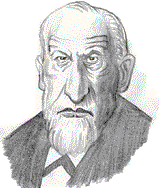
A loud war rages over Sigmund Freud and his legacy -- was he a scientist, or a fantasist? a healer or a charlatan? -- but the fact that no cease fire has emerged in the multiple decades since his death, nor any cozy nor cool detente been reached, indicates the staying power of his oeuvre. Freud's grip on us extends far beyond the realm of the academics, however, as Freudian concepts such as "anal-retentiveness" and "phallic symbol" have become easily absorbable constituents of the pop lexicon.

Born on this day in 1856 in Freiburg, Moravia, Freud was an exceptional student. He initially considered going into law or literary criticism -- both disciplines known for their interpretive manhandling of texts and utterances -- but instead turned his attention to natural science, entering the University of Vienna in 1873 and working with Brücke and Helmholtz. His earliest scientific paper was on male river eels (1877), but he later turned to human pathology, studying aphasia and infantile cerebral paralysis.

He graduated in 1881 and began a clinical research fellowship at Vienna General Hospital, where his research on the effects of cocaine prompted a colleague to embrace its use as a substitute for morphine in eye surgeries. In 1885, Freud went to Paris on scholarship and studied with the neuropathologist Jean Charcot, who was interested in the condition of "hysteria" -- then thought to be a nervous disorder linked to gynecological conditions and therefore afflicting only women. When he returned to Vienna, Freud presented a lecture on "male hysteria" which he claimed to have observed in Paris, but he was roundly humiliated by his colleagues for his outlandish view that such a thing could even exist.

At that point, Freud "withdrew from academic life and ceased to attend the learned societies," although as a practicing neuropathologist he would continue his research on nervous disorders. With Josef Breuer, he used hypnosis to treat "Anna O.," a young "hysteric." Their account of the experiment was published as Studies in Hysteria (1895), and in it, they described a treatment method called "catharsis," in which a patient relives a traumatic event under hypnosis; they posited that the resulting emotional discharge could relieve the patient of certain types of neuropathological blindness or paralysis. Freud's fruitful partnership with Breuer fell apart, however, over Freud's insistence that neurotic symptoms were produced as a psychological defense against repressed unacceptable sexual fantasies and drives.

In the half decade following Studies in Hysteria, Freud embarked on a "Project" to confirm this theoretical neurophysiological basis for psychology, aided by his exploratory correspondence with physician Wilhelm Fleiss as well as a period of intense "self-analysis" over ambivalent feelings toward his recently deceased father. On the therapeutic side, he abandoned hypnosis in favor of "free association," the provocation of stream-of-consciousness utterances from his patients that Freud believed provided a window on the unconscious mind.

From this period of isolation, although he failed to complete his "Project" successfully (he abandoned the desire to find observable, quantifiable biological causes for neuroses, although his methods would continue to have the buzz of biological determinism about them), at the age of 44 he emerged with the beginnings of a comprehensive theory of psychoanalysis, first in The Interpretation of Dreams (1900), a philosophical memoir in which he theorized that dreams contained symbolic clues to unconscious conflicts -- initiating the kind of textual interpretation and search for meaning in what would otherwise be seen as casual phenomena that would inhabit his analytical approach for the rest of his life. He continued to define his new "science" in The Psychology of Everyday Life (1904), in which Freud analyzed slips of the tongue (known today as "Freudian slips") and other mental "accidents" as further clues of inner conflict, and in Three Essays on Sexuality (1905), in which he boldly contended that adult neurosis was generated by unconscious crises of childhood sexual identity, embodied in the "Oedipal complex," an unarticulated childhood desire for sexual validation from one's opposite-sex parent.

While his theories were denounced by the old guard of mind-scientists, they were compelling enough to win a host of youthful admirers, such as Alfred Adler, Carl Jung and Otto Rank. Although all 3 of these star pupils would eventually bitterly break away from Freud (Adler would downplay the relative importance of unconscious sex drives in favor of the conscious drive for self-betterment; Jung would subordinate Freud's sex drive analysis to a consideration of the higher calling of the "collective unconscious"; and Rank would move on over the autocratic style of psychoanalytic treatment methods), Freud's views would continue to hold sway over an army of psychoanalysts around the world; and history tends to show the essential influence of Freud's habits of interpretation on his ex-Freudians, evidencing the propagation of Freud's thought through the protesting theories of his critics and former followers. In short, his definition of a relationship between the unconscious mind and one's observable behavior changed everything.

From 1905 to the early 1920s, Freud published numerous elucidations and applications of his theories (including Beyond the Pleasure Principle, 1920, in which he proposed eros, the life instinct, and thanatos, the death instinct, as the two principal, opposing and interlocking, motivating forces in humans) as he settled comfortably into the role of cigar-smoking, anecdote-telling Father of his own Movement. In 1923, coincident with being diagnosed with cancer of the jaw (launching 16 years of surgery, culminating in his jaw being replaced with a prosthesis), Freud further delineated his topography of the unconscious in The Ego and the Id. In it, he detailed his influential theory of human personality, involving the clash of the "id" (the infantile, biological engine of pleasure) and the "superego" (the regulating conscience) on the battlefield of the "ego" (the conscious personality) -- resulting in a new definition of therapy as an attempt to mitigate the harshness of the superego.

With the rise of the Nazis, psychoanalysis was banned in Germany, and when Hitler invaded Austria in 1938, Freud fled and resettled in London, where he died on September 23, 1939.

Freud's hobby of turning his theories on the creators and objects of art and literature has been amply rewarded (or avenged) over the years: in works by D.M. Thomas (The White Hotel), Irving Stone (The Passions of the Mind), John Irving (Hotel New Hampshire), Anthony Burgess (The End of the World News: An Entertainment) and E.L. Doctorow (Ragtime), Freud has taken a turn as protagonist or colorful cameo personality; and Freud himself has been portrayed in films by the likes of Montgomery Clift (Freud, 1962), Alan Arkin (The Seven-Per-Cent Solution, 1976) and Alec Guinness (Lovesick, 1983), most often for cartoon effect, such is the pop cultural stickiness of his image and his interpretive constructs.

Labels: , , , ,

Saturday, April 22, 2006

Kant


David Hume had left the upper floors of Western philosophy in a most untidy state with the publication of An Inquiry into Human Understanding in 1740: standing ruthlessly on the principle that all knowledge is based on experience, Hume argued that the concept of Causation, among other bedrock concepts, was an unsupportable belief, since it could never really be experienced. While this (almost nihilist) declaration might have been akin to a market crash leading a number of weakly diversified philosopher-investors to jump out of the tower windows, Immanuel Kant would not be so easily disheartened. He would simply pick up a broom and start sweeping.

The son of a genial leather cutter and his uneducated but practical and intelligent wife, born on this day in 1724 in Konigsberg, East Prussia, Kant grew up in relative poverty. At 18, he began studying theology at the University of Konigsberg, but soon his mind wandered to Newton, mathematics and the sciences. When his father died in 1746, Kant and his 5 sisters were penniless, and Kant was forced to leave the University without a degree and to eke out a living as a tutor to the children of the country-gentry. Although the pay was meager, the little man was dressed well by his patrons and encouraged to mingle, all of which drew him out of his cold, hard shell long enough for him to practice at dry wit and a diffident social grace.

At 31, he left the comfort of his patronage and returned to the University to finish his degree, taking up as a junior lecturer in the sciences at large for 15 years -- often drawing a crowd from outside the University who came to enjoy his shrewd and vivid use of language (characteristics which were regrettably not present in his notoriously turgid written works). During this period he immersed himself in the works of Newton, Leibniz, Hume and especially Rousseau, and cheerfully simmered in them while developing his eccentric daily routine which he would maintain for the rest of his life -- dining, writing, walking, and so on, all at an unvaried, precise time of day, come sun or storm. He grew impatient with Leibniz, and began to be convinced by Hume's destruction of metaphysics, until one day, in a flash, he believed he knew how he could restore order to the post-Hume world.

In his Critique of Pure Reason (1781), Kant agreed with Hume that innate ideas were a myth, but countered that experience could not be accessed without knowledge; Space, Time, Quality, Quantity, Relation and Causality might be subjective concepts, but without them experience would not be sensible. Kant promoted these "categories" as articles of "pure" or "a priori reason," things that could be known prior to experience. Kant also distinguished between "analytic" judgments (assertions which by their meaning alone are logically absurd if denied, e.g., "all wives are married") and "synthetic" judgments, often cast as laws of nature (such as Newton's third law of physics, "For every action there is an equal and opposite reaction") which we cannot know through experience alone -- they can be denied without logical absurdity, but their truth and necessity are evident without exhaustive observation of "every action."

Hume had argued that all judgments are either "analytic a priori" or "synthetic" and based on experience ("a posteriori"), but Kant holds, in support of the metaphysically knowable, that concepts in geometry and mathematics, for example, are synthetic judgments that are known prior to experience ("synthetic a priori") -- in effect, that geometry represents a set of not exhaustively experience-able rules about Space, and mathematics represents a set of not exhaustively experience-able rules about Time or Quantity.

Underlying all of that was Kant's highly influential rendering of human psychology, showing the distinction between perceiving (sensing and apprehending particulars) and thinking (understanding and applying concepts to particulars), and the view that because of the conceptual overlays which are necessary in order for humans to understand the things they experience, that we can never know the real world (the "thing-in-itself"), only the thing as perceived and processed.

In 1786, Kant found himself the target of a witch hunt in the court of Frederick William II for denying proofs of the existence of God in Pure Reason, leading him to promise to the king that he would refrain from writing about religion. The king died in 1787, however, and Kant broke his silence in Critique of Practical Reason (1788), in which he studies the metaphysical grounds for morality, in effect to bring God back into the equation. There he stated his famous "categorical imperative": "Act only in accord with a principle which you would at the same time will to be a universal law."

In 1790, he published Critique of Judgment, which dealt with aesthetics and attempted to articulate an a priori principle that makes judgments about beauty possible. He never finished his final project, a patently unreadable fragment he intended to call Transition from the Metaphysical Foundations of Natural Science to Physics, succumbing following a stroke at age 78 on February 12, 1804.

Kant's resurrection of metaphysics from the clutches of Hume's deadening skepticism launched the next wave of German Idealist philosophy, which culminated in the work of Hegel; his categorical imperative is a concept which lingers through the work of Rawls and Habermas; and his approach to perception and thought contributed to the development of Gestalt psychology and laid the groundwork for major movements in experimental psychology.

Labels: ,

Tuesday, March 07, 2006

Aristotle


Speaking of Aquinas, perhaps this is an opportune moment to take a look at Aristotle.

The diametric differences in approach between Aristotle and Plato, Aristotle's teacher at the Academy in Athens, are deeply embedded in much of what Western philosophers have bickered about for centuries since -- endless variations on the themes of Plato's belief in an objective reality existing apart from human sensation, and Aristotle's emphasis on intelligent observation of physical phenomena.

An orientation toward the physical may have been cooked into Aristotle's veins: his father Nicomachus was physician to the Macedonian king Amyntas II, and it is said that he began training Aristotle to follow in the profession from a young age. Nicomachus died when Aristotle was 10, but certainly there may have been some attempt on the part of Aristotle's guardian to carry out Nicomachus' wishes in sending the 17-year old to study in Plato's famous Academy. Although Plato was in Syracuse when Aristotle arrived, it did not take him long after his return to identify Aristotle as a young man of superior capabilities, and soon he began to call young Aristotle "the intellect of the school." Aristotle eventually became a teacher at the Academy, possibly instructing in rhetoric and dialectic -- the art of question and answer.

When Aristotle was 37, Plato died, leaving the Academy in the hands of his mathematically-oriented nephew Speusippus. Numbers not being Aristotle's cup of tea, he left the Academy. His old ties with powerful Macedonia (including with its ruler, his boyhood friend Philip) made him a marketable commodity, and he soon accepted the invitation of Hermias, king of Atarneus, to teach. Hermias, seen by some as a living embodiment of Plato's "philosopher-king," certainly saw the advantages of keeping the well-affiliated Macedonian around, and married his niece to Aristotle. Despite his loyalty to Hermias, Aristotle began a now-lost treatise at this time which suggested that it was a disadvantage for a king to be a philosopher, that instead a king who relied on the fresh perspectives of wise philosophers would be more effective than Plato's philosopher-king.

It is unclear whether the shortcomings of Hermias' own intellect had anything to do with it, but in 344 B.C. Hermias was captured and executed by invading Persians. Aristotle fled to the island of Lesbos, where in exile he returned to his childhood anatomy lessons, gathering specimens of marine life along the island's shore, inspecting them with his scalpel and recording copious notes about them. The idyll proved to have a profound influence on Aristotle's thought, gradually turning him away from Plato's concept of a higher plane of reality and back to the present fundamentals -- the scent of mollusks and sea air, the taste of salt water on his skin, the rush of the wind and the heat of the Aegean sun.

He left Lesbos for Macedonia after a couple of years, by legend to tutor Philip's son, the future Alexander the Great. Whether or not he was Alexander's tutor remains a matter of conjecture, but the close connections between the two are not: Alexander later saw to it that local specimens of flora and fauna from his conquests were sent back to Aristotle's library, and when Alexander became king in 336 B.C., he funded Aristotle's launch of the Lyceum in Athens, a rival school to the Academy.

Rather than engaging students in dialogues as Plato did, Aristotle preferred to lecture, wandering through the halls of the Lyceum with students gathered in tow. More importantly, however, Aristotle expanded the scope of education, defining new disciplines such as biology and psychology and lecturing on everything from politics and ethics to metaphysics, economics and rhetoric. It is the Aristotle of the Lyceum -- the squat, pinky-ring wearing, spindly-legged man in his late 40s and 50s, exceptionally well-organized and an avid collector of all manner of material things -- that we have incidentally come to know best.

The only texts by Aristotle which survive are his lecture notes from this period, which is a little like trying to get to know Dickens from a set of storyboard sketches, perhaps. Nonetheless, Aristotle's lecture notes reveal his concern with breaking things (or questions) down to their constituent parts for more manageable data analysis, with classification so that information could be easily accessed (his classifications of plants and animal life still form the basis of modern biological classification) and with the extraction of knowledge through the use of logic.

Principal among his works are Organon, on logic, illustrating the understanding of scientific questions through the implementation of systems of axioms; Physics, a review of astronomy, meteorology, plants and animals; First Philosophy, or Metaphysics, an analysis of the most general, abstract features of reality, the principles which define existence (including a description of Aristotle's God-like "Prime Mover," the first cause of all existence); his work on ethics, dedicated to his son Nico, the Nicomachean Ethics; Rhetoric; and Poetics.

His methodologies for understanding existence were derived from observation. His description of four causes for every real thing in nature (the material, based on a thing's component substances; the efficient, or the process which produces a thing; the formal, a thing's ultimate shape; and the final, that which gives it its purpose or meaning) and 10 categories of being (substance, quantity, quality, relation, place, time, position, state, action and affection) are quite far removed from Plato's extrasensory interests, revealing the mind of a diagnostic mechanic. If Plato might want to engage you in a discussion of your "stuff" with the aim of turning you toward unseen absolutes, Aristotle would not be able to keep his paws off your "stuff," taking it apart and putting it back together and showing you things you never guessed you'd ever know about your "stuff."

While the enveloping sense of authority throughout Aristotle's writings may be seen as somewhat self-important and overbearing (especially to his enemies), the old teacher is thought to have been generous and affectionate. When Alexander died in 323 B.C., Aristotle's enemies mobilized the anti-Macedonian sentiment in Athens and officially charged Aristotle with the crime of impiety. Recalling the fate of Socrates and his failed attempt to defend himself from similar false charges, Aristotle fled Athens for Chalcis, and died there of a stomach ailment after only a few months. His body was taken back to his hometown of Stagira and his ashes were buried with great honors.

Meanwhile, the Lyceum remained open until 529 A.D. when Justinian closed all "philosophy" schools. Aristotle's influence on the intellectual histories of Islam and the West has been pervasive: his work, particularly his Metaphysics and his rational model for the existence of a Prime Mover, was commented upon and engaged by such diverse writers as Ibn Sina, Ibn Rushd, Aquinas and Maimonides; and his conceptions of biology and astronomy defined most of what came afterwards, even as the empirical value of his conclusions have gradually eroded since the Renaissance.

Labels: ,

Saturday, October 15, 2005

Michel Foucault


Long after the cults of other 20th century French thinkers have faded here in the U.S., American academics still seem to love Michel Foucault, who was born on this day 79 years ago in Poitiers, France. Going out on a limb here, I'll guess that this has something to do with the fact that the historical, public ebb and flow of our Democratic institutions has given us a well-developed sense of injustice -- that, and we do love our conspiracy theories here. Although Foucault himself doesn't necessarily focus on such matters, his arsenal of critical weapons and predilection for piss-taking certainly have allowed us Americans to beat injustices and conspiracies with a stick.

A brilliant youth, Foucault entered the highly prestigious Ecole Normal Superieure in 1946 at a time when official France still required his homosexuality to be hidden from broad daylight. In the pressure-cooked environment of the ENS, Foucault developed an armor of argumentativeness, intellectual superiority and scorn for those who earnestly played by the rules, coupled with an obsession with suicide resulting in an unsuccessful attempt to kill himself in 1948.

Although he read philosophy voraciously, particularly Heidegger and Nietzsche, and studied under Maurice Merleau-Ponty, Georges Canguilhem and Louis Althusser, he supplemented his education by immersing himself in psychology. After graduating in 1952, he taught at Lille and Uppsala and worked in a psychiatric hospital before publishing his first work, Madness and Civilization: A History of Insanity in the Age of Reason (1961), in which he argued that the notion of "insanity" was a discursive tool used by authorities to categorize acceptable and unacceptable behavior (rather than an illness), and that insane asylums were depositories for excluding nonconformists (rather than treatment facilities).

In this first book, he established some themes that would dominate his subsequent work: writing beyond the genre of "philosophy," Foucault wrote about the history of thought, science, society and institutions with highly personal doses of irony, cynicism and wit (remnants, no doubt, from his old ENS suit of armor) to supplement his philosophic seriousness and skepticism, exploring the ways in which those who are in power cultivate distinctions within society -- dividing and conquering in the process -- and therein hide the mechanisms of their self-preservation.

His books The Birth of the Clinic: An Archaeology of Medical Perception (1963) and Discipline and Punish: The Birth of the Prison (1975) discussed the rationalization of practices which were ultimately used to control subjects within the domains of the physician and the state, respectively; and The Order of Things (1966) and The Archaeology of Knowledge (1969) examined the embeddedness of "organization" or "order" as a component of social knowledge and self-identification, and the limits of revolution as an effective device for change in the face of such organization.

Finally, his unfinished History of Sexuality (1978-87) revealed some of the aims of his later work, that he was less interested in articulating a theory of power than in providing opportunities for reexamining the "self," taking Nietzche's destruction of cause-and-effect and the notion of phenomena not having any intrinsic meaning as points of departure for crashing through the web of social relations which constitute the "self."

Foucault was often grouped with the Structuralists, such as Claude Levi-Strauss, because his arguments were based on the view that the world is only intelligible to humans because of the order they impose upon experiences. Although he personally campaigned for the same causes as the Marxist radicals (prison reform, gay rights, the student uprisings of 1968), he rejected Marxism for its strident scientific strains. In fact, he stubbornly refused to attach himself to "movements," as "movements" for him were themselves rationalized regimes for perhaps casting himself as intellectual victim.

Foucault, who died of AIDS-related complications on June 25, 1984, concealed the nature of his illness at the end (some would say, as a way of dismissing the relevance of biographical facts), and ironically died in the same hospital, once an insane asylum, that he had researched for Madness and Civilization.

Labels: , ,