Saturday, February 03, 2007

First Woman Physician in the U.S.


Elizabeth Blackwell, the first woman physician in the U.S., the sister of pioneer woman surgeon Emily Blackwell, and the founder of the London School of Medicine for Women, was born on this day in 1821 in Bristol, England.

The Blackwell family was chock full of progressives. Elizabeth's brothers Henry and Samuel were active opponents of slavery and supporters of women's rights; Harry married suffragist Lucy Stone, and Samuel married the first formally ordained woman minister in the U.S., Antoinette Brown. Indeed, they arrived in the U.S., in part, because their father's interests in reform had marred his commercial prospects in England. Unfortunately, he died when Elizabeth was 17, whereupon the Blackwells opened a school for girls to support themselves.

Elizabeth, who had received a decent education, taught at the school, but did not see teaching as her life's calling. Despite feeling tempted by the attentions of men, she made up her mind early that she would not marry -- and her attitudes about the way men alter the course of women's life and health would be a constant theme for her throughout her career. A woman friend dying of cervical cancer urged Blackwell to study medicine because the presence of a woman doctor (then unheard of in the U.S.) might have eased her worst suffering.

Blackwell was intrigued by the idea, but she was aware that to pursue medicine would be to take on a disapproving male medical establishment, as well as the unfavorable perception of women who dabbled in medicine, such as Madame Restell in New York City, a then-notorious backstreet abortionist. Nevertheless, she began to read medicine with family friends in the Carolinas and with progressive physicians in Philadelphia. She was rejected entrance to medical schools in Philadelphia and New York, and turned down the suggestion that she study in Europe or disguise herself as a man. Finally, in 1847, she was accepted at the Geneva Medical College (after a vote of the student body prankishly approved), and fought her way past the cynicism to earn the respect of her anatomy professor, who had initially decided to exclude her from lectures on the reproductive system until Blackwell convinced him otherwise.

While at Geneva, she made clinical studies in the wards of a Philadelphia poorhouse, where her observations of Irish immigrants suffering from typhus, and of women suffering from syphilis, awakened in Blackwell a conviction that hygiene and sanitation were critical aspects of medical practice, and that the moral dimensions of sexuality were also aspects of a patient which needed to be "treated."

After graduation, Blackwell went to Paris to study at La Maternite, but contracted opthalmia from an infant she was treating and left Europe blinded in one eye. Although her plans to become a surgeon were dashed, Elizabeth returned to New York City to open a general practice; her earliest attempts were foiled by landlords and a cold shoulder from her male colleagues, but after a period of public lecturing on women's health issues, she bought her own place and opened her practice in 1856, with her sister Emily (who had recently studied surgery in Edinburgh) and Marie Zakrzewska, a recent graduate of Western Reserve Medical School.

While Emily and Zakrewska ran the practice, Blackwell assumed the role of international spokesman for women's medicine, undertaking a critique of male-dominated medicine in writings and speeches which indicted "medical materialism" (the treatment of patients as objects) and "laboratory medicine" (which focused on certain afflictions in a specialized way). For Blackwell, preventive care and treatment of the whole patient -- techniques which emphasized nurturing, empathy and moral education, as well as an awareness of the social and political climates of disease -- were "female" ideals which needed to be advanced within the "masculine" milieu of the new experimental medicine. At times, her ideas kept her from recognizing progress (she resisted vaccination, for example), but Blackwell's ideas continue to live through the approaches of alternative medicine, and more recently have been given increased attention in formal medical education.

She settled permanently in England after 1869, providing inspiration to England's first generation of women physicians, such as Sophia Jex-Blake. She died on September 7, 1910 in Argyllshire, Scotland.

Labels: ,

Friday, March 31, 2006

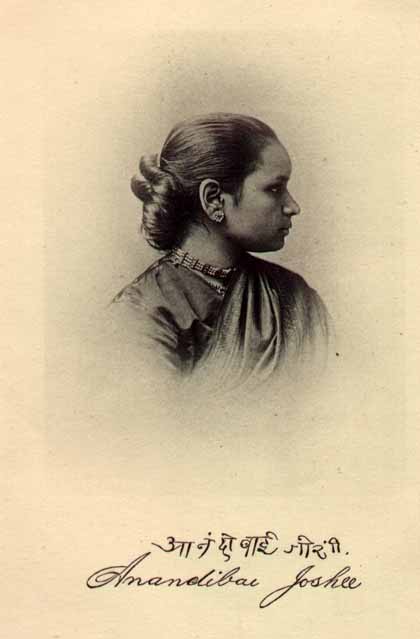
Anandibai Joshi


Anandibai Joshi, the first Hindu woman to obtain a medical degree in the Western hemisphere, was born Yamuna Joshi on this day in 1865 in Poona, India.

Although she only lived to be nearly 22, the example of Anandibai Joshi's life provided inspiration to generations of Indian women seeking education and, in particular, those who aspired to become physicians. Born to a wealthy Brahmin family, Anandi's parents indulged her love of learning and permitted a local Sanskrit scholar, Gopal, to teach her. At age 9, Anandi married Gopal (a widower 20 years her senior) and at 14, she gave birth to their first and only child. The infant survived only 10 days, but in her grief Anandi turned her thoughts to what could have been done to save her child: she became convinced that if there had been a female doctor available, the child might have lived. At 14, she became determined to become a doctor.

Despite the fact that Hindu culture discouraged the education of women and could not even contemplate a woman as a professional, let alone a doctor, Gopal was broad-minded and supportive of his wife's dream. In 1880, he sent a letter to Royal Wilder, a well-known American missionary in India and publisher of Princeton's Missionary Review, expressing his wife's interest in attending medical school in the U.S. and inquiring about a suitable post there for himself. Wilder superciliously responded with a plea for their conversion to Christianity, and added insult to injury by publishing the correspondence in the Review.

Shortly thereafter, however, a Mrs. Carpenter of Roselle, New Jersey picked up that edition of the Review while waiting to see her dentist, read Gopal's letter, and was moved by the man's earnest hopes for his wife. She immediately wrote to Gopal offering to host Anandi if she would come to the U.S. to study. Anandi and Mrs. Carpenter began an enthusiastic correspondence about Hindu culture and religion, through which Mrs. Carpenter noted that Anandi possessed a rich command of English and an active mind. Although Mrs. Carpenter's attentions were encouraging, Gopal knew he would not be able to leave his responsibilities in India. It was considered unsuitable for a married Hindu woman to travel alone, but Anandi was determined to go, and Gopal relented.

When Anandi's decision became known within her Bengali community, however, the two of them found themselves at odds with their neighbors -- some even resorted to spitting at Anandi and throwing stones at her when she walked through the streets carrying her books. The Christians in the community, on the other hand, did not oppose her plans -- they only wanted her to submit to Christian baptism before she left. To set everyone straight, Anandi decided to explain her decision to go to the U.S. alone to obtain a medical degree in an address at Serampore College Hall in Calcutta; according to some, it would be the first time an Indian woman would deliver a public address. She cited the need for Hindu female physicians in India, explained her goal to open a medical college for women in India, described the persecution that had been dealt to her and her husband, and made a startling pledge: "I will go as a Hindu and come back to live as a Hindu."

Following the publication of her speech, contributions came in from throughout India -- including 200 rupees from the Viceroy. She sold her gold wedding bangles and booked passage on the City of Calcutta for New York in the company of some European women, where she was met in June 1883 by Mrs. Carpenter. Soon afterward, she wrote to the Women's College of Pennsylvania asking to be admitted to the medical program (the first women's medical program in the world) and, moved by her passion, the dean of the medical school asked her to enroll.

Thus, Anandi began her American medical education at the the age of 19, and she was a model student, submitting a thesis on "Obstetrics among the Aryan Hindoos" and graduating with her M.D. on March 11, 1886. Queen Victoria sent a congratulatory message, and with the news of her achievement, Anandi was offered a job as physician-in-charge of the female ward at Albert Edward Hospital in Kolhapur, India.

In the meantime, however, Anandi had contracted tuberculosis -- perhaps worsened by a combination of cold weather and an unfamiliar diet -- and her health was steadily declining. Her friends sent her to Colorado Springs for her health, but she returned without improvement. Nevertheless, she returned to India, receiving a hero's welcome, while the newspapers closely monitored her physical condition. She died on February 26, 1887, in her mother's arms at her birthplace, and was mourned throughout India, celebrated for her courage and perseverance. Her ashes were sent to Mrs. Carpenter, who placed them in her family cemetery in Poughkeepsie, New York.

Labels: , , ,

I Think, Therefore I Am


"The view of nature which predominated in the West down to the eve of the Scientific Revolution was that of an enchanted world. Rocks, trees, rivers, and clouds were all seen as wondrous, alive, and human beings felt comfortable in this environment. The cosmos, in short, was a place of belonging . . . Scientific consciousness is alienated consciousness: there is no ecstatic merger with nature, but rather total separation from it . . . I do not wish to suggest that Descartes is the lone architect of our current outlook, but only that modern definitions of reality can be identified with specific planks in his scientific platform." -- Morris Berman, The Reenchantment of the World.

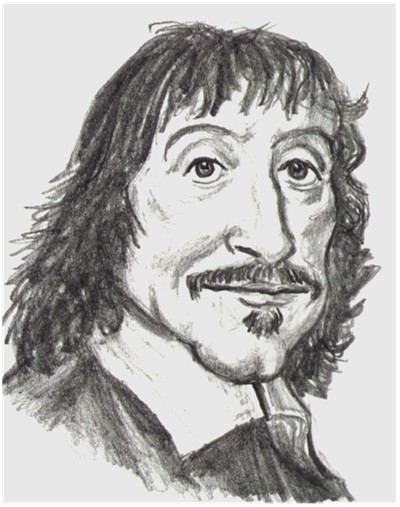
Rene Descartes was born on this day in 1596 in La Haye, Touraine, France.

Educated at a Jesuit school founded by Henry IV, during a commemoration of the assassination of Henry's death, young Descartes became intrigued by references in one of the eulogies to Galileo's discovery of certain moons of Jupiter. Galileo soon became Descartes' intellectual hero -- a pioneer thinker and mathematician who sought objective answers, leaving dogma and the morass of moral uncertainty behind in the service of knowing what was knowable, but hidden.

At 21, Descartes' impatience with scholastic texts led him to military service, where he had a mystical awakening of sorts. On November 10, 1619, after a day filled with reflection as he waited for active duty, Descartes had a dream that he was destined to found a unified scientific movement based on a method for the proper management of human reason. From that point on he was single-minded in his pursuit of reason. Preferring to learn from travel and encounter rather than dusty, hopelessly muddled books, Descartes arrived in Paris and stunned a gathering of scholars there with a first, furtive attempt to free philosophical inquiry from scholastic rigidity through logical analysis, offering "12 evident reasons" for the falsity of a statement which was widely considered to be true. He then apologized to the thoroughly convinced crowd that his methodology was not yet mature.

Despite the danger of such independent thinking, he was encouraged by a Roman Catholic cardinal who was present at the gathering to complete his methodology, that it was "God's will" that he do so. In 1633, as Galileo and his solar-centered view of our planetary system were being condemned by the Inquisition, Descartes had completed an astronomical treatise called Le Monde. He considered burning his manuscript, because it too reflected the Copernican cosmology which the Church had condemned, but instead he set it aside with the idea of having it published posthumously.

In 1637, Descartes published The Discourse on Method, which articulated his method of systematic doubt for the first time, distilled as follows: (1) admit as true only what is free from all doubt; (2) divide all difficult problems into analyzable elements; (3) pass synthetically from the easy to the difficult; and (4) record the steps of your reasoning without omission, so they can be retraced like a trail of bread crumbs back into the darkness if necessary.

Descartes' aim was to blow away the old science, which started with axioms and assumptions, and make humans the possessors of their own universe by pushing reason to calculated, practical effects. "I think, therefore I am," seemed to be the only proposition which was free from doubt (because one must exist in order to doubt at all) in his metaphysical inquiry, Meditations on First Philosophy (1641); it became his first principle. Further meditations led him to conclude that thinking is what defines the essence of the individual, the body being a separate, distinct and perhaps illusory substance, accessible only through one's intellect. Perhaps it is not surprising that a man who could find his future framed so vividly in a dream should have exalted 'the mind' over the 'the body' so definitively.

Descartes' Meditations were celebrated throughout Europe; although theologians found Descartes' questioning of what were once considered to be basic principles to be discomforting, despite the fact that the Meditations contained Descartes' proof of the existence of God, and scientific empiricists, led by Pierre Gassendi, did not appreciate Descartes' distrust of the senses and experimental method. The opposition of organized religion posed the more serious threat at the time. One theologian, Reformed pastor Gysbertus Voetius, had Descartes tried in absentia for "libel," after which he was sentenced to be burned at the stake.

Meanwhile, encouraged by his friendship with Elizabeth of Bohemia while in exile in the Hague, Descartes wrote Principles of Philosophy (1644), proposing, as he had once dreamed, a science with metaphysical reasoning as its foundation, physics as its set of logically derived regulations, and all of the other branches of science, from medicine to astronomy, as its beneficiaries.

His final work, The Passions of the Soul (1649) takes his "Cartesian duality" to its logical extreme, proposing that all psychological manifestations can be traced to mechanical causes -- that human bodies are, in essence, automatons with souls located in the pineal gland. (Meanwhile, Descartes viewed animals as soulless, giving a justification for using animals in scientific research which to this day brands him as an enemy to animal rights activists.) These views had a profound effect on medicine, which for hundreds of years afterward officially ignored the potential impact of psychological stresses back onto physiology; it also foreshadowed the notion of artificial intelligence, thinking conducted by robots.

Legend holds that Descartes had himself built a "life-like" hydraulic robot-servant which he called "Francine" (named after his only child, an illegitimate daughter by one of his servants, who had died at age 5) whose realistic movements so scared a ship's captain on Descartes' journey to Holland that the captain, believing that the Brigitte Helm-like puppet was the creation of the devil, had it thrown overboard.

In 1649, Descartes was invited to the court of Christina of Sweden, who became his enthusiastic pupil in the new science and philosophy. Within a year, however, Descartes grew deathly ill from pneumonia, and died on February 11, 1650 in Stockholm holding the Queen's hand.

In addition to the profound effect he had on the shape of philosophy and science, Descartes employed his own advice to divide difficult problems into analyzable elements by founding analytic geometry, by which he plotted algebraic equations as points on a grid.

Labels: ,