Saturday, June 09, 2007

Household Sounds


Fred Waring was born on this day in 1900 in Tyrone, Pennsylvania. He died on July 29, 1983 in State College, Pennsylvania.

Waring was a violinist and banjo player, best known as the leader of a 70-man white-bread swing band, "Fred Waring and the Pennsylvanians," from 1923 up until his death. An expert marketeer and wheeler-dealer, Waring managed to build his rickety college jazz quartet into a diversified corporate venture, operated from his headquarters on Broadway in Manhattan, spawning radio and TV shows, recordings, world tours, summer choral workshops, music publishing, real estate ventures ... and a blender.

Waring's name is indeed associated with the first popular non-commercial electric blender, known as the "Waring blender." In the 1930s, an inventor named Frederick Osius asked Waring (a one-time Penn State engineering student and an incorrigible gear-head) for financing to develop his patent for an electric blender. Waring invested $25,000, but Osius developed technical difficulties with his design, so Waring fired Osius and had the machine redesigned. The new "Miracle Mixer" was introduced at the 1937 National Restaurant Show in Chicago. The following year, Waring changed the name of the product to the "Waring blender" and marketed the machine while touring the country with the Pennsylvanians. The Waring blender became a must-have item, whirring away in every American kitchen (over a million of them were sold by 1954), and commercial versions of the blender became standard laboratory equipment -- apparently even Jonas Salk used a Waring blender while developing the polio vaccine.

Waring's other distinct claim to fame was his direct effect on the nature of music played on the radio. While during the 1920s, it was fairly common for radio stations to hire bands to perform live on the air, the effects of the Depression had forced radio stations to cut back on such gigs, resorting instead to spinning records, despite the fact that records were generally sold with a stamp that prohibited them from being played on the air. Waring and his band were popular recording artists in the 1920s on the Victor label, but by 1932, Waring decided to stop recording, fearing that his records were cutting in to his more lucrative live gigs. He was also well aware of the fact that as a performer, he did not receive a penny when one of his records was played on the radio -- despite the fact that ASCAP, the American Society of Composers and Publishers, had already begun to establish rights on behalf of songwriters to be paid each time their work was broadcast. (The rival rights organization, BMI, was actually established by the National Association of Broadcasters in 1940 to break the grip of ASCAP, but expanded protection for songwriters by signing African-American songwriters who had been barred from participating in ASCAP.)

While Waring was still under contract with Victor, a bootlegging sound engineer made a transcription of one of Waring's live radio performances and sold a copy of it to a radio station. Waring successfully sued both the bootlegger and the radio station, WDAS in Philadelphia, and then he his sights on something bigger -- securing a piece of the action for performers whenever an authorized recording was played on the radio. Waring founded a new organization, the National Association of Performing Artists, and took aim at radio stations. In a case in Pennsylvania court in 1937, Waring successfully enforced a restrictive legend placed on one of his records that stated that the record was "Not Licensed for Broadcast" -- thus, in theory, giving Waring the ability to negotiate a fee for permitting a station to play the record.

In 1940, however, in the federal Second Circuit Court of Appeals, Judge Learned Hand virtually ignored the Waring case and articulated what became settled law in the matter in a case between bandleader Paul Whiteman and RCA (on the one hand) and WBO Broadcasting (owner of radio station WNEW), stating that RCA, Whiteman's label, had no power "to impose ... pretended servitude on the records; and WBO Broadcasting Corporation is free to buy and use them in entire disregard of any attempt to do so." In reading the opinion, one senses the usually redoubtable Hand's reticence to elevate the work of performers to the same status enjoyed by writers, viewing performers' work as somehow inherently ephemeral. (Maybe yes, maybe no; but what, pray tell, would Judge Hand, if he were alive today, be listening to on his iPod?)

The upshot was that, as a result of Whiteman's defeat, radio stations were emboldened to play records without worrying about claims for compensation from the performers. The record companies were quick to see the angles following the Waring and Whiteman cases; they switched their strategy from attempting to collect licensing fees from radio stations to buddying up with radio stations, enticing them to play their records in order to promote their sale. While record companies were trying to increase the free airplay of records, musicians like Fred Waring began receiving fewer invitations to perform live on the radio. Singer-songwriters, slowly and steadily, began to assert themselves as the prime movers in the pop music medium, since at least they'd get paid through ASCAP or BMI for radio airplay.

After heaving a professional sigh, Waring went back to recording after World War II.


Labels: , ,

Sunday, November 19, 2006

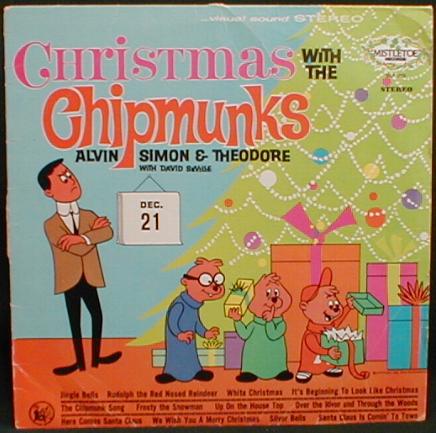
Giving Christmas Back to the Chipmunks


We had barely recovered from Halloween in Napa, its inevitable San Francisco repercussions, and the great grinning mania of Election Day -- when sitting in our local grill the other day, looking up from our pints of Bass Ale, my wife and I suddenly noticed that the bar had already been decorated for Christmas. Silent Night played softly in the background, while someone on Fox News was announcing that Steny Hoyer had been elected House majority leader. "All is calm, all is bright . . ."

Okay -- so it seemed a little early to be thinking about Christmas, but that's a well-worn cliche at this point. The question is why -- why do our friends in commerce feel the need to initiate the celebration of Christmas some time after Election Day and well before Thanksgiving? And why do I have the sneaking suspicion that Christmas will start being celebrated just before Labor Day by 2010?

I think the main reason for "Christmas drift" has to do with the size of Christmas today, as compared with the size of Christmas 35 years ago. When I was a kid, we threw up a tree and put the big colored lights on the facie of the house, we practiced the school Christmas show for a week, sang some songs, and opened up presents on Christmas Day. That was it. Today, the logistics and scale of Christmas for the average family seems to have exploded from that simple sequence into something that compares favorably to a major public construction project. It is now, of course, de rigueur for every middle-class American family to have its own personal Holiday on Ice pageant, combined with the Macy's Thanksgiving Day Parade, Space Mountain and The Price is Right -- until, all swirled up, it feels a lot more like a holiday edition of Survivor. In one's own family room. You can't pull that off in just a week.

This is no different, in fact, from what has happened with presidential election campaigns. In 1952, Adlai Stevenson wasn't even sure he was running for president as late as April -- a mere seven months before he nearly won the popular vote in the general election. Fast forward to 2006: we've just had a mid-term election, the coffin lids haven't even been nailed down on losing incumbents like George Allen and Rick Santorum yet, and here, 22 months before the 2008 presidential election, we have John McCain, Rudy Giuliani and Tom Vilsack already forming exploratory committees. Spending on all campaigns for federal office has mushroomed from less than $250 million in 1952 to $3 billion in 2000. Bigger almost always means more time.

But I digress. As I started to think about the simplicity of my own childhood Christmases, inevitably my mind turned back to a classic among Christmas music albums, a tiny gem of an LP that we would play on our little portable turntables in our little suburban bedrooms. I am speaking, of course, about Christmas with the Chipmunks (Vol. I), originally released in 1962.

This was pure low-tech fun of the kind today's children can barely appreciate. In fact, once you got the hang of what producer Ross Bagdasarian was doing with recording and playing speeds, you could turn all your parents' Andy Williams or Vikki Carr albums into Chipmunks records by flipping the turntable speed switch from 33-1/3 to 45. Try doing that on your iPod. (As comedian Patton Oswalt has famously observed, you could also turn your Chipmunks album into "three normal, monotone guys singing a song about Christmas," with Ross Bagdasarian as the Chipmunks' impresario, David Seville, sounding like a "demon from the ninth level of murderers and traitors," by turning the switch from 33-1/3 to 78. He's not lying.)

How can you not just break out into a silly smile listening to the album's first song, "The Chipmunk Song (Christmas Don't Be Late)"?:

(All right you Chipmunks! Ready to sing your song?
-I'll say we are!
-Yeah!
-Let's sing it now!
Okay, Simon?
-Okay!
Okay, Theodore?
-Okay!
Okay, Alvin? Alvin? ALVIN!
-OKAY!!!)

Christmas, Christmas time is near
Time for toys and time for cheer
We've been good, but we can't last
Hurry Christmas, hurry fast
Want a plane that loops the loop
Me, I want a hula hoop
We can hardly stand the wait
Please Christmas, don't be late.

(Okay fellas get ready.
That was very good, Simon.
-Naturally.
Very good Theodore.
-Ahhh.
Ah, Alvin, you were a little flat, watch it.
Ah, Alvin. Alvin. ALVIN!
-OKAY.)
That, my friends, was a song that spent four weeks on the top of the charts. Critic Stanton Swihart says the tune has "the allure of an old Italian love song."

With fine familial harmonies, Alvin, Simon and Theodore have always seemed to me like a cartoon version of the Beach Boys. This was brought home to me in high relief with the release of the Help Me Ronda Sessions not too long ago, in which Murry Wilson, father of Brian, Carl and Dennis, arrives in the middle of the session and manhandles the boys, drunkenly berating and humiliating them by turns for their lack of discipline. "David Seville" did much the same thing with the Chipmunks, only without the Chivas on his breath, and perhaps without so much out-and-out abuse or such far-reaching psychological effects on his young charges.

Whatever the psychodramatic backstory, here it certainly produces some charming results. The Chipmunks' covers of "Frosty the Snowman," "Here Comes Santa Claus" and "Over the River and Through the Woods" are startlingly wide-eyed and innocent in their embrace of the Christmas holiday -- they are irresistibly quirky reminders of an elegantly simple flavor of a child's Christmas Past that lasted little more than a decade or so within American culture . . . a kind of Eisenhower Christmas before the intrusion of the Holiday Industrial Complex, if you will.

If I could get away with it, I would block Christmas out of my mind until December 19 or so, and then enjoy it to the hilt by wrapping gifts and listening to albums like Christmas with the Chipmunks. As you may recall, however, I sold all of my LPs to make room for my wife's collection of Christmas decorations. So if anyone needs me today, I'll be out front reassembling the digital holographic audio-animatronic nativity scene.

Labels: , , ,

Sunday, July 30, 2006

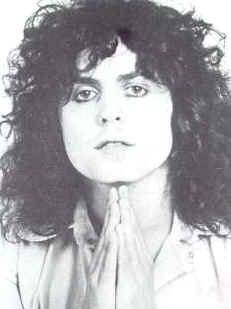
Bang a Gong


Marc Bolan, leader of glam group T. Rex, was born Marc Feld on this day in 1947 in Hackney, London. He was the spacey, cherubic, fragile leader of British power pop during the 1970s, a genre distinguished by ripe, simple grooves, "fat, distorted guitars . . . [and] an overarching folkie/hippie spirituality," according to S. Erlewine. A teenage model, Bolan plunged headlong into psychedelic folk music in 1965 and formed the band Tyrannosaurus Rex (later shortened to T. Rex) in 1968, becoming a major force in British pop music by the early 70s with hits such as "Ride a White Swan" (1970), "Hot Love" (1971) and the glam-classic "Bang a Gong (Get it On)" (1972). His stage persona -- usually sequined and feather-boa'd, always androgynous -- attracted the attention of teens, fomenting the fan phenomenon of "T-Rextasy." Bolan's music was disposable, yet it somehow served to make fellow glam-guy Elton John seem more credible, and at the same time it provided elliptical inspiration to British punks in the late 1970s such as The Damned and The Jam. Bolan died when the Mini 1275 GT driven by his girlfriend, singer Gloria Jones, crashed into a tree in Barnes Common, London on September 17, 1977.

Labels:

Wednesday, June 07, 2006

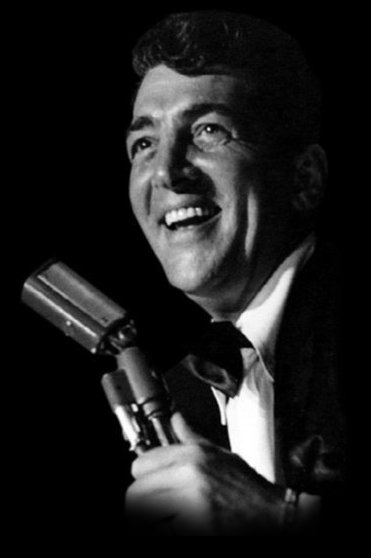
Dino


Dean Martin was born Dino Paul Crocetti on this day in 1917 in Steubenville, Ohio.

An icon of 1960s, middle-aged "cool," Dean Martin boxed (using the name "Kid Crochet"), worked in a steel mill and served as croupier in an illegal gambling club before launching his career as a nightclub singer styled gesture-for-nuance after Bing Crosby (with a healthy dose of Harry Mills thrown in for good measure). He achieved only minor success on the nightclub circuit until an impromptu pairing with frenetic young comic Jerry Lewis at the 500 Club in Atlantic City in 1946, in which Martin sang and acted as slightly patronizing straight man to Lewis' obstreperous interruptions.

The act caught on, and soon Martin and Lewis were headliners at the Copacabana in Manhattan, their pay increasing from $350 to $5,000 a week as the most popular post-war nightclub act around. Their success led to a quick succession of Hollywood movies (beginning as supporting characters in My Friend Irma, 1949, reaching starring status in At War with the Army, 1951). Although his singing career was moderately successful ("That's Amore" reached the top 5 on the charts in 1953), Martin was increasingly marginalized in the Martin and Lewis movies, and having to take a backseat to the Lewis put a strain on their relationship.

On the 10th anniversary of their first show together, they split up the partnership, giving a farewell performance at the Copacabana, and it was widely believed that Martin would fade quickly thereafter. To the surprise of nearly everyone, however, Martin turned out to be quite a good dramatic actor, holding up well alongside Marlon Brando and Montgomery Clift in The Young Lions (1958), and that year he also managed to conquer TV (with his first color variety special on NBC), concerts (with successful live appearances at the Sands in Las Vegas), and the charts ("Volare"). With his appearance in Some Came Running (1959) with old friend Frank Sinatra, the "Rat Pack" (also consisting of Shirley MacLaine, Sammy Davis, Jr., Joey Bishop and Peter Lawford, not to mention John Kennedy, known as "Chicky Baby" to the Pack) was born, and Martin began to assume the persona by which he would be known for the rest of his life: with cigarettes and booze as props, Martin was the quip-happy dipsomaniacal hipster, the likeable, leisure-loving screw-up who could trade comic insults with the best of them -- all of which obscured his self-discipline, contemplative nature, need for privacy and intense fraternal generosity and loyalty.

After the Rat Pack dates in Las Vegas and movies (such as the original Ocean's Eleven, 1960) played their course, Martin starred in a popular series of "James Bond" parodies as the swingin' secret agent "Matt Helm." In 1964, he knocked Lennon and McCartney off the top of the charts with "Everybody Loves Somebody" (which became his signature song) and in 1965, he agreed to host his own weekly variety series on NBC, becoming one of the most highly paid entertainers in show business and spinning off the hit Celebrity Roast specials during the 1970s.

After his son Dean Paul died in an Air Force Reserve plane crash in 1987, the already semi-retired Martin lost his good-life pretenses for good. He bailed out of a 1988 Rat Pack reunion tour and spent his last years in solitude. He died on Christmas Day, 1995 in Beverly Hills, California.

"Martin was what the Italians called a menefreghista - 'one who simply does not give a f***.'" -- Nick Tosches.

Labels: ,

Tuesday, April 25, 2006

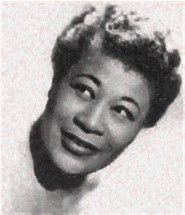
Ella


"The Fitzgerald persona communicates as pure and humble, and most of her peers rate her as their favorite singer." -- Linda Dahl.

Die-hard pure jazz aficionados tend to place Billie Holiday on a higher plane than Ella Fitzgerald: while Billie’s singing was raw, intense and rhythmically sophisticated, Ella possessed qualities which are sometimes undervalued in the jazz world -- superb diction, a bell-like tone, and a jaunty, youthful, light touch. Pure jazz fans aside, Fitzgerald emerged by the end of the 20th century as one of the definitive jazz singers (or pop singers, if you prefer), charming and immediately accessible, and was surely the queen of be-bop, entrancing audiences by revitalizing the old form of "scatting" used so well by Louis Armstrong in the 1920s within the idiom of bop.

Born on this day in 1917 in Newport News, Virginia and orphaned at 15, Fitzgerald moved in with an aunt in New York City and cultivated dreams of some kind of stardom. Though shy and somewhat hulking and awkward, while still a teenager she entered a talent show hoping to dance her way to the prize, but she changed her mind at the last minute and tried singing. The episode was not a success, but she continue to pursue singing, and in 1934 she won an amateur contest at the Apollo Theater in Harlem singing "Judy" in the style of her idol, Connee Boswell. Friends finally convinced drummer/bandleader Chick Webb to take her on as his protégé ("Listen to the voice, don’t look at her," was how he convinced his own manager of the project), becoming her legal guardian (she was living in an orphanage at the time) and her professional mentor, honing her craft and even taking charge of her wardrobe.

Within a short period of time, Fitzgerald became a hit at the Savoy Hotel and began recording with Webb on Decca, making such sides as "I’ll Chase the Blues Away" and "Sing Me a Swing Song and Let Me Dance," principally for the dance audience. In 1938 she recorded the swinging "A-Tisket, A-Tasket" (on which she co-wrote the lyrics) which became a huge smash hit. Webb died in 1939, and Fitzgerald became the nominal bandleader until 1941, when she decided to go solo.

Although she could have rested on her laurels as a dance band vocalist with a string of commercial hits, with the advent of bop she stretched herself artistically, honing her improvisational skills on tour with Dizzy Gillespie, and by the 1950s she was an accomplished scat-singer ("her scatting was . . . a revelation" -- according to Dahl), with mesmerizing renditions of "Lady Be Good," "Flying Home" and "How High the Moon."

In 1955, she appeared in a Hollywood movie, Pete Kelly’s Blues (directed by and starring Jack Webb) and then signed on with Verve Records to begin recording her most memorable works, a series of "Songbook" albums featuring top-shelf popular songs by such songwriters as Cole Porter (1956), Duke Ellington (1956-57), Rodgers and Hart (1957), Irving Berlin (1958) and George and Ira Gershwin (1958-59). Other remarkable recordings during the 1950s and 1960s included her live, improvised rendition of "Mack the Knife" and the classic live album, Ella in Berlin (1960).

In the 1970s, she had eye surgery, which slowed her down, but with the initiation of Pablo Records in 1971, she turned it up again, recording splendid jazz albums with Joe Pass, Oscar Peterson and Count Basie. She also lent her voice and image to an oft-imitated TV commercial for Memorex audio tape, scatting to a high-note climax which shattered a wine glass before the off-screen announcer asked, "Is it live, or is it Memorex?" She died on June 15, 1996 in Beverly Hills, California at the age of 78, having all but retired during the 1980s due to eye and heart problems associated with diabetes.

Labels: ,

Friday, April 07, 2006

Lady Day


"Her melody is rich with dissonance, and when Billie sings, ‘My man don’t love me’ on those dissonant notes, she can chill the blood. This ability to tell us something real made her not merely the finest of all jazz singers, but one of the finest jazz musicians American has produced." -- J.L. Collier.

Indisputably one of the great singers of the 20th century (Frank Sinatra called her "the most important influence on popular singing" of her time), Holiday’s voice was raw and round and tiny -- like that of a husky alley kitten -- but in every line she sang, she invited her listeners into her sometimes horrifying inner world, with its genuine appetites, pain and fleeting hopes. She said she was aiming at capturing the big sound of Bessie Smith, with the feeling of Louis Armstrong’s behind-the-beat cornet playing; but in addition, she had uncanny instincts about dramatic balance, knowing when to minimize the form to make the sometimes outlandishly overwrought content of the songs which were written for her seem simple, elegant and authentic.

Born Eleanora Fagan on this day in 1915 in Baltimore, Holiday’s early life is mysterious, obscured by the fanciful cocktail served up in her ghost-written autobiography, Lady Sings the Blues (1956), but it is surmised that she lived with relatives in Maryland while her mother went to New York to look for work; that her natural father, Clarence Holiday, was a guitarist in Fletcher Henderson’s band; and that Billie came to New York in 1927, worked in a brothel, and spent a little time in jail.

Legend has it that her singing career started when she was 15: as she and her mother were about to be evicted from their apartment for not paying their rent, Billie pushed her way into a dancing audition at a New York club, Pod and Jerry’s. A moment into the audition, it became very clear that Billie was no dancer, but the pianist took pity on her and asked her if she could sing. She tried "Trav’lin’ All Alone" and "Body and Soul," after which the customers sat in stunned silence, some of them moved to tears, and the owner sent her home with a couple of chickens and enough money to pay the rent.

By 1933, she was a regular in clubs around 133rd Street, when talent scout John Hammond arranged to have her record a few sides with Benny Goodman. Later with small bands led by Teddy Wilson, featuring such giants as Lester Young, Ben Webster, Roy Eldridge and Johnny Hodges, Holiday recorded some of the quintessential classics of jazz, including "These Foolish Things," "I’ll Get By" and "Gettin’ Some Fun Out of Life." In 1937, she sang with the Count Basie Band, but did not mix well with Basie personally; and joined Artie Shaw in 1938 as Shaw boldly attempted to break the color line.

The strain of race relations while on the road led her to split with Shaw, after which she landed a steady headlining gig at Barney Josephson’s Cafe Society in Greenwich Village, an early attempt to mix upscale black and white audiences and present top-flight black and white entertainment. The engagement took Holiday from being an admired singer within the narrow circle of jazz musicians and enthusiasts to a national crooning phenomenon. Pressed by popular tastes, she pulled away from classic bluesy and light jazz-pop to sing torch songs -- slow tempo tales of love gone awry. In addition to "Strange Fruit" (an anti-lynching song which became her anthem, sending chills down the spines of Cafe Society patrons in 1939), "Fine and Mellow" and "God Bless the Child," she had hits with "Lover Man," "Good Morning Heartache" and "Gloomy Sunday."

Beginning in 1942, however, Holiday had a string of four failed marriages to drug addicts, and in the course of being physically and mentally abused by these men (who preyed on her leviathan lack of self-esteem), she became a heroin addict herself, and spent most of 1947 in prison following a drug arrest. While this resulted in her cabaret card being revoked (New York City law prohibited felons from working in places where alcohol was served), she made a triumphant return to Carnegie Hall in 1948. In 1949, she was arrested in a narcotics frame-up on the West coast (third husband John Levy was the likely stoolie), but released on testimony that she was clean at the time. Years of alcohol (to which she turned when attempting to stay clear of heroin), fitful drug use and temperamental behavior were making her persona non grata at clubs, and were taking their toll on her health and voice by the early 1950s.

At the age of 43 she was sounding 70, croaking her way through recordings for Verve which nonetheless still captured her bold interpretative touch. She was still moving live audiences, perhaps displaying her real-life torments so close to the surface that one could not help but be moved by the reality behind the artifice, when in 1959 she collapsed from liver trouble, went into a coma for a time, rallied but was set back by a kidney infection. As a final insult, although she was probably clean, she was arrested yet again for drug possession and fingerprinted on her deathbed at the age of 46. She passed away on July 17, 1959 in New York City.

Labels: ,

Sunday, February 26, 2006

A Man Named Cash


"He knows how to fill up a room. Elvis Presley had it. Bob Dylan has it. Geronimo probably had it. Jesus Christ had it. Johnny Cash has it." -- Marty Stuart.

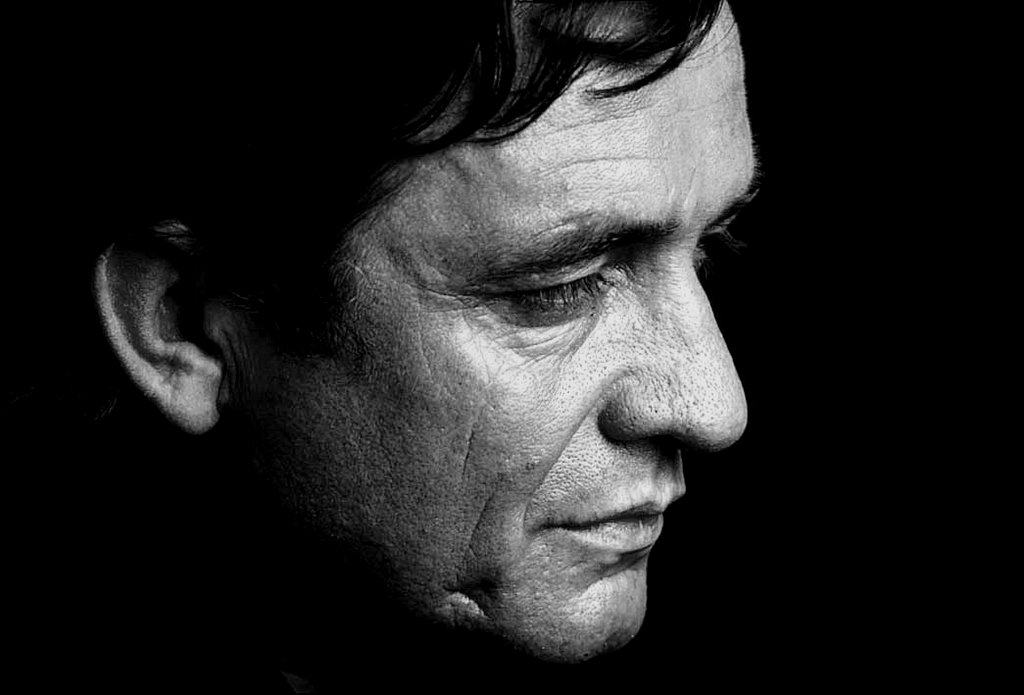
While we await the outcome of the Oscar race and the fate of the critically-acclaimed biopic Walk the Line, starring Joaquin Phoenix as the legendary singer/songwriter Johnny Cash, let us take a moment to recall Cash himself, who was born on this day in 1932 in Kingsland, Arkansas. The real thing is always better than an imitation.

Although thought of primarily as a country musician, the "Man in Black," Johnny Cash, stands as an arresting and influential figure in the pantheon of pop music, a member of both the Country Music Hall of Fame (the youngest inductee at the time) and the Rock ‘n Roll Hall of Fame. With his mighty, sonorous baritone sounding like one’s father just before a whipping, rambling over a lean guitar line, Cash’s music at its best is basic and pure.

He liked to write songs as a teen, growing up in Depression-scarred Arkansas, but it wasn’t until after high school, when he was serving in the Air Force in the early 1950s, that he bought his own guitar and began to think seriously of music as a career. After leaving the USAF, he showed up at Sam Phillips' Sun Studios in Memphis in 1955, where he was offered a contract and sidled up to other Sun stablehands Roy Orbison, Carl Perkins, Jerry Lee Lewis and Elvis Presley. His informal sessions with Perkins, Lewis and Presley were later released as The Million Dollar Quartet, but Cash established himself as a solo artist from the start, with rockabilly hits "Cry, Cry, Cry," "Folsom Prison Blues," and "I Walk the Line," all 3 of which were top country hits with some cross-chart appeal during 1955-56.

He stood out like a vulture at a tea party wearing all black at the Grand Ole Opry while the other stars were decked out in rhinestones in 1958, but he was encountered as a refreshingly authentic and unadorned persona by the fans. By the early 1960s he was playing 300 shows a year around the country, and to keep himself from collapsing from exhaustion he developed an amphetamine habit which alienated him from his first wife. With Columbia Records he was branching out musically, recording gospel tunes and concept albums on railroad songs and Native Americans, but his personal life was a shambles (including scrapes with the law over starting a forest fire and smuggling pills) until he married June Carter in 1968 and returned to his fundamentalist Christian roots.

Carter had written one of his best known songs for him, the endlessly transformable anthem of self-conscious co-dependence, "Ring of Fire" (1963). The rejuvenated Cash was ubiquitous at the end of the 1960s, with a successful TV variety series, a hit concert LP and documentary Johnny Cash at San Quentin (1969, featuring his biggest hit, "A Boy Named Sue," written by Shel Silverstein), an appearance on Bob Dylan’s Nashville Skyline album (also 1969), a part in The Gunfighter (1970) with Kirk Douglas, and a concert with John Williams and the Boston Pops. During the 1970s, his popularity declined somewhat, but he remained busy as a social activist, campaigning for prison and Native American reforms as well as working with evangelist Billy Graham. The 1980s found him teaming up with old cronies to moderate success, with Perkins and Lewis as The Survivors (1982) and with Waylon Jennings, Willie Nelson and Kris Kristofferson as The Highwaymen (1985 and 1992).

He unleashed a masterpiece in 1994 with American Recordings, the first of 4 projects with producer Rick Rubin -- a stirring acoustic collection of his own songs and selections from Tom Waits and Leonard Cohen which opened the ears of a new generation to his sepulchral, apocalyptic murmurs, as well as to his avuncular warmth and humor. By the end of his run with Rubin, he was making evocative, off-genre acoustic covers of such recordings as Beck's "Rowboat," U2's "One Love," Depeche Mode's "Personal Jesus" and Nine Inch Nails' "Hurt" -- the latter of which was the subject of an MTV-VMA-nominated video by Mark Romanek.

Cash, beset by Parkinson's Disease, diabetes and heart troubles near the end, died 4 months after the death of his beloved June, on September 12, 2003 in Nashville, Tennessee.

Labels:

Sunday, January 08, 2006

Elvis, the King


Elvis Presley was born on this day in 1935 in Tupelo, Mississippi.

In Jim Jarmusch's film Mystery Train (1989), a pair of Japanese teens, boy and girl, arrive in Memphis to see where rock 'n roll was born. After a breathless tour of Sun Studios, the two retreat to a seedy Memphis hotel, where the girl, a die-hard Elvis fan, shows her too-cool boyfriend her scrapbook of "discoveries" of Elvis in history -- in dead-on comparison photos with a Middle Eastern king, Buddha, Madonna and Bartholdi's Statue of Liberty -- to which the boy responds, deadpan: "Elvis was even more influential than I thought."

The film, like much of pop culture in the years since Presley burst onto the scene in 1954, is thoroughly infected by Elvis; even Elvis' ghost makes an appearance, played (perhaps appropriately in a kind of hair-raisingly gyroscopic, post-Modern sort of way) by the one-time husband of Bill Clinton's accuser Paula Jones.

Is there a point? The point is: Elvis was terrifically influential, and yes, in the theology of our collective prefab pop canon, he is everywhere.

His humble beginnings are the Lincolnesque stuff of American legend: born to a poor Mississippi family during the Depression, the survivor of a stillborn twin named Jesse, Elvis' first home was a 2-room shotgun shack. As a youth he absorbed Southern popular music from all angles -- blues, country, gospel and bluegrass -- wore zoot suits and trendy hairstyles and called himself "Valentino."

As a 21-year old truck driver, he wandered into Sun Studios trying to record a ballad which studio head Sam Phillips might be persuaded to put out on a record. Just for fun, he recorded a souped-up version of an R&B standard called "That's All Right," and when Phillips heard it, he thought he might have found an eminently marketable "white boy who sounded black"; a clean-cut, athletic young man who would be acceptable to parents while singing the African-American rhythm-and-blues that the hip kids were already listening to on the sly.

The genie was out of the bottle, though, and by 1956 when the mass hysteria of teen girls was reaching fever-pitch, parents were denouncing Elvis Presley as a cause of moral decay in American society. What Phillips perhaps didn't see at first was Presley's animal-form, brought forth on stage as with the Wolfman on a full moon, with snarling lips and gyrating rear haunches. Presley was the most palpably, overtly sexual famous male since Valentino himself.

His singing did in fact "whiten" R&B, taking its sensuality and injecting it with dose of back-country exuberance and slow-burning gospel fire. Did he invent rock n' roll? No, but for all significant purposes he was the center of the commotion surrounding its birth, single-handedly elevating the role of "rock star" and beginning its creeping replacement of "movie star" as the Alpha-male idol of public life.

The hits came one after the next ("Mystery Train was his first national #1, 1955, followed by such tunes as "Heartbreak Hotel," "Hound Dog" and "Don't be Cruel"), and soon he was offending parents on national TV (suffering below-the-waist censorship on the Ed Sullivan Show in 1956). It was natural that the new champeen should be a movie star as well, and in his earliest films (such as Love Me Tender, 1956, and Jailhouse Rock, 1957) he successfully elaborated on his rebellious image.

A stint in the U.S. Army, stationed in Germany, took him out of commission from 1958 to 1960 and probably got him addicted to speed. After that, he lost his edge for several years: his records had more in common with Dean Martin than James Brown, and his movies ranged from the pleasantly cute to the ridiculous. The British Invasion in pop music, led by Lennon & McCartney and Jagger and others, made him seem less exotic, even gracious and polite by contrast, and he was becoming almost inconsequential as a performer (except perhaps in his beloved South, although his movies continued to make money) when he did an about-face and returned to his rebel roots: singing rock 'n roll, looking trim and wearing black leather in the Elvis '68 TV special; returning to Memphis after years of recording in Hollywood and releasing From Elvis in Memphis in 1969; playing to sell-out crowds in an elaborately staged and choreographed Las Vegas show, complete with sequined jumpsuits and karate-chop dancing; and, in 1973, appearing tan and fit in another TV special, Elvis in Hawaii.

Hawaii was his last hurrah. His last years were a tale of isolation and excess, marked by rapid weight gain (he ballooned to 250 lbs.), an increased dependence on drugs, the spontaneous consumption of material things (for himself and randomly as gifts for others -- Cadillacs, yachts, five-figure checks), and the collection of acolytes and toadies who began to manage his increasingly eccentric daily life in a manner similar to that experienced by Howard Hughes (who died a year after the 42-year old Elvis did at the age of 71). From almost the instant of Elvis' death in Memphis on August 16, 1977 (the official cause was "cardiac arrhythmia"), he achieved popular beatification. His legion of die-hard fans refused to believe he was a drug addict (after all, he did offer to Richard Nixon to serve as a "Federal Agent-at-large" in the war on drugs), and argued that all attempts to make him out to be anything but a wholesome good old boy with the voice of an angel were downright anti-American.

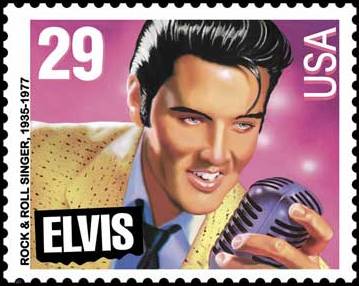
So it goes: "Elvis impersonator" is now a more or less legitimate occupation and a durable if kooky genre of entertainment, the U.S. government has put him on a postage stamp, and a veritable Elvis industry has grown up in the years since his death, supporting the sale of everything from vials of his sweat and dirt from his grave to black velvet paintings to thousands of other novelties. Indeed, one surmises that if you really want to, you can buy any commonly used household item with his image on it. Tell-all books rotate the topsoil of his burial place at the shrine known as Graceland, his mansion in Memphis, and references to him in all manner of media seem to multiply exponentially.

At the wacky rag-end of Elvis worship, there are those refuse to believe that he is even dead, his "sighting" at a Burger King in Kalamazoo, Michigan years after his death now being the stuff of legend, with hubristically irresistible parallels to Christ's resurrection. Elvis may have "left the building," but only in the sense that he has leeched into the space outside the building, right into the space between our ears, a recurrent "hunk-a-hunk-a burnin'" myth of humble birth, triumph, death and rebirth into eternity.


Labels: ,

Monday, December 12, 2005

Sinatra


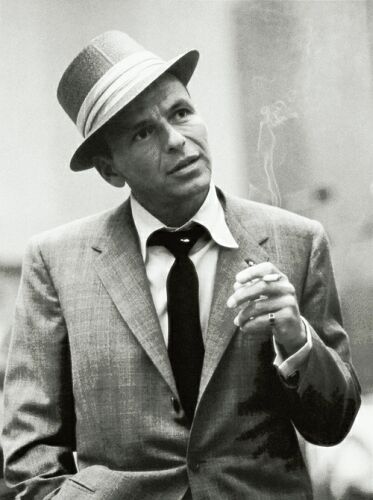
One of the great pop singers, perhaps the greatest, of the 20th century was born on this day in 1915 in Hoboken, New Jersey.

The son of an ex-boxer, Francis Albert Sinatra quit school early to sing like his early idol Bing Crosby, and at 19 he won Major Bowes’ Amateur Hour radio contest as part of the Hoboken Four. As a soloist he got a steady gig with the Harry James Orchestra, then with Tommy Dorsey’s band, but when he branched out on his own in 1942, he transformed the pop culture landscape.

Skinny and big-eared but with a warm, husky and sensitive voice and undeniable charm, Sinatra’s fanatically loyal teenaged female fans -- known as his bobby-soxers -- began to shift the focus of the pop music industry from bands to singers, and in effect became the prototype of all teen idols. Unlike many who followed, Sinatra had genuine talent, bringing smoothness and precise enunciation to the still-developing genre of microphone singing, displaying a natural gift for subtly shading song lyrics, a value little appreciated in mainstream popular music outside of Billie Holiday (to whom he often acknowledged his debt) until Sinatra showed the way.

Hollywood recognized his charisma and put him in a few popular but lightweight musical comedies (notably, with Gene Kelly, Anchors Aweigh, 1945, and On the Town, 1949), but his career took a downward spiral coincident with the news that he was leaving his wife and 3 children for starlet Ava Gardner. Branded box office poison for the scandal surrounding his romance, Sinatra struggled by singing in nightclubs until, through his new wife’s influence, he landed the role of "Maggio," the wry, pathetic Army private, in Fred Zinnemann’s film of James Jones’ novel, From Here to Eternity (1953). He won a best supporting actor Oscar for his performance, propelling him into a whole new career as a serious actor, capped by his performances in prestige productions such as The Man with the Golden Arm (1956) and The Manchurian Candidate (1962, directed by John Frankenheimer).

The comeback was remarkable, but not as remarkable as the transformation of "Sinatra -- teen idol" to "Sinatra -- chairman of the board": as his tempestuous relationship with Gardner burst at the seams, Sinatra began to record a series of long-playing records (another departure from the norm -- Sinatra was the first great advocate of the thematic LP as a pop music medium) at Capitol Records by which he reinvented himself as the "most magnetic musical communicator and the ace mood-pitcher of the era" (as one biographer has put it).

Although he was not a jazz singer (a brief, promising fling with bossa nova and Antonio Carlos Jobim being the exception), his mature recordings showed a jazz man's grasp of the rhythm of pathos (the "tempo of the heartbeat" he called it), hanging back on the beat and letting his lush accompaniment lure him along. Adding a world-weary, bitter-edged swagger to his already evocative style in albums such as Songs for Swingin’ Lovers (1955), In the Wee Small Hours (1955), Come Fly With Me (1958) and September of My Years (1965), Sinatra laid down the definitive pre-rock pop music statements about grown-up love -- the great giddy heights as well as the regret and loss.

His swagger was a hallmark of his tabloid persona as well, as the defiantly pleasure-seeking hipster with the cool veneer and a volcanic temper underneath, the powerful star with rumored mafia connections, he was the ring leader of the "Rat Pack," an unofficial group of show biz cronies at the top of their form (Dean Martin, Sammy Davis, Jr., Peter Lawford, Joey Bishop and sometimes Shirley MacLaine), cutting up and living the high life together in public. As such, Sinatra in the late 1950s and early 1960s was the middle-class American male hero: would that I could be Frank Sinatra, said the traveling salesman or the factory foreman, I would sling my coat over my shoulder with one hand, wear my fedora and my shirtsleeves, swig hard liquor from hi-ball glasses, flirt with broads in nightclubs and not take any crap from anyone. Luxury cars, cigarettes, steak dinners, Palm Springs, Vegas -- Sinatra said this was the way to live one’s life, with his jaded stylings over a Billy May arrangement at 33 rpm.

After throwing his weight behind party-pal John Kennedy's presidential campaign in 1960, he was ostracized by the White House due to his mob ties (conspiracy theorists love to speculate that when Sinatra's mob friends perceived that Sinatra had lost his White House playmate and any protection that gave them, they retaliated against Kennedy), and soon thereafter Sinatra's public party went private. After a brief and improbable marriage to 21-year old flower child Mia Farrow, Sinatra settled down to concert touring and charity with 4th wife Barbara Blakeley (the ex-wife of Zeppo Marx). In his later years, his music increasingly took a darker turn, although he remained one of the biggest draws in show business until shortly before his death.

Labels: , ,